

8 Accelerator Engineering and Technology: Accelerator Technology
363
Table 8.7 Analytical formulae for the main field and field errors for the sector coil configurations
shown in Fig. 8.10
Dipole (a)
Main field
B 1 =
2μ 0
π J (R out − R in ) sin (ϕ)
Field errors
B n =
2μ 0
π J
R
2−n
out −R
2−n
in
n(2−n)
sin (nϕ)
n = 3, 5, 7, . . . , (2 m + 1)
Force per coil
quadrant
F x =
√
3μ 0 J 2
π
2π−
√
3
36 R 3
out +
√
3
12 ln
Rout
R in
+
4π+
√
3
36
R 3
in −
π
6 R out R 2
in
F y =
√
3μ 0 J 2
π
1
12 R 3
out +
1
4 ln
R in
Rout
−
1
12
R
3
in
F z =
3μ 0 J 2
π
1
6 R 4
out −
2
3 R out R 3
in +
1
2 R 4
in
Energy per
unit length
E
l =
πB 2
1 R 2
in
μ 0
1 +
2
3
Rout
R in
− 1
+
1
6
Rout
R in
− 1
2
Quadrupole (b)
Main field
G = B 2 =
2μ 0
π J ln
Rout
R in
sin (2ϕ)
Field errors
B n =
4μ 0
π J
R
2−n
out −R
2−n
in
n(2−n)
sin (nϕ)
n = 6, 10, 14, . . . , 2(2 m + 1)
Force per coil
quadrant
F x =
√
3μ 0 J 2
6π
1
72
12R 4
out −36R 4
in
Rout
+
ln
R in
Rout
+
1
3
R
3
in
F y =
√
3μ 0 J 2
π
5−2
√
3
36 R 3
out +
1
12
R 4
in
Rout
2−
√
3
6 ln
R in
Rout
+
√
3−4
18
R 3
in
F y =
3μ 0 J 2
4π
1
4 R 4
out −
ln
Rout
R in
+
1
4
R 4
in
Energy per
unit length
E
l =
πB 2
2 R 4
in
2μ 0 ln 2
Rout
R in
1
8
Rout
R in
4 − 1
−
1
2 ln
Rout
R in
Tevatron
HERA
RHIC
LHC
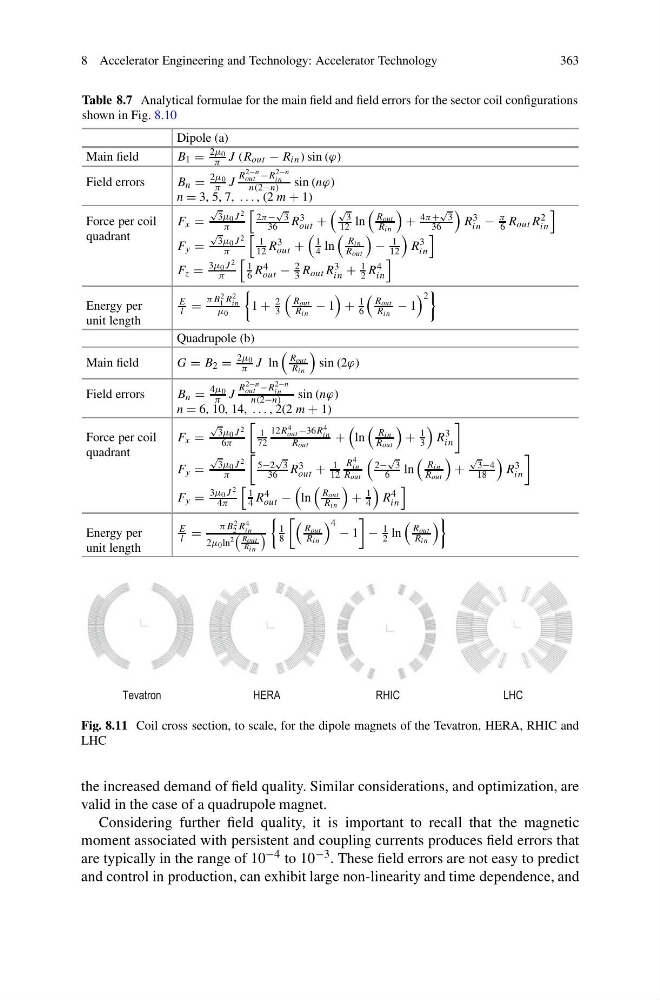
Fig. 8.11 Coil cross section, to scale, for the dipole magnets of the Tevatron, HERA, RHIC and
LHC
the increased demand of field quality. Similar considerations, and optimization, are
valid in the case of a quadrupole magnet.
Considering further field quality, it is important to recall that the magnetic
moment associated with persistent and coupling currents produces field errors that
are typically in the range of 10 −4 to 10 −3 . These field errors are not easy to predict
and control in production, can exhibit large non-linearity and time dependence, and
363
Table 8.7 Analytical formulae for the main field and field errors for the sector coil configurations
shown in Fig. 8.10
Dipole (a)
Main field
B 1 =
2μ 0
π J (R out − R in ) sin (ϕ)
Field errors
B n =
2μ 0
π J
R
2−n
out −R
2−n
in
n(2−n)
sin (nϕ)
n = 3, 5, 7, . . . , (2 m + 1)
Force per coil
quadrant
F x =
√
3μ 0 J 2
π
2π−
√
3
36 R 3
out +
√
3
12 ln
Rout
R in
+
4π+
√
3
36
R 3
in −
π
6 R out R 2
in
F y =
√
3μ 0 J 2
π
1
12 R 3
out +
1
4 ln
R in
Rout
−
1
12
R
3
in
F z =
3μ 0 J 2
π
1
6 R 4
out −
2
3 R out R 3
in +
1
2 R 4
in
Energy per
unit length
E
l =
πB 2
1 R 2
in
μ 0
1 +
2
3
Rout
R in
− 1
+
1
6
Rout
R in
− 1
2
Quadrupole (b)
Main field
G = B 2 =
2μ 0
π J ln
Rout
R in
sin (2ϕ)
Field errors
B n =
4μ 0
π J
R
2−n
out −R
2−n
in
n(2−n)
sin (nϕ)
n = 6, 10, 14, . . . , 2(2 m + 1)
Force per coil
quadrant
F x =
√
3μ 0 J 2
6π
1
72
12R 4
out −36R 4
in
Rout
+
ln
R in
Rout
+
1
3
R
3
in
F y =
√
3μ 0 J 2
π
5−2
√
3
36 R 3
out +
1
12
R 4
in
Rout
2−
√
3
6 ln
R in
Rout
+
√
3−4
18
R 3
in
F y =
3μ 0 J 2
4π
1
4 R 4
out −
ln
Rout
R in
+
1
4
R 4
in
Energy per
unit length
E
l =
πB 2
2 R 4
in
2μ 0 ln 2
Rout
R in
1
8
Rout
R in
4 − 1
−
1
2 ln
Rout
R in
Tevatron
HERA
RHIC
LHC
Fig. 8.11 Coil cross section, to scale, for the dipole magnets of the Tevatron, HERA, RHIC and
LHC
the increased demand of field quality. Similar considerations, and optimization, are
valid in the case of a quadrupole magnet.
Considering further field quality, it is important to recall that the magnetic
moment associated with persistent and coupling currents produces field errors that
are typically in the range of 10 −4 to 10 −3 . These field errors are not easy to predict
and control in production, can exhibit large non-linearity and time dependence, and