

364
F. Bordry et al.
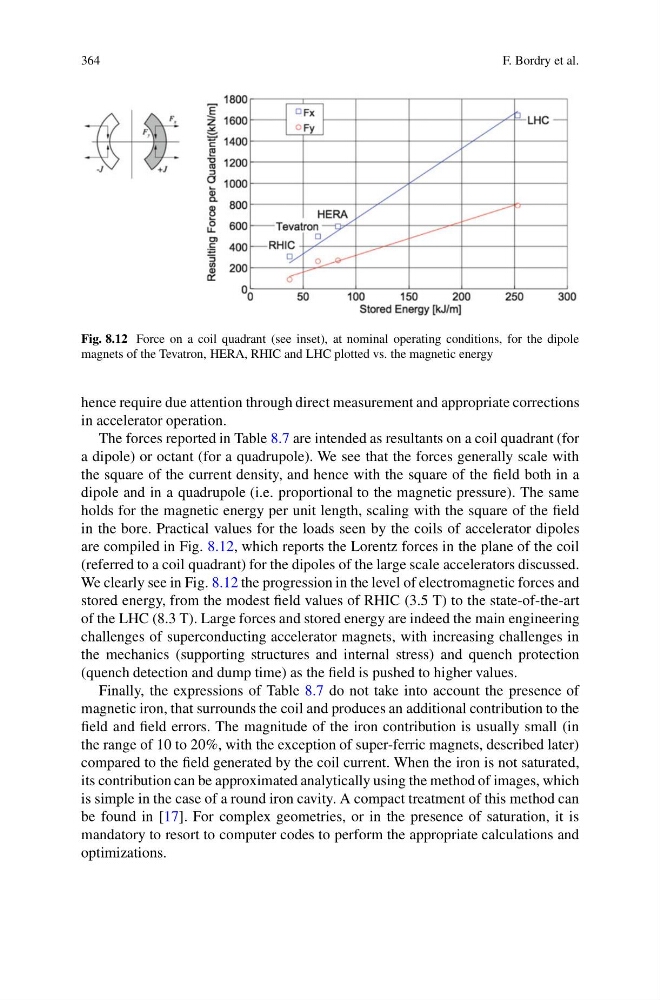
Fig. 8.12 Force on a coil quadrant (see inset), at nominal operating conditions, for the dipole
magnets of the Tevatron, HERA, RHIC and LHC plotted vs. the magnetic energy
hence require due attention through direct measurement and appropriate corrections
in accelerator operation.
The forces reported in Table 8.7 are intended as resultants on a coil quadrant (for
a dipole) or octant (for a quadrupole). We see that the forces generally scale with
the square of the current density, and hence with the square of the field both in a
dipole and in a quadrupole (i.e. proportional to the magnetic pressure). The same
holds for the magnetic energy per unit length, scaling with the square of the field
in the bore. Practical values for the loads seen by the coils of accelerator dipoles
are compiled in Fig. 8.12, which reports the Lorentz forces in the plane of the coil
(referred to a coil quadrant) for the dipoles of the large scale accelerators discussed.
We clearly see in Fig. 8.12 the progression in the level of electromagnetic forces and
stored energy, from the modest field values of RHIC (3.5 T) to the state-of-the-art
of the LHC (8.3 T). Large forces and stored energy are indeed the main engineering
challenges of superconducting accelerator magnets, with increasing challenges in
the mechanics (supporting structures and internal stress) and quench protection
(quench detection and dump time) as the field is pushed to higher values.
Finally, the expressions of Table 8.7 do not take into account the presence of
magnetic iron, that surrounds the coil and produces an additional contribution to the
field and field errors. The magnitude of the iron contribution is usually small (in
the range of 10 to 20%, with the exception of super-ferric magnets, described later)
compared to the field generated by the coil current. When the iron is not saturated,
its contribution can be approximated analytically using the method of images, which
is simple in the case of a round iron cavity. A compact treatment of this method can
be found in [17]. For complex geometries, or in the presence of saturation, it is
mandatory to resort to computer codes to perform the appropriate calculations and
optimizations.
F. Bordry et al.
Fig. 8.12 Force on a coil quadrant (see inset), at nominal operating conditions, for the dipole
magnets of the Tevatron, HERA, RHIC and LHC plotted vs. the magnetic energy
hence require due attention through direct measurement and appropriate corrections
in accelerator operation.
The forces reported in Table 8.7 are intended as resultants on a coil quadrant (for
a dipole) or octant (for a quadrupole). We see that the forces generally scale with
the square of the current density, and hence with the square of the field both in a
dipole and in a quadrupole (i.e. proportional to the magnetic pressure). The same
holds for the magnetic energy per unit length, scaling with the square of the field
in the bore. Practical values for the loads seen by the coils of accelerator dipoles
are compiled in Fig. 8.12, which reports the Lorentz forces in the plane of the coil
(referred to a coil quadrant) for the dipoles of the large scale accelerators discussed.
We clearly see in Fig. 8.12 the progression in the level of electromagnetic forces and
stored energy, from the modest field values of RHIC (3.5 T) to the state-of-the-art
of the LHC (8.3 T). Large forces and stored energy are indeed the main engineering
challenges of superconducting accelerator magnets, with increasing challenges in
the mechanics (supporting structures and internal stress) and quench protection
(quench detection and dump time) as the field is pushed to higher values.
Finally, the expressions of Table 8.7 do not take into account the presence of
magnetic iron, that surrounds the coil and produces an additional contribution to the
field and field errors. The magnitude of the iron contribution is usually small (in
the range of 10 to 20%, with the exception of super-ferric magnets, described later)
compared to the field generated by the coil current. When the iron is not saturated,
its contribution can be approximated analytically using the method of images, which
is simple in the case of a round iron cavity. A compact treatment of this method can
be found in [17]. For complex geometries, or in the presence of saturation, it is
mandatory to resort to computer codes to perform the appropriate calculations and
optimizations.