

362
F. Bordry et al.
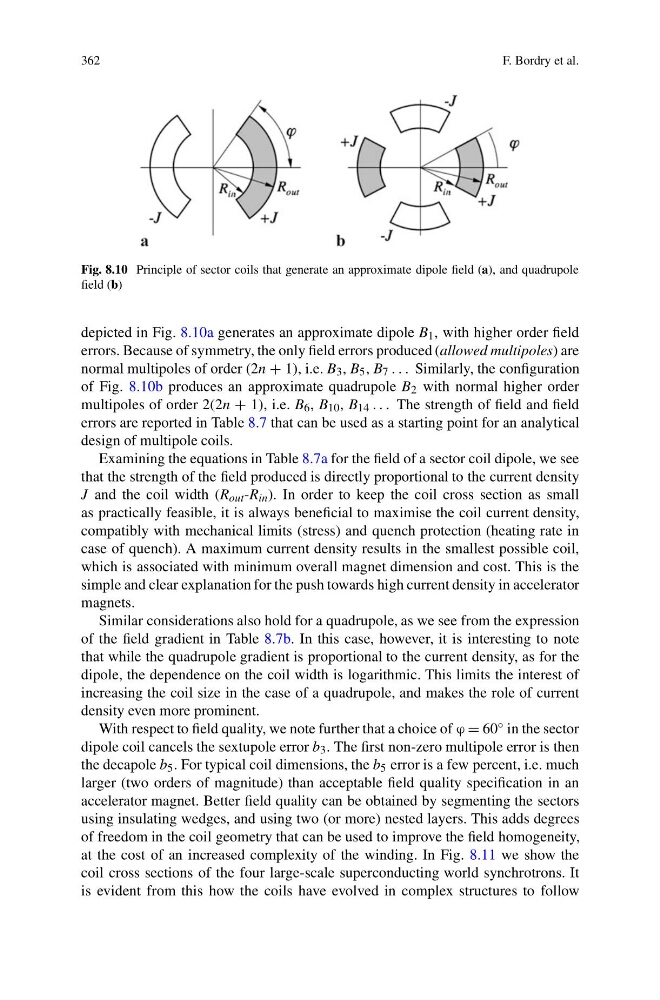
Fig. 8.10 Principle of sector coils that generate an approximate dipole field (a), and quadrupole
field (b)
depicted in Fig. 8.10a generates an approximate dipole B 1 , with higher order field
errors. Because of symmetry, the only field errors produced (allowed multipoles) are
normal multipoles of order (2n + 1), i.e. B 3 , B 5 , B 7 . . . Similarly, the configuration
of Fig. 8.10b produces an approximate quadrupole B 2 with normal higher order
multipoles of order 2(2n + 1), i.e. B 6 , B 10 , B 14 . . . The strength of field and field
errors are reported in Table 8.7 that can be used as a starting point for an analytical
design of multipole coils.
Examining the equations in Table 8.7a for the field of a sector coil dipole, we see
that the strength of the field produced is directly proportional to the current density
J and the coil width (R out -R in ). In order to keep the coil cross section as small
as practically feasible, it is always beneficial to maximise the coil current density,
compatibly with mechanical limits (stress) and quench protection (heating rate in
case of quench). A maximum current density results in the smallest possible coil,
which is associated with minimum overall magnet dimension and cost. This is the
simple and clear explanation for the push towards high current density in accelerator
magnets.
Similar considerations also hold for a quadrupole, as we see from the expression
of the field gradient in Table 8.7b. In this case, however, it is interesting to note
that while the quadrupole gradient is proportional to the current density, as for the
dipole, the dependence on the coil width is logarithmic. This limits the interest of
increasing the coil size in the case of a quadrupole, and makes the role of current
density even more prominent.
With respect to field quality, we note further that a choice of ϕ = 60 ◦ in the sector
dipole coil cancels the sextupole error b 3 . The first non-zero multipole error is then
the decapole b 5 . For typical coil dimensions, the b 5 error is a few percent, i.e. much
larger (two orders of magnitude) than acceptable field quality specification in an
accelerator magnet. Better field quality can be obtained by segmenting the sectors
using insulating wedges, and using two (or more) nested layers. This adds degrees
of freedom in the coil geometry that can be used to improve the field homogeneity,
at the cost of an increased complexity of the winding. In Fig. 8.11 we show the
coil cross sections of the four large-scale superconducting world synchrotrons. It
is evident from this how the coils have evolved in complex structures to follow
F. Bordry et al.
Fig. 8.10 Principle of sector coils that generate an approximate dipole field (a), and quadrupole
field (b)
depicted in Fig. 8.10a generates an approximate dipole B 1 , with higher order field
errors. Because of symmetry, the only field errors produced (allowed multipoles) are
normal multipoles of order (2n + 1), i.e. B 3 , B 5 , B 7 . . . Similarly, the configuration
of Fig. 8.10b produces an approximate quadrupole B 2 with normal higher order
multipoles of order 2(2n + 1), i.e. B 6 , B 10 , B 14 . . . The strength of field and field
errors are reported in Table 8.7 that can be used as a starting point for an analytical
design of multipole coils.
Examining the equations in Table 8.7a for the field of a sector coil dipole, we see
that the strength of the field produced is directly proportional to the current density
J and the coil width (R out -R in ). In order to keep the coil cross section as small
as practically feasible, it is always beneficial to maximise the coil current density,
compatibly with mechanical limits (stress) and quench protection (heating rate in
case of quench). A maximum current density results in the smallest possible coil,
which is associated with minimum overall magnet dimension and cost. This is the
simple and clear explanation for the push towards high current density in accelerator
magnets.
Similar considerations also hold for a quadrupole, as we see from the expression
of the field gradient in Table 8.7b. In this case, however, it is interesting to note
that while the quadrupole gradient is proportional to the current density, as for the
dipole, the dependence on the coil width is logarithmic. This limits the interest of
increasing the coil size in the case of a quadrupole, and makes the role of current
density even more prominent.
With respect to field quality, we note further that a choice of ϕ = 60 ◦ in the sector
dipole coil cancels the sextupole error b 3 . The first non-zero multipole error is then
the decapole b 5 . For typical coil dimensions, the b 5 error is a few percent, i.e. much
larger (two orders of magnitude) than acceptable field quality specification in an
accelerator magnet. Better field quality can be obtained by segmenting the sectors
using insulating wedges, and using two (or more) nested layers. This adds degrees
of freedom in the coil geometry that can be used to improve the field homogeneity,
at the cost of an increased complexity of the winding. In Fig. 8.11 we show the
coil cross sections of the four large-scale superconducting world synchrotrons. It
is evident from this how the coils have evolved in complex structures to follow