

8 Accelerator Engineering and Technology: Accelerator Technology
361
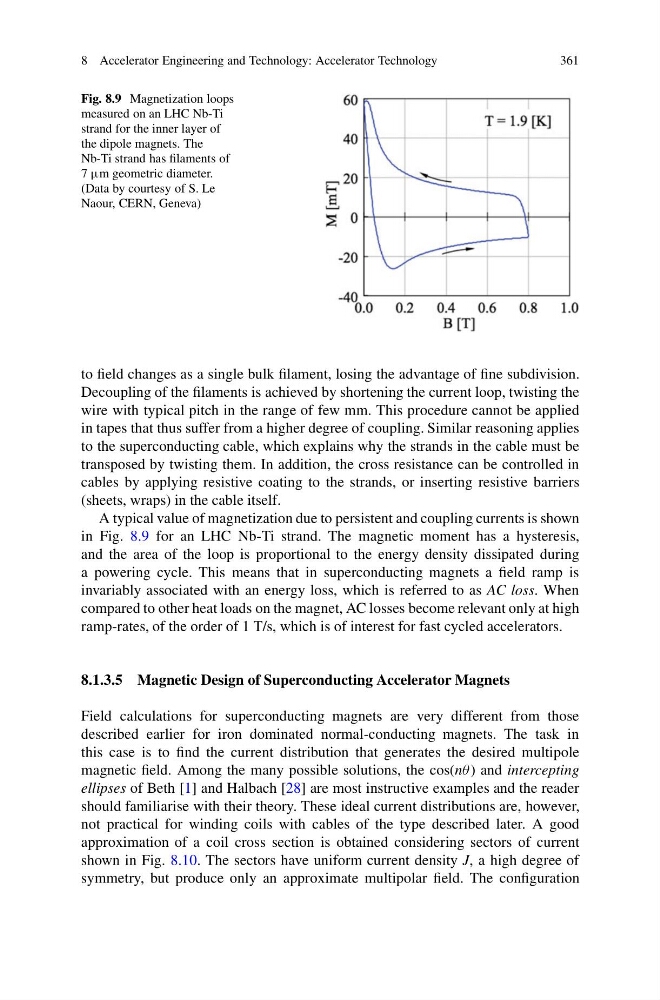
Fig. 8.9 Magnetization loops
measured on an LHC Nb-Ti
strand for the inner layer of
the dipole magnets. The
Nb-Ti strand has filaments of
7 μm geometric diameter.
(Data by courtesy of S. Le
Naour, CERN, Geneva)
to field changes as a single bulk filament, losing the advantage of fine subdivision.
Decoupling of the filaments is achieved by shortening the current loop, twisting the
wire with typical pitch in the range of few mm. This procedure cannot be applied
in tapes that thus suffer from a higher degree of coupling. Similar reasoning applies
to the superconducting cable, which explains why the strands in the cable must be
transposed by twisting them. In addition, the cross resistance can be controlled in
cables by applying resistive coating to the strands, or inserting resistive barriers
(sheets, wraps) in the cable itself.
A typical value of magnetization due to persistent and coupling currents is shown
in Fig. 8.9 for an LHC Nb-Ti strand. The magnetic moment has a hysteresis,
and the area of the loop is proportional to the energy density dissipated during
a powering cycle. This means that in superconducting magnets a field ramp is
invariably associated with an energy loss, which is referred to as AC loss. When
compared to other heat loads on the magnet, AC losses become relevant only at high
ramp-rates, of the order of 1 T/s, which is of interest for fast cycled accelerators.
8.1.3.5 Magnetic Design of Superconducting Accelerator Magnets
Field calculations for superconducting magnets are very different from those
described earlier for iron dominated normal-conducting magnets. The task in
this case is to find the current distribution that generates the desired multipole
magnetic field. Among the many possible solutions, the cos(nθ ) and intercepting
ellipses of Beth [1] and Halbach [28] are most instructive examples and the reader
should familiarise with their theory. These ideal current distributions are, however,
not practical for winding coils with cables of the type described later. A good
approximation of a coil cross section is obtained considering sectors of current
shown in Fig. 8.10. The sectors have uniform current density J, a high degree of
symmetry, but produce only an approximate multipolar field. The configuration
361
Fig. 8.9 Magnetization loops
measured on an LHC Nb-Ti
strand for the inner layer of
the dipole magnets. The
Nb-Ti strand has filaments of
7 μm geometric diameter.
(Data by courtesy of S. Le
Naour, CERN, Geneva)
to field changes as a single bulk filament, losing the advantage of fine subdivision.
Decoupling of the filaments is achieved by shortening the current loop, twisting the
wire with typical pitch in the range of few mm. This procedure cannot be applied
in tapes that thus suffer from a higher degree of coupling. Similar reasoning applies
to the superconducting cable, which explains why the strands in the cable must be
transposed by twisting them. In addition, the cross resistance can be controlled in
cables by applying resistive coating to the strands, or inserting resistive barriers
(sheets, wraps) in the cable itself.
A typical value of magnetization due to persistent and coupling currents is shown
in Fig. 8.9 for an LHC Nb-Ti strand. The magnetic moment has a hysteresis,
and the area of the loop is proportional to the energy density dissipated during
a powering cycle. This means that in superconducting magnets a field ramp is
invariably associated with an energy loss, which is referred to as AC loss. When
compared to other heat loads on the magnet, AC losses become relevant only at high
ramp-rates, of the order of 1 T/s, which is of interest for fast cycled accelerators.
8.1.3.5 Magnetic Design of Superconducting Accelerator Magnets
Field calculations for superconducting magnets are very different from those
described earlier for iron dominated normal-conducting magnets. The task in
this case is to find the current distribution that generates the desired multipole
magnetic field. Among the many possible solutions, the cos(nθ ) and intercepting
ellipses of Beth [1] and Halbach [28] are most instructive examples and the reader
should familiarise with their theory. These ideal current distributions are, however,
not practical for winding coils with cables of the type described later. A good
approximation of a coil cross section is obtained considering sectors of current
shown in Fig. 8.10. The sectors have uniform current density J, a high degree of
symmetry, but produce only an approximate multipolar field. The configuration