

322
J. Seeman et al.
7.7 Low Emittance Generation
S. Guiducci · Y. Papaphilippou
The high luminosity of a linear collider depends strongly on the generation of
ultra-low emittance high-intensity bunches, with remarkable stability. Conventional
electron sources and positron production schemes provide beams with several
orders of magnitude larger emittances, than the ones needed. The required cooling
mechanism is generated by the natural synchrotron radiation damping of the beam
when circulating in rings.
The requested performance of the damping rings (DRs) is driven by the collider’s
principal parameters, the upstream or downstream systems’ requirements, and
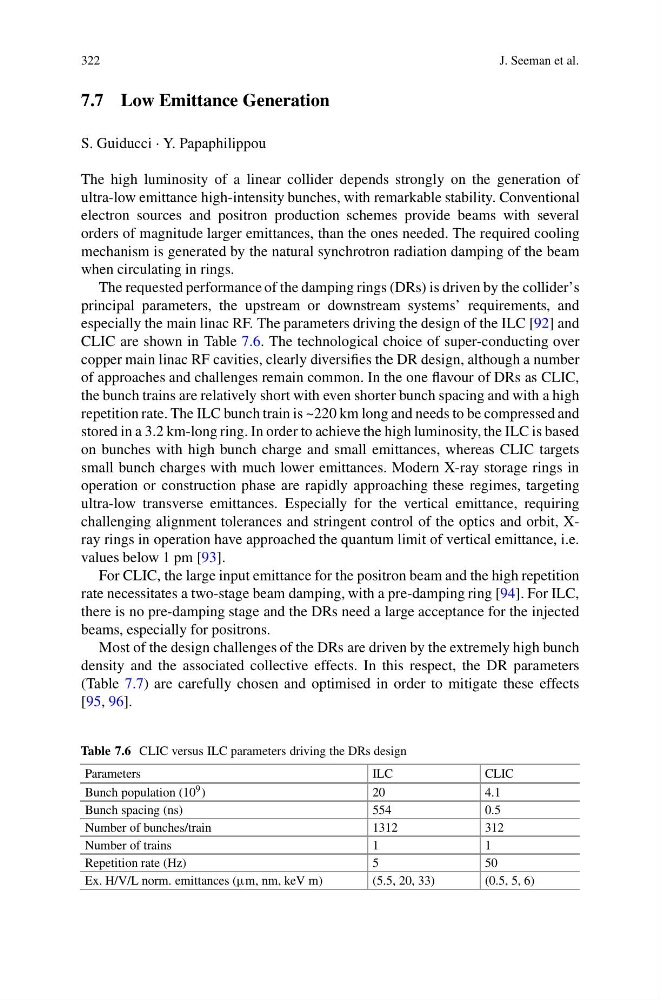
especially the main linac RF. The parameters driving the design of the ILC [92] and
CLIC are shown in Table 7.6. The technological choice of super-conducting over
copper main linac RF cavities, clearly diversifies the DR design, although a number
of approaches and challenges remain common. In the one flavour of DRs as CLIC,
the bunch trains are relatively short with even shorter bunch spacing and with a high
repetition rate. The ILC bunch train is ~220 km long and needs to be compressed and
stored in a 3.2 km-long ring. In order to achieve the high luminosity, the ILC is based
on bunches with high bunch charge and small emittances, whereas CLIC targets
small bunch charges with much lower emittances. Modern X-ray storage rings in
operation or construction phase are rapidly approaching these regimes, targeting
ultra-low transverse emittances. Especially for the vertical emittance, requiring
challenging alignment tolerances and stringent control of the optics and orbit, Xray rings in operation have approached the quantum limit of vertical emittance, i.e.
values below 1 pm [93].
For CLIC, the large input emittance for the positron beam and the high repetition
rate necessitates a two-stage beam damping, with a pre-damping ring [94]. For ILC,
there is no pre-damping stage and the DRs need a large acceptance for the injected
beams, especially for positrons.
Most of the design challenges of the DRs are driven by the extremely high bunch
density and the associated collective effects. In this respect, the DR parameters
(Table 7.7) are carefully chosen and optimised in order to mitigate these effects
[95, 96].
Table 7.6 CLIC versus ILC parameters driving the DRs design
Parameters
ILC
CLIC
Bunch population (10 9 )
20
4.1
Bunch spacing (ns)
554
0.5
Number of bunches/train
1312
312
Number of trains
1
1
Repetition rate (Hz)
5
50
Ex. H/V/L norm. emittances (μm, nm, keV m)
(5.5, 20, 33)
(0.5, 5, 6)
J. Seeman et al.
7.7 Low Emittance Generation
S. Guiducci · Y. Papaphilippou
The high luminosity of a linear collider depends strongly on the generation of
ultra-low emittance high-intensity bunches, with remarkable stability. Conventional
electron sources and positron production schemes provide beams with several
orders of magnitude larger emittances, than the ones needed. The required cooling
mechanism is generated by the natural synchrotron radiation damping of the beam
when circulating in rings.
The requested performance of the damping rings (DRs) is driven by the collider’s
principal parameters, the upstream or downstream systems’ requirements, and
especially the main linac RF. The parameters driving the design of the ILC [92] and
CLIC are shown in Table 7.6. The technological choice of super-conducting over
copper main linac RF cavities, clearly diversifies the DR design, although a number
of approaches and challenges remain common. In the one flavour of DRs as CLIC,
the bunch trains are relatively short with even shorter bunch spacing and with a high
repetition rate. The ILC bunch train is ~220 km long and needs to be compressed and
stored in a 3.2 km-long ring. In order to achieve the high luminosity, the ILC is based
on bunches with high bunch charge and small emittances, whereas CLIC targets
small bunch charges with much lower emittances. Modern X-ray storage rings in
operation or construction phase are rapidly approaching these regimes, targeting
ultra-low transverse emittances. Especially for the vertical emittance, requiring
challenging alignment tolerances and stringent control of the optics and orbit, Xray rings in operation have approached the quantum limit of vertical emittance, i.e.
values below 1 pm [93].
For CLIC, the large input emittance for the positron beam and the high repetition
rate necessitates a two-stage beam damping, with a pre-damping ring [94]. For ILC,
there is no pre-damping stage and the DRs need a large acceptance for the injected
beams, especially for positrons.
Most of the design challenges of the DRs are driven by the extremely high bunch
density and the associated collective effects. In this respect, the DR parameters
(Table 7.7) are carefully chosen and optimised in order to mitigate these effects
[95, 96].
Table 7.6 CLIC versus ILC parameters driving the DRs design
Parameters
ILC
CLIC
Bunch population (10 9 )
20
4.1
Bunch spacing (ns)
554
0.5
Number of bunches/train
1312
312
Number of trains
1
1
Repetition rate (Hz)
5
50
Ex. H/V/L norm. emittances (μm, nm, keV m)
(5.5, 20, 33)
(0.5, 5, 6)