

7 Design and Principles of Linear Accelerators and Colliders
321
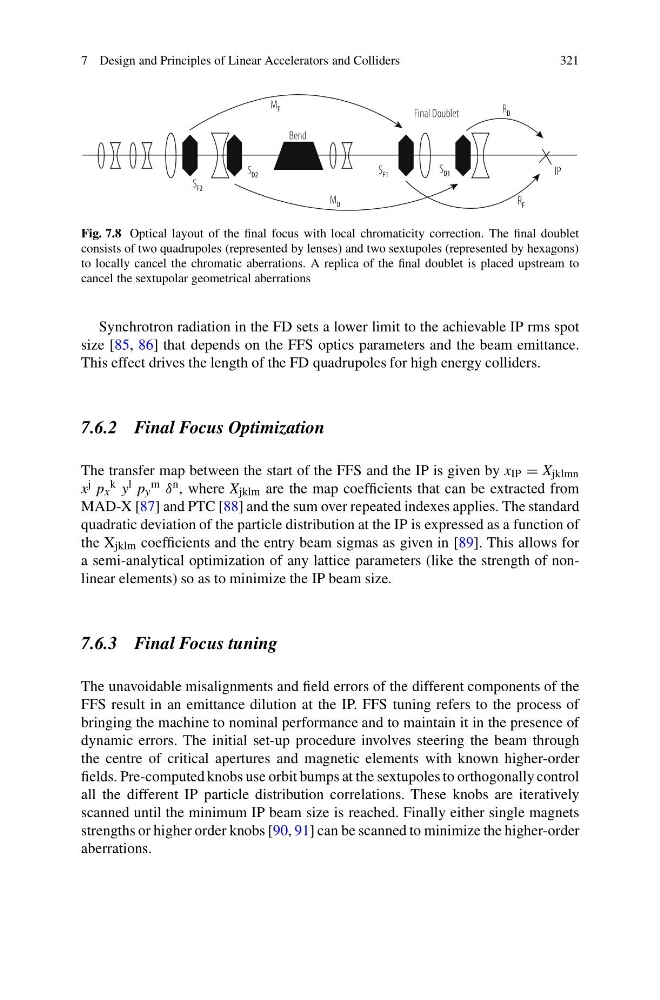
Fig. 7.8 Optical layout of the final focus with local chromaticity correction. The final doublet
consists of two quadrupoles (represented by lenses) and two sextupoles (represented by hexagons)
to locally cancel the chromatic aberrations. A replica of the final doublet is placed upstream to
cancel the sextupolar geometrical aberrations
Synchrotron radiation in the FD sets a lower limit to the achievable IP rms spot
size [85, 86] that depends on the FFS optics parameters and the beam emittance.
This effect drives the length of the FD quadrupoles for high energy colliders.
7.6.2 Final Focus Optimization
The transfer map between the start of the FFS and the IP is given by x IP = X jklmn
x j p x
k y l p y
m δ n , where X jklm are the map coefficients that can be extracted from
MAD-X [87] and PTC [88] and the sum over repeated indexes applies. The standard
quadratic deviation of the particle distribution at the IP is expressed as a function of
the X jklm coefficients and the entry beam sigmas as given in [89]. This allows for
a semi-analytical optimization of any lattice parameters (like the strength of nonlinear elements) so as to minimize the IP beam size.
7.6.3 Final Focus tuning
The unavoidable misalignments and field errors of the different components of the
FFS result in an emittance dilution at the IP. FFS tuning refers to the process of
bringing the machine to nominal performance and to maintain it in the presence of
dynamic errors. The initial set-up procedure involves steering the beam through
the centre of critical apertures and magnetic elements with known higher-order
fields. Pre-computed knobs use orbit bumps at the sextupoles to orthogonally control
all the different IP particle distribution correlations. These knobs are iteratively
scanned until the minimum IP beam size is reached. Finally either single magnets
strengths or higher order knobs [90, 91] can be scanned to minimize the higher-order
aberrations.
321
Fig. 7.8 Optical layout of the final focus with local chromaticity correction. The final doublet
consists of two quadrupoles (represented by lenses) and two sextupoles (represented by hexagons)
to locally cancel the chromatic aberrations. A replica of the final doublet is placed upstream to
cancel the sextupolar geometrical aberrations
Synchrotron radiation in the FD sets a lower limit to the achievable IP rms spot
size [85, 86] that depends on the FFS optics parameters and the beam emittance.
This effect drives the length of the FD quadrupoles for high energy colliders.
7.6.2 Final Focus Optimization
The transfer map between the start of the FFS and the IP is given by x IP = X jklmn
x j p x
k y l p y
m δ n , where X jklm are the map coefficients that can be extracted from
MAD-X [87] and PTC [88] and the sum over repeated indexes applies. The standard
quadratic deviation of the particle distribution at the IP is expressed as a function of
the X jklm coefficients and the entry beam sigmas as given in [89]. This allows for
a semi-analytical optimization of any lattice parameters (like the strength of nonlinear elements) so as to minimize the IP beam size.
7.6.3 Final Focus tuning
The unavoidable misalignments and field errors of the different components of the
FFS result in an emittance dilution at the IP. FFS tuning refers to the process of
bringing the machine to nominal performance and to maintain it in the presence of
dynamic errors. The initial set-up procedure involves steering the beam through
the centre of critical apertures and magnetic elements with known higher-order
fields. Pre-computed knobs use orbit bumps at the sextupoles to orthogonally control
all the different IP particle distribution correlations. These knobs are iteratively
scanned until the minimum IP beam size is reached. Finally either single magnets
strengths or higher order knobs [90, 91] can be scanned to minimize the higher-order
aberrations.