

318
J. Seeman et al.
7.5.3.3 Energy Spread Compensation
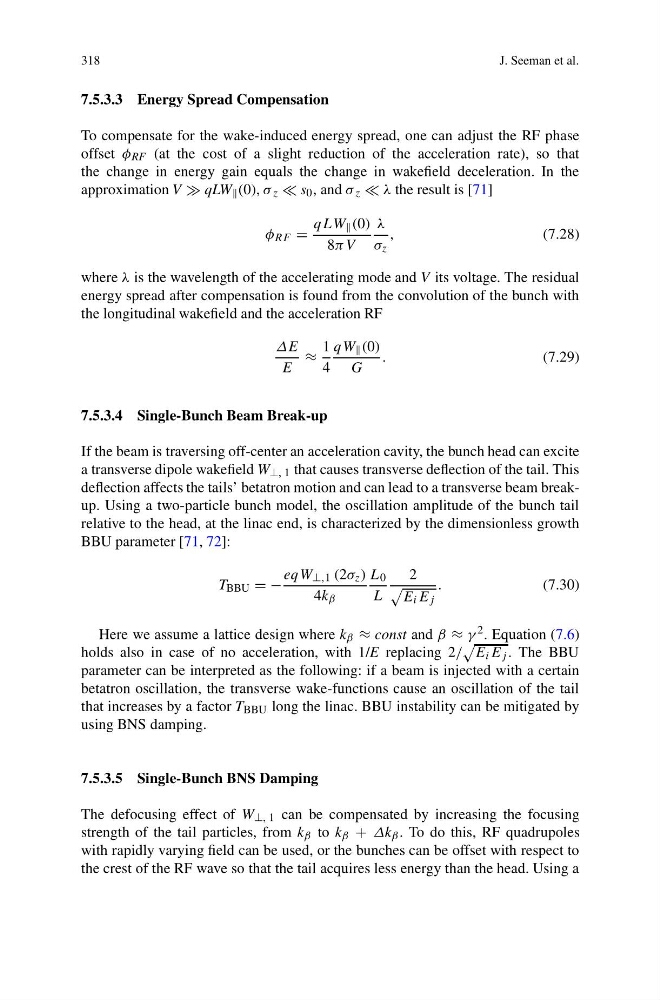
To compensate for the wake-induced energy spread, one can adjust the RF phase
offset φ RF (at the cost of a slight reduction of the acceleration rate), so that
the change in energy gain equals the change in wakefield deceleration. In the
approximation V qLW (0), σ z s 0 , and σ z λ the result is [71]
φ RF =
qLW (0)
8πV
λ
σ z
,
(7.28)
where λ is the wavelength of the accelerating mode and V its voltage. The residual
energy spread after compensation is found from the convolution of the bunch with
the longitudinal wakefield and the acceleration RF
ΔE
E
≈
1
4
qW (0)
G
.
(7.29)
7.5.3.4 Single-Bunch Beam Break-up
If the beam is traversing off-center an acceleration cavity, the bunch head can excite
a transverse dipole wakefield W ⊥, 1 that causes transverse deflection of the tail. This
deflection affects the tails’ betatron motion and can lead to a transverse beam breakup. Using a two-particle bunch model, the oscillation amplitude of the bunch tail
relative to the head, at the linac end, is characterized by the dimensionless growth
BBU parameter [71, 72]:
T BBU = −
eqW ⊥,1 (2σ z )
4k β
L 0
L
2
E i E j
.
(7.30)
Here we assume a lattice design where k β ≈ const and β ≈ γ 2 . Equation (7.6)
holds also in case of no acceleration, with 1/E replacing 2/
E i E j . The BBU
parameter can be interpreted as the following: if a beam is injected with a certain
betatron oscillation, the transverse wake-functions cause an oscillation of the tail
that increases by a factor T BBU long the linac. BBU instability can be mitigated by
using BNS damping.
7.5.3.5 Single-Bunch BNS Damping
The defocusing effect of W ⊥, 1 can be compensated by increasing the focusing
strength of the tail particles, from k β to k β + Δk β . To do this, RF quadrupoles
with rapidly varying field can be used, or the bunches can be offset with respect to
the crest of the RF wave so that the tail acquires less energy than the head. Using a
J. Seeman et al.
7.5.3.3 Energy Spread Compensation
To compensate for the wake-induced energy spread, one can adjust the RF phase
offset φ RF (at the cost of a slight reduction of the acceleration rate), so that
the change in energy gain equals the change in wakefield deceleration. In the
approximation V qLW (0), σ z s 0 , and σ z λ the result is [71]
φ RF =
qLW (0)
8πV
λ
σ z
,
(7.28)
where λ is the wavelength of the accelerating mode and V its voltage. The residual
energy spread after compensation is found from the convolution of the bunch with
the longitudinal wakefield and the acceleration RF
ΔE
E
≈
1
4
qW (0)
G
.
(7.29)
7.5.3.4 Single-Bunch Beam Break-up
If the beam is traversing off-center an acceleration cavity, the bunch head can excite
a transverse dipole wakefield W ⊥, 1 that causes transverse deflection of the tail. This
deflection affects the tails’ betatron motion and can lead to a transverse beam breakup. Using a two-particle bunch model, the oscillation amplitude of the bunch tail
relative to the head, at the linac end, is characterized by the dimensionless growth
BBU parameter [71, 72]:
T BBU = −
eqW ⊥,1 (2σ z )
4k β
L 0
L
2
E i E j
.
(7.30)
Here we assume a lattice design where k β ≈ const and β ≈ γ 2 . Equation (7.6)
holds also in case of no acceleration, with 1/E replacing 2/
E i E j . The BBU
parameter can be interpreted as the following: if a beam is injected with a certain
betatron oscillation, the transverse wake-functions cause an oscillation of the tail
that increases by a factor T BBU long the linac. BBU instability can be mitigated by
using BNS damping.
7.5.3.5 Single-Bunch BNS Damping
The defocusing effect of W ⊥, 1 can be compensated by increasing the focusing
strength of the tail particles, from k β to k β + Δk β . To do this, RF quadrupoles
with rapidly varying field can be used, or the bunches can be offset with respect to
the crest of the RF wave so that the tail acquires less energy than the head. Using a