

7 Design and Principles of Linear Accelerators and Colliders
317
7.5.3 Single-Bunch Wakefield-Induced Effects
7.5.3.1 Beam Loading
The electromagnetic interaction between the bunch tail and the wakes induced by
the bunch head, causes the tail to radiate and lose energy. This decelerating effect
is called beam loading. The energy loss experienced by each particle is estimated
by adding to the self-generated wake the decelerating voltage due to the upstream
generated wakefields:
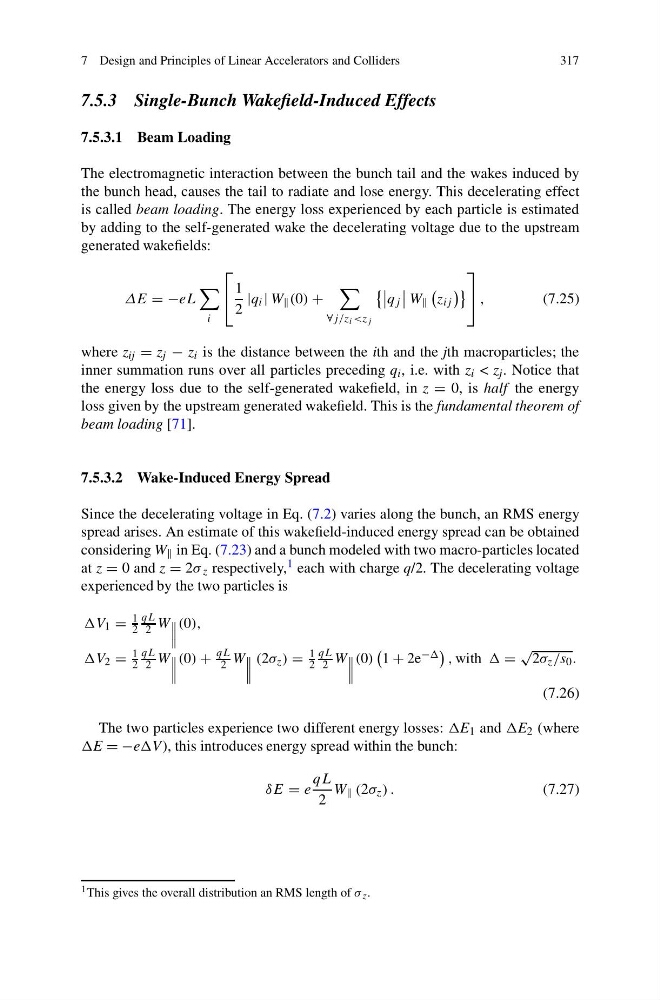
ΔE = −eL
i
⎡
⎣ 1
2
|q i | W (0) +
∀j/z i
W
z ij
⎤
⎦ ,
(7.25)
where z ij = z j − z i is the distance between the ith and the jth macroparticles; the
inner summation runs over all particles preceding q i , i.e. with z i < z j . Notice that
the energy loss due to the self-generated wakefield, in z = 0, is half the energy
loss given by the upstream generated wakefield. This is the fundamental theorem of
beam loading [71].
7.5.3.2 Wake-Induced Energy Spread
Since the decelerating voltage in Eq. (7.2) varies along the bunch, an RMS energy
spread arises. An estimate of this wakefield-induced energy spread can be obtained
considering W in Eq. (7.23) and a bunch modeled with two macro-particles located
at z = 0 and z = 2σ z respectively, 1 each with charge q/2. The decelerating voltage
experienced by the two particles is
1 =
1
2
qL
2 W
(0),
2 =
1
2
qL
2 W
(0) +
qL
2 W
(2σ z ) =
1
2
qL
2 W
(0)
1 + 2e −
, with =
√
2σ z /s 0 .
(7.26)
The two particles experience two different energy losses: 1 and 2 (where
= −e this introduces energy spread within the bunch:
δE = e
qL
2
W (2σ z ) .
(7.27)
1 This gives the overall distribution an RMS length of σ z .
317
7.5.3 Single-Bunch Wakefield-Induced Effects
7.5.3.1 Beam Loading
The electromagnetic interaction between the bunch tail and the wakes induced by
the bunch head, causes the tail to radiate and lose energy. This decelerating effect
is called beam loading. The energy loss experienced by each particle is estimated
by adding to the self-generated wake the decelerating voltage due to the upstream
generated wakefields:
ΔE = −eL
i
⎡
⎣ 1
2
|q i | W (0) +
∀j/z i
W
z ij
⎤
⎦ ,
(7.25)
where z ij = z j − z i is the distance between the ith and the jth macroparticles; the
inner summation runs over all particles preceding q i , i.e. with z i < z j . Notice that
the energy loss due to the self-generated wakefield, in z = 0, is half the energy
loss given by the upstream generated wakefield. This is the fundamental theorem of
beam loading [71].
7.5.3.2 Wake-Induced Energy Spread
Since the decelerating voltage in Eq. (7.2) varies along the bunch, an RMS energy
spread arises. An estimate of this wakefield-induced energy spread can be obtained
considering W in Eq. (7.23) and a bunch modeled with two macro-particles located
at z = 0 and z = 2σ z respectively, 1 each with charge q/2. The decelerating voltage
experienced by the two particles is
1 =
1
2
qL
2 W
(0),
2 =
1
2
qL
2 W
(0) +
qL
2 W
(2σ z ) =
1
2
qL
2 W
(0)
1 + 2e −
, with =
√
2σ z /s 0 .
(7.26)
The two particles experience two different energy losses: 1 and 2 (where
= −e this introduces energy spread within the bunch:
δE = e
qL
2
W (2σ z ) .
(7.27)
1 This gives the overall distribution an RMS length of σ z .