

316
J. Seeman et al.
transverse offset of the exciting charge. For example, the transverse and longitudinal
momentum kicks experienced by a charge q following at a distance z a charge Q,
due to the transverse dipole and the longitudinal monopole modes, are respectively
− → p ⊥ = −qQL structure
− → r ⊥ W ⊥,1 (z), and − → p = −qQL structure W (z), where
L structure is the length of the structure and − → r ⊥ is the (small) transverse offset of the
exciting charge.
7.5.1 Short-Range Wakefields
The wake-functions of a periodic accelerating structure have been parameterized by
a number of authors. Here we present a convenient formula for the longitudinal and
the transverse component of the wake-potential, W , provided by Bane et al. [69]:
W =
Zc
πa 2 exp
−
s
s 0
, and s 0 ≈ 0.41
a 1.8 g 1.6
d 2.4 ,
(7.23)
W ⊥,1 = 4
Zc
πa 4 s 0
1 −
1 +
s
s 0
exp
−
s
s 0
, and s 0 ≈ 0.169
a 1.79 g 0.38
d 1.17 ,
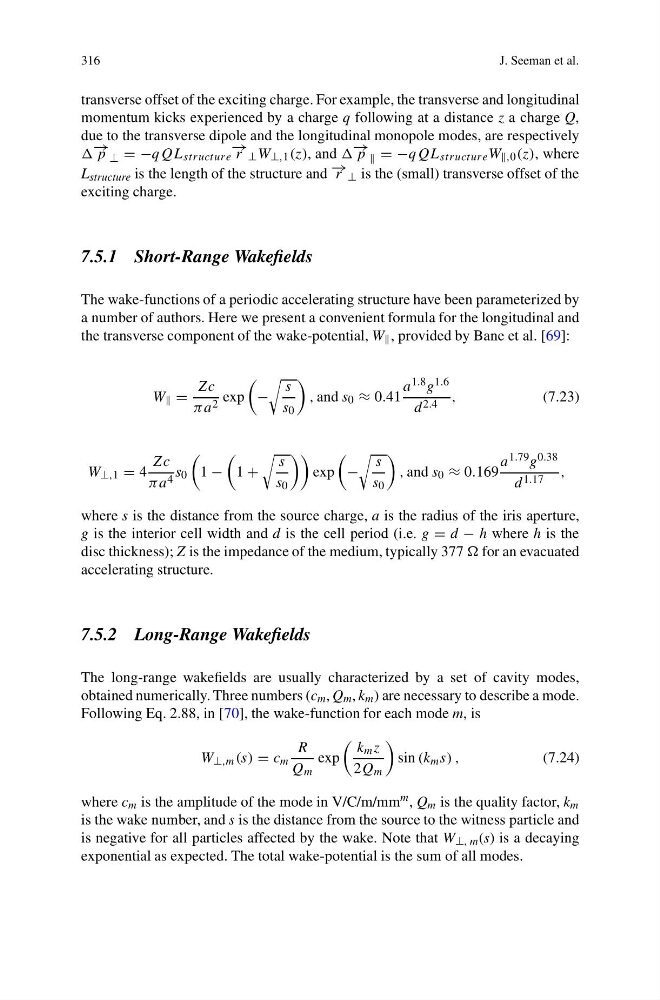
where s is the distance from the source charge, a is the radius of the iris aperture,
g is the interior cell width and d is the cell period (i.e. g = d − h where h is the
disc thickness); Z is the impedance of the medium, typically 377 for an evacuated
accelerating structure.
7.5.2 Long-Range Wakefields
The long-range wakefields are usually characterized by a set of cavity modes,
obtained numerically. Three numbers (c m , Q m , k m ) are necessary to describe a mode.
Following Eq. 2.88, in [70], the wake-function for each mode m, is
W ⊥,m (s) = c m
R
Q m
exp
k m z
2Q m
sin (k m s) ,
(7.24)
where c m is the amplitude of the mode in V/C/m/mm m , Q m is the quality factor, k m
is the wake number, and s is the distance from the source to the witness particle and
is negative for all particles affected by the wake. Note that W ⊥, m (s) is a decaying
exponential as expected. The total wake-potential is the sum of all modes.
J. Seeman et al.
transverse offset of the exciting charge. For example, the transverse and longitudinal
momentum kicks experienced by a charge q following at a distance z a charge Q,
due to the transverse dipole and the longitudinal monopole modes, are respectively
− → p ⊥ = −qQL structure
− → r ⊥ W ⊥,1 (z), and − → p = −qQL structure W (z), where
L structure is the length of the structure and − → r ⊥ is the (small) transverse offset of the
exciting charge.
7.5.1 Short-Range Wakefields
The wake-functions of a periodic accelerating structure have been parameterized by
a number of authors. Here we present a convenient formula for the longitudinal and
the transverse component of the wake-potential, W , provided by Bane et al. [69]:
W =
Zc
πa 2 exp
−
s
s 0
, and s 0 ≈ 0.41
a 1.8 g 1.6
d 2.4 ,
(7.23)
W ⊥,1 = 4
Zc
πa 4 s 0
1 −
1 +
s
s 0
exp
−
s
s 0
, and s 0 ≈ 0.169
a 1.79 g 0.38
d 1.17 ,
where s is the distance from the source charge, a is the radius of the iris aperture,
g is the interior cell width and d is the cell period (i.e. g = d − h where h is the
disc thickness); Z is the impedance of the medium, typically 377 for an evacuated
accelerating structure.
7.5.2 Long-Range Wakefields
The long-range wakefields are usually characterized by a set of cavity modes,
obtained numerically. Three numbers (c m , Q m , k m ) are necessary to describe a mode.
Following Eq. 2.88, in [70], the wake-function for each mode m, is
W ⊥,m (s) = c m
R
Q m
exp
k m z
2Q m
sin (k m s) ,
(7.24)
where c m is the amplitude of the mode in V/C/m/mm m , Q m is the quality factor, k m
is the wake number, and s is the distance from the source to the witness particle and
is negative for all particles affected by the wake. Note that W ⊥, m (s) is a decaying
exponential as expected. The total wake-potential is the sum of all modes.