

7 Design and Principles of Linear Accelerators and Colliders
319
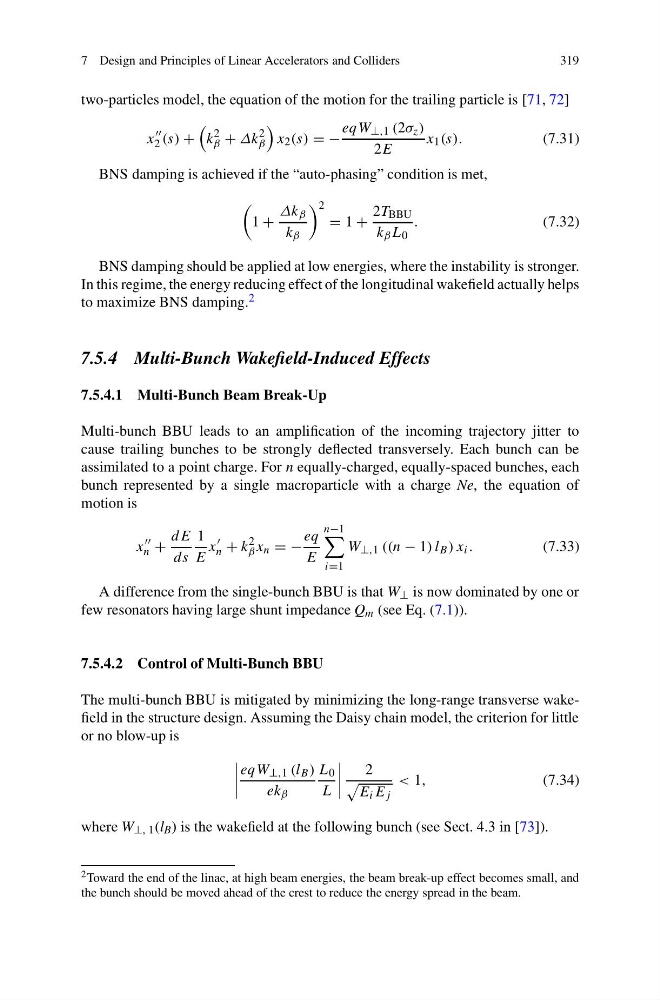
two-particles model, the equation of the motion for the trailing particle is [71, 72]
x
2 (s) +
k
2
β + Δk
2
β
x 2 (s) = −
eqW ⊥,1 (2σ z )
2E
x 1 (s).
(7.31)
BNS damping is achieved if the “auto-phasing” condition is met,
1 +
Δk β
k β
2
= 1 +
2T BBU
k β L 0
.
(7.32)
BNS damping should be applied at low energies, where the instability is stronger.
In this regime, the energy reducing effect of the longitudinal wakefield actually helps
to maximize BNS damping. 2
7.5.4 Multi-Bunch Wakefield-Induced Effects
7.5.4.1 Multi-Bunch Beam Break-Up
Multi-bunch BBU leads to an amplification of the incoming trajectory jitter to
cause trailing bunches to be strongly deflected transversely. Each bunch can be
assimilated to a point charge. For n equally-charged, equally-spaced bunches, each
bunch represented by a single macroparticle with a charge Ne, the equation of
motion is
x
n +
dE
ds
1
E
x
n + k
2
β x n = −
eq
E
n−1
i=1
W ⊥,1 ((n − 1) l B ) x i .
(7.33)
A difference from the single-bunch BBU is that W ⊥ is now dominated by one or
few resonators having large shunt impedance Q m (see Eq. (7.1)).
7.5.4.2 Control of Multi-Bunch BBU
The multi-bunch BBU is mitigated by minimizing the long-range transverse wakefield in the structure design. Assuming the Daisy chain model, the criterion for little
or no blow-up is
eqW ⊥,1 (l B )
ek β
L 0
L
2
E i E j
< 1,
(7.34)
where W ⊥, 1 (l B ) is the wakefield at the following bunch (see Sect. 4.3 in [73]).
2 Toward the end of the linac, at high beam energies, the beam break-up effect becomes small, and
the bunch should be moved ahead of the crest to reduce the energy spread in the beam.
319
two-particles model, the equation of the motion for the trailing particle is [71, 72]
x
2 (s) +
k
2
β + Δk
2
β
x 2 (s) = −
eqW ⊥,1 (2σ z )
2E
x 1 (s).
(7.31)
BNS damping is achieved if the “auto-phasing” condition is met,
1 +
Δk β
k β
2
= 1 +
2T BBU
k β L 0
.
(7.32)
BNS damping should be applied at low energies, where the instability is stronger.
In this regime, the energy reducing effect of the longitudinal wakefield actually helps
to maximize BNS damping. 2
7.5.4 Multi-Bunch Wakefield-Induced Effects
7.5.4.1 Multi-Bunch Beam Break-Up
Multi-bunch BBU leads to an amplification of the incoming trajectory jitter to
cause trailing bunches to be strongly deflected transversely. Each bunch can be
assimilated to a point charge. For n equally-charged, equally-spaced bunches, each
bunch represented by a single macroparticle with a charge Ne, the equation of
motion is
x
n +
dE
ds
1
E
x
n + k
2
β x n = −
eq
E
n−1
i=1
W ⊥,1 ((n − 1) l B ) x i .
(7.33)
A difference from the single-bunch BBU is that W ⊥ is now dominated by one or
few resonators having large shunt impedance Q m (see Eq. (7.1)).
7.5.4.2 Control of Multi-Bunch BBU
The multi-bunch BBU is mitigated by minimizing the long-range transverse wakefield in the structure design. Assuming the Daisy chain model, the criterion for little
or no blow-up is
eqW ⊥,1 (l B )
ek β
L 0
L
2
E i E j
< 1,
(7.34)
where W ⊥, 1 (l B ) is the wakefield at the following bunch (see Sect. 4.3 in [73]).
2 Toward the end of the linac, at high beam energies, the beam break-up effect becomes small, and
the bunch should be moved ahead of the crest to reduce the energy spread in the beam.