

6 Design and Principles of Synchrotrons and Circular Colliders
283
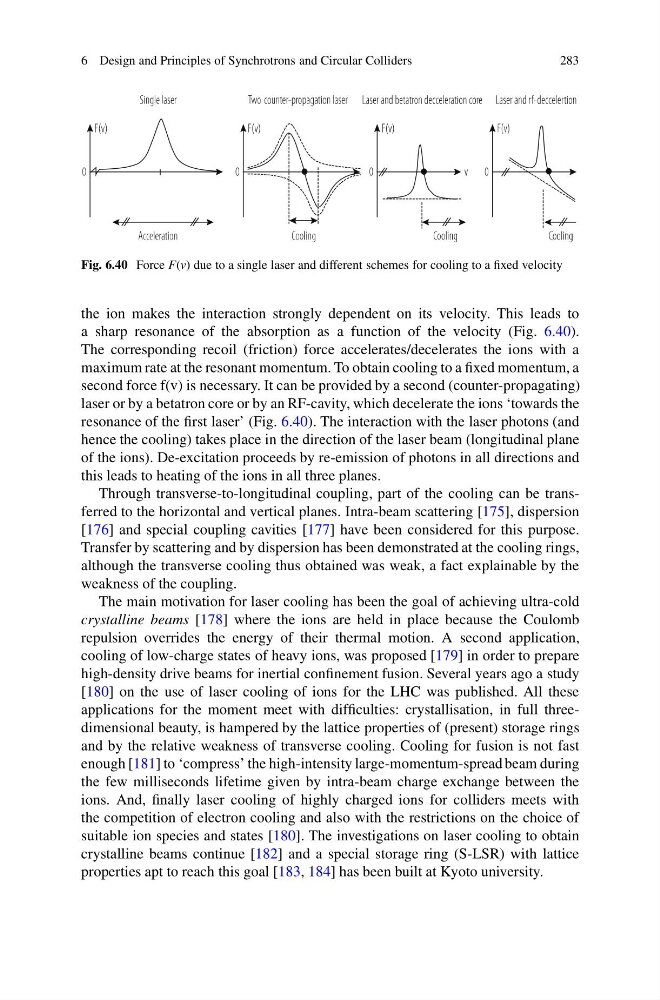
Fig. 6.40 Force F(v) due to a single laser and different schemes for cooling to a fixed velocity
the ion makes the interaction strongly dependent on its velocity. This leads to
a sharp resonance of the absorption as a function of the velocity (Fig. 6.40).
The corresponding recoil (friction) force accelerates/decelerates the ions with a
maximum rate at the resonant momentum. To obtain cooling to a fixed momentum, a
second force f(v) is necessary. It can be provided by a second (counter-propagating)
laser or by a betatron core or by an RF-cavity, which decelerate the ions ‘towards the
resonance of the first laser’ (Fig. 6.40). The interaction with the laser photons (and
hence the cooling) takes place in the direction of the laser beam (longitudinal plane
of the ions). De-excitation proceeds by re-emission of photons in all directions and
this leads to heating of the ions in all three planes.
Through transverse-to-longitudinal coupling, part of the cooling can be transferred to the horizontal and vertical planes. Intra-beam scattering [175], dispersion
[176] and special coupling cavities [177] have been considered for this purpose.
Transfer by scattering and by dispersion has been demonstrated at the cooling rings,
although the transverse cooling thus obtained was weak, a fact explainable by the
weakness of the coupling.
The main motivation for laser cooling has been the goal of achieving ultra-cold
crystalline beams [178] where the ions are held in place because the Coulomb
repulsion overrides the energy of their thermal motion. A second application,
cooling of low-charge states of heavy ions, was proposed [179] in order to prepare
high-density drive beams for inertial confinement fusion. Several years ago a study
[180] on the use of laser cooling of ions for the LHC was published. All these
applications for the moment meet with difficulties: crystallisation, in full threedimensional beauty, is hampered by the lattice properties of (present) storage rings
and by the relative weakness of transverse cooling. Cooling for fusion is not fast
enough [181] to ‘compress’ the high-intensity large-momentum-spread beam during
the few milliseconds lifetime given by intra-beam charge exchange between the
ions. And, finally laser cooling of highly charged ions for colliders meets with
the competition of electron cooling and also with the restrictions on the choice of
suitable ion species and states [180]. The investigations on laser cooling to obtain
crystalline beams continue [182] and a special storage ring (S-LSR) with lattice
properties apt to reach this goal [183, 184] has been built at Kyoto university.
283
Fig. 6.40 Force F(v) due to a single laser and different schemes for cooling to a fixed velocity
the ion makes the interaction strongly dependent on its velocity. This leads to
a sharp resonance of the absorption as a function of the velocity (Fig. 6.40).
The corresponding recoil (friction) force accelerates/decelerates the ions with a
maximum rate at the resonant momentum. To obtain cooling to a fixed momentum, a
second force f(v) is necessary. It can be provided by a second (counter-propagating)
laser or by a betatron core or by an RF-cavity, which decelerate the ions ‘towards the
resonance of the first laser’ (Fig. 6.40). The interaction with the laser photons (and
hence the cooling) takes place in the direction of the laser beam (longitudinal plane
of the ions). De-excitation proceeds by re-emission of photons in all directions and
this leads to heating of the ions in all three planes.
Through transverse-to-longitudinal coupling, part of the cooling can be transferred to the horizontal and vertical planes. Intra-beam scattering [175], dispersion
[176] and special coupling cavities [177] have been considered for this purpose.
Transfer by scattering and by dispersion has been demonstrated at the cooling rings,
although the transverse cooling thus obtained was weak, a fact explainable by the
weakness of the coupling.
The main motivation for laser cooling has been the goal of achieving ultra-cold
crystalline beams [178] where the ions are held in place because the Coulomb
repulsion overrides the energy of their thermal motion. A second application,
cooling of low-charge states of heavy ions, was proposed [179] in order to prepare
high-density drive beams for inertial confinement fusion. Several years ago a study
[180] on the use of laser cooling of ions for the LHC was published. All these
applications for the moment meet with difficulties: crystallisation, in full threedimensional beauty, is hampered by the lattice properties of (present) storage rings
and by the relative weakness of transverse cooling. Cooling for fusion is not fast
enough [181] to ‘compress’ the high-intensity large-momentum-spread beam during
the few milliseconds lifetime given by intra-beam charge exchange between the
ions. And, finally laser cooling of highly charged ions for colliders meets with
the competition of electron cooling and also with the restrictions on the choice of
suitable ion species and states [180]. The investigations on laser cooling to obtain
crystalline beams continue [182] and a special storage ring (S-LSR) with lattice
properties apt to reach this goal [183, 184] has been built at Kyoto university.