

282
B. J. Holzer et al.
In summary: 45 years after its invention, the field of electron cooling continues
to expand with exciting old and new questions to be answered. Bunched beam
cooling is no longer a magic barrier and even a merger between electron cooling and
stochastic cooling i.e. the “coherent electron cooling” [171] appears at the horizon.
In the concept of coherent electron information of the particle distribution of the
hadron beam to be cooled is sampled by the electron beam, amplified and further
downstream fed back onto the hadron beam.
6.10.2.4 Laser Cooling
Due to the pioneering work of the Heidelberg (TSR) [172] and Aarhus (ASTRID)
[173] groups in the 1990s, laser cooling in storage rings has evolved into a very
powerful technique. Longitudinal cooling times as short as a few milliseconds
and momentum spreads as small as 10 −6 are reported. These bright perspectives
are somewhat mitigated by two specific attributes [174]: laser cooling takes place
(mainly) in the longitudinal plane and it works (only) for special ions that have
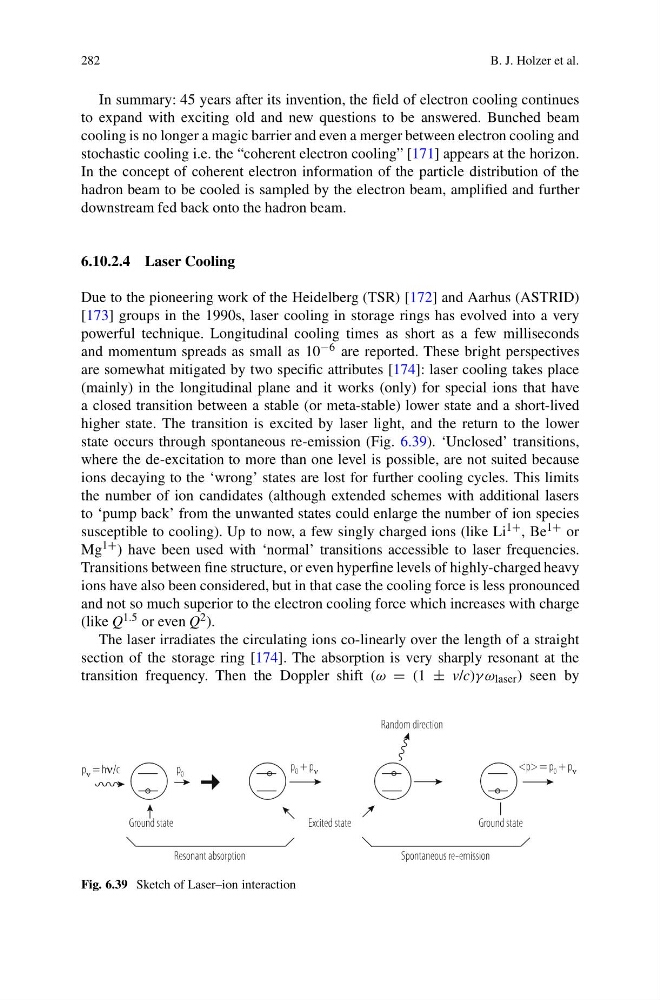
a closed transition between a stable (or meta-stable) lower state and a short-lived
higher state. The transition is excited by laser light, and the return to the lower
state occurs through spontaneous re-emission (Fig. 6.39). ‘Unclosed’ transitions,
where the de-excitation to more than one level is possible, are not suited because
ions decaying to the ‘wrong’ states are lost for further cooling cycles. This limits
the number of ion candidates (although extended schemes with additional lasers
to ‘pump back’ from the unwanted states could enlarge the number of ion species
susceptible to cooling). Up to now, a few singly charged ions (like Li 1+ , Be 1+ or
Mg 1+ ) have been used with ‘normal’ transitions accessible to laser frequencies.
Transitions between fine structure, or even hyperfine levels of highly-charged heavy
ions have also been considered, but in that case the cooling force is less pronounced
and not so much superior to the electron cooling force which increases with charge
(like Q 1.5 or even Q 2 ).
The laser irradiates the circulating ions co-linearly over the length of a straight
section of the storage ring [174]. The absorption is very sharply resonant at the
transition frequency. Then the Doppler shift (ω = (1 ± v/c)γ ω laser ) seen by
Fig. 6.39 Sketch of Laser–ion interaction
B. J. Holzer et al.
In summary: 45 years after its invention, the field of electron cooling continues
to expand with exciting old and new questions to be answered. Bunched beam
cooling is no longer a magic barrier and even a merger between electron cooling and
stochastic cooling i.e. the “coherent electron cooling” [171] appears at the horizon.
In the concept of coherent electron information of the particle distribution of the
hadron beam to be cooled is sampled by the electron beam, amplified and further
downstream fed back onto the hadron beam.
6.10.2.4 Laser Cooling
Due to the pioneering work of the Heidelberg (TSR) [172] and Aarhus (ASTRID)
[173] groups in the 1990s, laser cooling in storage rings has evolved into a very
powerful technique. Longitudinal cooling times as short as a few milliseconds
and momentum spreads as small as 10 −6 are reported. These bright perspectives
are somewhat mitigated by two specific attributes [174]: laser cooling takes place
(mainly) in the longitudinal plane and it works (only) for special ions that have
a closed transition between a stable (or meta-stable) lower state and a short-lived
higher state. The transition is excited by laser light, and the return to the lower
state occurs through spontaneous re-emission (Fig. 6.39). ‘Unclosed’ transitions,
where the de-excitation to more than one level is possible, are not suited because
ions decaying to the ‘wrong’ states are lost for further cooling cycles. This limits
the number of ion candidates (although extended schemes with additional lasers
to ‘pump back’ from the unwanted states could enlarge the number of ion species
susceptible to cooling). Up to now, a few singly charged ions (like Li 1+ , Be 1+ or
Mg 1+ ) have been used with ‘normal’ transitions accessible to laser frequencies.
Transitions between fine structure, or even hyperfine levels of highly-charged heavy
ions have also been considered, but in that case the cooling force is less pronounced
and not so much superior to the electron cooling force which increases with charge
(like Q 1.5 or even Q 2 ).
The laser irradiates the circulating ions co-linearly over the length of a straight
section of the storage ring [174]. The absorption is very sharply resonant at the
transition frequency. Then the Doppler shift (ω = (1 ± v/c)γ ω laser ) seen by
Fig. 6.39 Sketch of Laser–ion interaction