

284
B. J. Holzer et al.
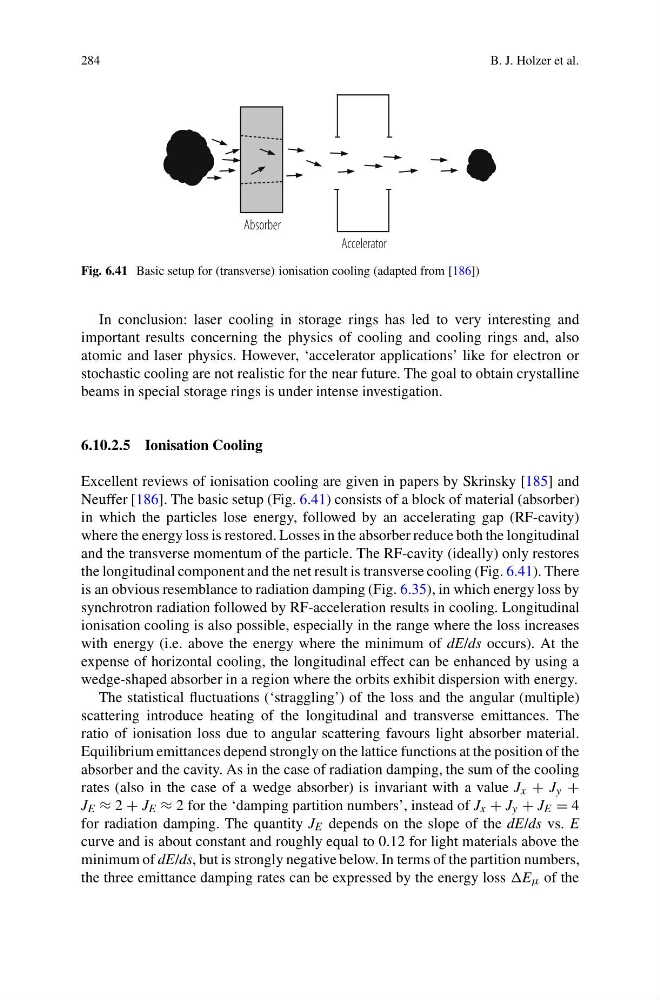
Fig. 6.41 Basic setup for (transverse) ionisation cooling (adapted from [186])
In conclusion: laser cooling in storage rings has led to very interesting and
important results concerning the physics of cooling and cooling rings and, also
atomic and laser physics. However, ‘accelerator applications’ like for electron or
stochastic cooling are not realistic for the near future. The goal to obtain crystalline
beams in special storage rings is under intense investigation.
6.10.2.5 Ionisation Cooling
Excellent reviews of ionisation cooling are given in papers by Skrinsky [185] and
Neuffer [186]. The basic setup (Fig. 6.41) consists of a block of material (absorber)
in which the particles lose energy, followed by an accelerating gap (RF-cavity)
where the energy loss is restored. Losses in the absorber reduce both the longitudinal
and the transverse momentum of the particle. The RF-cavity (ideally) only restores
the longitudinal component and the net result is transverse cooling (Fig. 6.41). There
is an obvious resemblance to radiation damping (Fig. 6.35), in which energy loss by
synchrotron radiation followed by RF-acceleration results in cooling. Longitudinal
ionisation cooling is also possible, especially in the range where the loss increases
with energy (i.e. above the energy where the minimum of dE/ds occurs). At the
expense of horizontal cooling, the longitudinal effect can be enhanced by using a
wedge-shaped absorber in a region where the orbits exhibit dispersion with energy.
The statistical fluctuations (‘straggling’) of the loss and the angular (multiple)
scattering introduce heating of the longitudinal and transverse emittances. The
ratio of ionisation loss due to angular scattering favours light absorber material.
Equilibrium emittances depend strongly on the lattice functions at the position of the
absorber and the cavity. As in the case of radiation damping, the sum of the cooling
rates (also in the case of a wedge absorber) is invariant with a value J x + J y +
J E ≈ 2 + J E ≈ 2 for the ‘damping partition numbers’, instead of J x + J y + J E = 4
for radiation damping. The quantity J E depends on the slope of the dE/ds vs. E
curve and is about constant and roughly equal to 0.12 for light materials above the
minimum of dE/ds, but is strongly negative below. In terms of the partition numbers,
the three emittance damping rates can be expressed by the energy loss E μ of the
B. J. Holzer et al.
Fig. 6.41 Basic setup for (transverse) ionisation cooling (adapted from [186])
In conclusion: laser cooling in storage rings has led to very interesting and
important results concerning the physics of cooling and cooling rings and, also
atomic and laser physics. However, ‘accelerator applications’ like for electron or
stochastic cooling are not realistic for the near future. The goal to obtain crystalline
beams in special storage rings is under intense investigation.
6.10.2.5 Ionisation Cooling
Excellent reviews of ionisation cooling are given in papers by Skrinsky [185] and
Neuffer [186]. The basic setup (Fig. 6.41) consists of a block of material (absorber)
in which the particles lose energy, followed by an accelerating gap (RF-cavity)
where the energy loss is restored. Losses in the absorber reduce both the longitudinal
and the transverse momentum of the particle. The RF-cavity (ideally) only restores
the longitudinal component and the net result is transverse cooling (Fig. 6.41). There
is an obvious resemblance to radiation damping (Fig. 6.35), in which energy loss by
synchrotron radiation followed by RF-acceleration results in cooling. Longitudinal
ionisation cooling is also possible, especially in the range where the loss increases
with energy (i.e. above the energy where the minimum of dE/ds occurs). At the
expense of horizontal cooling, the longitudinal effect can be enhanced by using a
wedge-shaped absorber in a region where the orbits exhibit dispersion with energy.
The statistical fluctuations (‘straggling’) of the loss and the angular (multiple)
scattering introduce heating of the longitudinal and transverse emittances. The
ratio of ionisation loss due to angular scattering favours light absorber material.
Equilibrium emittances depend strongly on the lattice functions at the position of the
absorber and the cavity. As in the case of radiation damping, the sum of the cooling
rates (also in the case of a wedge absorber) is invariant with a value J x + J y +
J E ≈ 2 + J E ≈ 2 for the ‘damping partition numbers’, instead of J x + J y + J E = 4
for radiation damping. The quantity J E depends on the slope of the dE/ds vs. E
curve and is about constant and roughly equal to 0.12 for light materials above the
minimum of dE/ds, but is strongly negative below. In terms of the partition numbers,
the three emittance damping rates can be expressed by the energy loss E μ of the