

266
B. J. Holzer et al.
processes the LEIR vacuum system is designed for a dynamic pressure of less than
10 −12 mbar. From LEIR the ions are injected into the PS where the bunches are
split to obtain the bunch spacing needed for the LHC. After acceleration in the PS
the last remaining electrons are stripped before injection into the SPS. In the SPS
at injection space charge and intrabeam scattering were a concern, and an emittance
growth of about 20% is observed at injection. Acceleration in the SPS requires a
special fixed frequency acceleration scheme since the main 200 MHz RF system
does not have the frequency range required to accelerate heavy ions with a constant
harmonic number. The SPS acceleration scheme takes advantage of the fact than the
ion bunch train only fills a fraction of the circumference allowing for an adjustment
of the RF phase during the time without beam [89].
The luminosity is given by
L = (βγ )
f rev
4π
k c
N b1 N b2
ε n β ∗ H
where f rev is the revolution frequency, k c the number of bunch-bunch collisions
per turn, N b1 and N b2 the bunch intensities in the two beams respectively, and β ∗
the lattice envelope function at the interaction point. The factor H accounts for
the hourglass effect and crossing angles, and is smaller than and of order 1. The
luminosity is limited by different effects in RHIC and the LHC.
In RHIC bunches of fully stripped heavy ions like Au 79+ with the same number
of charges as proton bunches have IBS growth rates an order of magnitude larger.
In RHIC at injection IBS leads to bunch lengthening, and at store to particle loss
out of the RF buckets and an increase in the transverse emittance. Longitudinal
and transverse bunched beam stochastic cooling at store has been implemented [90]
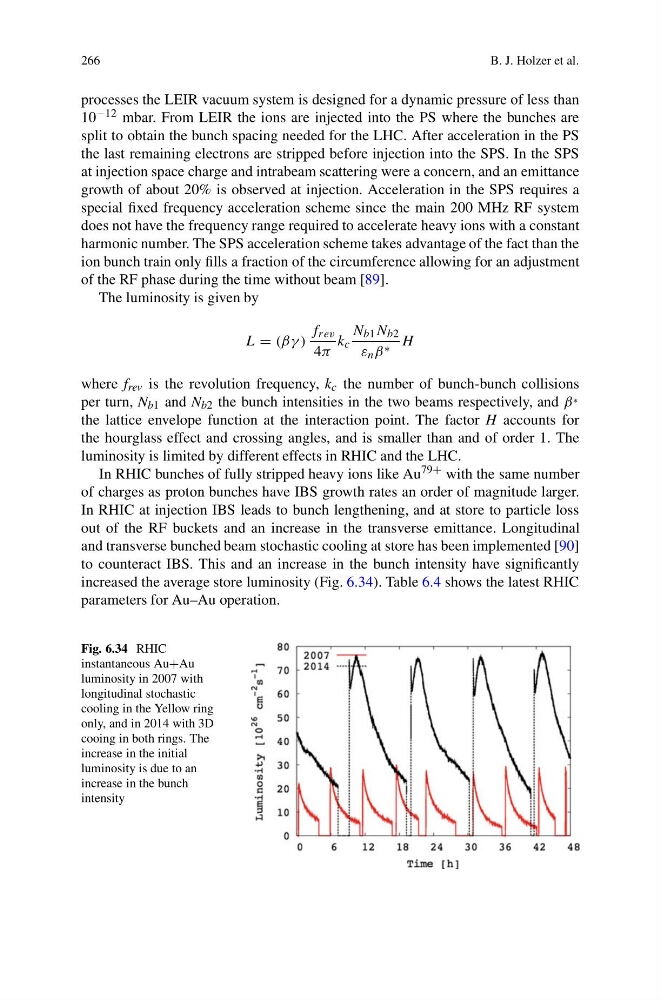
to counteract IBS. This and an increase in the bunch intensity have significantly
increased the average store luminosity (Fig. 6.34). Table 6.4 shows the latest RHIC
parameters for Au–Au operation.
Fig. 6.34 RHIC
instantaneous Au+Au
luminosity in 2007 with
longitudinal stochastic
cooling in the Yellow ring
only, and in 2014 with 3D
cooing in both rings. The
increase in the initial
luminosity is due to an
increase in the bunch
intensity
B. J. Holzer et al.
processes the LEIR vacuum system is designed for a dynamic pressure of less than
10 −12 mbar. From LEIR the ions are injected into the PS where the bunches are
split to obtain the bunch spacing needed for the LHC. After acceleration in the PS
the last remaining electrons are stripped before injection into the SPS. In the SPS
at injection space charge and intrabeam scattering were a concern, and an emittance
growth of about 20% is observed at injection. Acceleration in the SPS requires a
special fixed frequency acceleration scheme since the main 200 MHz RF system
does not have the frequency range required to accelerate heavy ions with a constant
harmonic number. The SPS acceleration scheme takes advantage of the fact than the
ion bunch train only fills a fraction of the circumference allowing for an adjustment
of the RF phase during the time without beam [89].
The luminosity is given by
L = (βγ )
f rev
4π
k c
N b1 N b2
ε n β ∗ H
where f rev is the revolution frequency, k c the number of bunch-bunch collisions
per turn, N b1 and N b2 the bunch intensities in the two beams respectively, and β ∗
the lattice envelope function at the interaction point. The factor H accounts for
the hourglass effect and crossing angles, and is smaller than and of order 1. The
luminosity is limited by different effects in RHIC and the LHC.
In RHIC bunches of fully stripped heavy ions like Au 79+ with the same number
of charges as proton bunches have IBS growth rates an order of magnitude larger.
In RHIC at injection IBS leads to bunch lengthening, and at store to particle loss
out of the RF buckets and an increase in the transverse emittance. Longitudinal
and transverse bunched beam stochastic cooling at store has been implemented [90]
to counteract IBS. This and an increase in the bunch intensity have significantly
increased the average store luminosity (Fig. 6.34). Table 6.4 shows the latest RHIC
parameters for Au–Au operation.
Fig. 6.34 RHIC
instantaneous Au+Au
luminosity in 2007 with
longitudinal stochastic
cooling in the Yellow ring
only, and in 2014 with 3D
cooing in both rings. The
increase in the initial
luminosity is due to an
increase in the bunch
intensity