

6 Design and Principles of Synchrotrons and Circular Colliders
265
Table 6.3 Preparation of the heavy ions for RHIC and LHC
RHIC (Au)
LHC (Pb)
Charge state Z
Ion energy
[eV/nucleon]
Charge state Z
Ion energy
[eV/nucleon]
LION a
1+
150
ECR
27+
2.5 k
EBIS b
32+
0.9 M
LINAC3 54+
4.2 M
Booster 77+
101 M
LEIR
54+
72.2 M
AGS
79+
8.8 G
PS
82+
5.9 G
RHIC
79+
99 G
SPS
82+
177 G
LHC
82+
2.51 T
For each accelerator, the kinetic energy of the ions is given at extraction, and the charge state in
the following transfer line
a Laser Ion Source; b Electron Beam Ion Source
mass number. IBS growth rates 1/T x,y,s scale like [81]
1
T x,y,s
∝
Z 4
A 2
N b
γ ε x ε y ε s
where N b is the bunch intensity, and ε x,y,s are the normalized emittances. High
charge states also reduce the electron stripping probability, and electron stripping
at higher energies is generally more efficient.
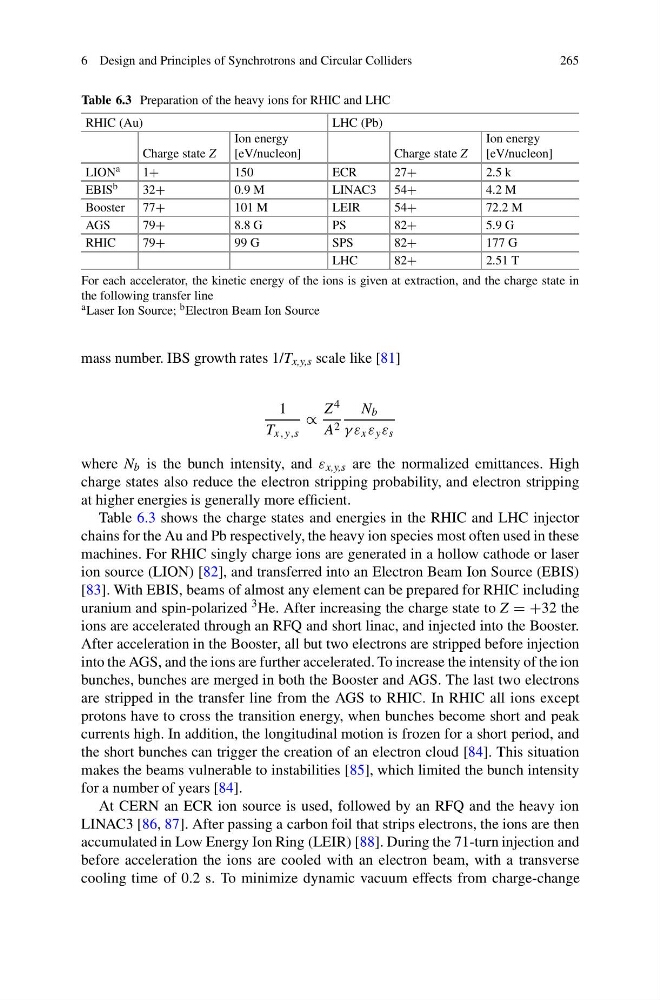
Table 6.3 shows the charge states and energies in the RHIC and LHC injector
chains for the Au and Pb respectively, the heavy ion species most often used in these
machines. For RHIC singly charge ions are generated in a hollow cathode or laser
ion source (LION) [82], and transferred into an Electron Beam Ion Source (EBIS)
[83]. With EBIS, beams of almost any element can be prepared for RHIC including
uranium and spin-polarized 3 He. After increasing the charge state to Z = +32 the
ions are accelerated through an RFQ and short linac, and injected into the Booster.
After acceleration in the Booster, all but two electrons are stripped before injection
into the AGS, and the ions are further accelerated. To increase the intensity of the ion
bunches, bunches are merged in both the Booster and AGS. The last two electrons
are stripped in the transfer line from the AGS to RHIC. In RHIC all ions except
protons have to cross the transition energy, when bunches become short and peak
currents high. In addition, the longitudinal motion is frozen for a short period, and
the short bunches can trigger the creation of an electron cloud [84]. This situation
makes the beams vulnerable to instabilities [85], which limited the bunch intensity
for a number of years [84].
At CERN an ECR ion source is used, followed by an RFQ and the heavy ion
LINAC3 [86, 87]. After passing a carbon foil that strips electrons, the ions are then
accumulated in Low Energy Ion Ring (LEIR) [88]. During the 71-turn injection and
before acceleration the ions are cooled with an electron beam, with a transverse
cooling time of 0.2 s. To minimize dynamic vacuum effects from charge-change
265
Table 6.3 Preparation of the heavy ions for RHIC and LHC
RHIC (Au)
LHC (Pb)
Charge state Z
Ion energy
[eV/nucleon]
Charge state Z
Ion energy
[eV/nucleon]
LION a
1+
150
ECR
27+
2.5 k
EBIS b
32+
0.9 M
LINAC3 54+
4.2 M
Booster 77+
101 M
LEIR
54+
72.2 M
AGS
79+
8.8 G
PS
82+
5.9 G
RHIC
79+
99 G
SPS
82+
177 G
LHC
82+
2.51 T
For each accelerator, the kinetic energy of the ions is given at extraction, and the charge state in
the following transfer line
a Laser Ion Source; b Electron Beam Ion Source
mass number. IBS growth rates 1/T x,y,s scale like [81]
1
T x,y,s
∝
Z 4
A 2
N b
γ ε x ε y ε s
where N b is the bunch intensity, and ε x,y,s are the normalized emittances. High
charge states also reduce the electron stripping probability, and electron stripping
at higher energies is generally more efficient.
Table 6.3 shows the charge states and energies in the RHIC and LHC injector
chains for the Au and Pb respectively, the heavy ion species most often used in these
machines. For RHIC singly charge ions are generated in a hollow cathode or laser
ion source (LION) [82], and transferred into an Electron Beam Ion Source (EBIS)
[83]. With EBIS, beams of almost any element can be prepared for RHIC including
uranium and spin-polarized 3 He. After increasing the charge state to Z = +32 the
ions are accelerated through an RFQ and short linac, and injected into the Booster.
After acceleration in the Booster, all but two electrons are stripped before injection
into the AGS, and the ions are further accelerated. To increase the intensity of the ion
bunches, bunches are merged in both the Booster and AGS. The last two electrons
are stripped in the transfer line from the AGS to RHIC. In RHIC all ions except
protons have to cross the transition energy, when bunches become short and peak
currents high. In addition, the longitudinal motion is frozen for a short period, and
the short bunches can trigger the creation of an electron cloud [84]. This situation
makes the beams vulnerable to instabilities [85], which limited the bunch intensity
for a number of years [84].
At CERN an ECR ion source is used, followed by an RFQ and the heavy ion
LINAC3 [86, 87]. After passing a carbon foil that strips electrons, the ions are then
accumulated in Low Energy Ion Ring (LEIR) [88]. During the 71-turn injection and
before acceleration the ions are cooled with an electron beam, with a transverse
cooling time of 0.2 s. To minimize dynamic vacuum effects from charge-change