

264
B. J. Holzer et al.
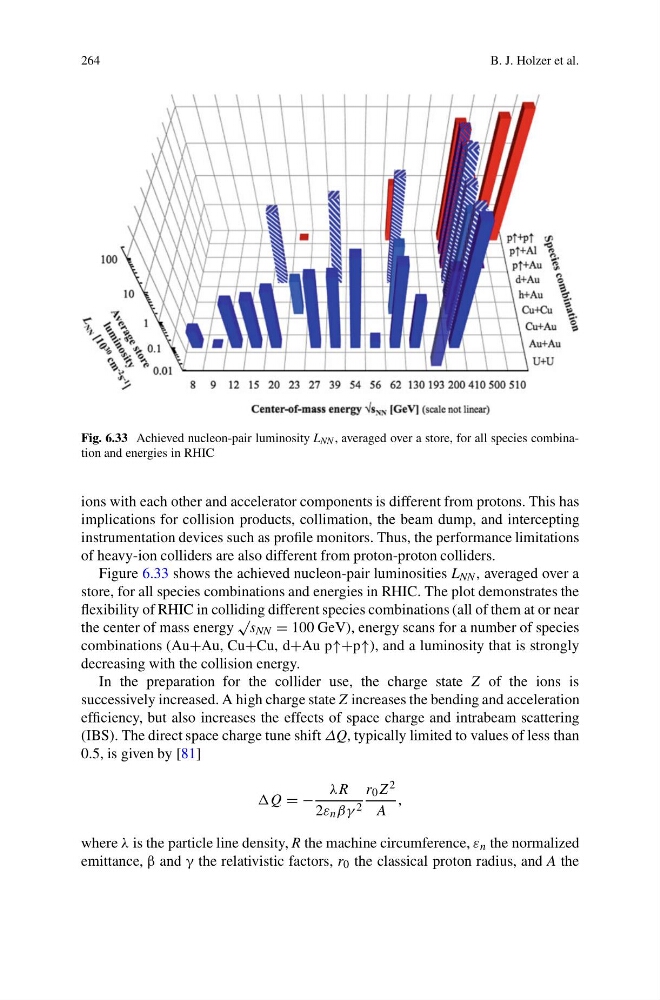
Fig. 6.33 Achieved nucleon-pair luminosity L NN , averaged over a store, for all species combination and energies in RHIC
ions with each other and accelerator components is different from protons. This has
implications for collision products, collimation, the beam dump, and intercepting
instrumentation devices such as profile monitors. Thus, the performance limitations
of heavy-ion colliders are also different from proton-proton colliders.
Figure 6.33 shows the achieved nucleon-pair luminosities L NN , averaged over a
store, for all species combinations and energies in RHIC. The plot demonstrates the
flexibility of RHIC in colliding different species combinations (all of them at or near
the center of mass energy
√
s NN = 100 GeV), energy scans for a number of species
combinations (Au+Au, Cu+Cu, d+Au p↑+p↑), and a luminosity that is strongly
decreasing with the collision energy.
In the preparation for the collider use, the charge state Z of the ions is
successively increased. A high charge state Z increases the bending and acceleration
efficiency, but also increases the effects of space charge and intrabeam scattering
(IBS). The direct space charge tune shift ΔQ, typically limited to values of less than
0.5, is given by [81]
Q = −
λR
2ε n βγ 2
r 0 Z 2
A
,
where λ is the particle line density, R the machine circumference, ε n the normalized
emittance, β and γ the relativistic factors, r 0 the classical proton radius, and A the
B. J. Holzer et al.
Fig. 6.33 Achieved nucleon-pair luminosity L NN , averaged over a store, for all species combination and energies in RHIC
ions with each other and accelerator components is different from protons. This has
implications for collision products, collimation, the beam dump, and intercepting
instrumentation devices such as profile monitors. Thus, the performance limitations
of heavy-ion colliders are also different from proton-proton colliders.
Figure 6.33 shows the achieved nucleon-pair luminosities L NN , averaged over a
store, for all species combinations and energies in RHIC. The plot demonstrates the
flexibility of RHIC in colliding different species combinations (all of them at or near
the center of mass energy
√
s NN = 100 GeV), energy scans for a number of species
combinations (Au+Au, Cu+Cu, d+Au p↑+p↑), and a luminosity that is strongly
decreasing with the collision energy.
In the preparation for the collider use, the charge state Z of the ions is
successively increased. A high charge state Z increases the bending and acceleration
efficiency, but also increases the effects of space charge and intrabeam scattering
(IBS). The direct space charge tune shift ΔQ, typically limited to values of less than
0.5, is given by [81]
Q = −
λR
2ε n βγ 2
r 0 Z 2
A
,
where λ is the particle line density, R the machine circumference, ε n the normalized
emittance, β and γ the relativistic factors, r 0 the classical proton radius, and A the