

6 Design and Principles of Synchrotrons and Circular Colliders
263
The first ion collider was the CERN Intersecting Storage Rings (ISR), which
briefly collided light ions [79, 80] in the late 1970s. The BNL Relativistic Heavy
Ion Collider (RHIC) has been in operation since 2000 and collided a number of
species at numerous energies. The CERN Large Hadron Collider (LHC) started its
Run 1 heavy ion program in 2010 and has provided mainly p-p, p-Pb and Pb-Pb at
increasing luminosity with a substantial increase in energy in Run 2 (2015–2018).
Both RHIC and the LHC have an expected operating time exceeding 20 years.
Further upgrades to the LHC, its injector complex and its experiments, foreseen
in the shutdown after Run 2, should allow the integrated luminosity in Runs 3
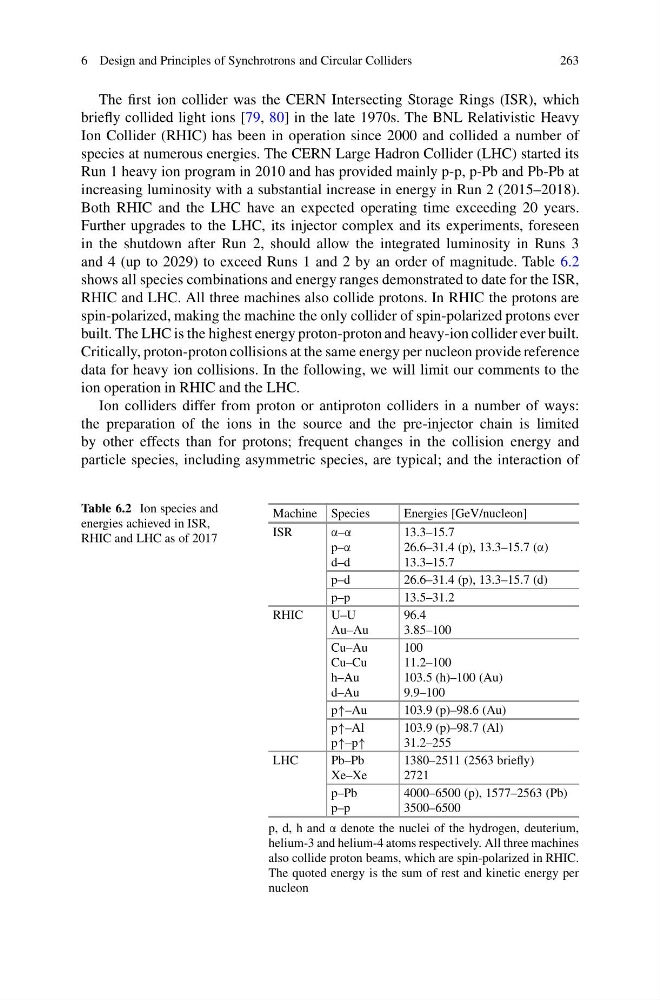
and 4 (up to 2029) to exceed Runs 1 and 2 by an order of magnitude. Table 6.2
shows all species combinations and energy ranges demonstrated to date for the ISR,
RHIC and LHC. All three machines also collide protons. In RHIC the protons are
spin-polarized, making the machine the only collider of spin-polarized protons ever
built. The LHC is the highest energy proton-proton and heavy-ion collider ever built.
Critically, proton-proton collisions at the same energy per nucleon provide reference
data for heavy ion collisions. In the following, we will limit our comments to the
ion operation in RHIC and the LHC.
Ion colliders differ from proton or antiproton colliders in a number of ways:
the preparation of the ions in the source and the pre-injector chain is limited
by other effects than for protons; frequent changes in the collision energy and
particle species, including asymmetric species, are typical; and the interaction of
Table 6.2 Ion species and
energies achieved in ISR,
RHIC and LHC as of 2017
Machine Species
Energies [GeV/nucleon]
ISR
α–α
p–α
d–d
13.3–15.7
26.6–31.4 (p), 13.3–15.7 (α)
13.3–15.7
p–d
26.6–31.4 (p), 13.3–15.7 (d)
p–p
13.5–31.2
RHIC
U–U
Au–Au
96.4
3.85–100
Cu–Au
Cu–Cu
h–Au
d–Au
100
11.2–100
103.5 (h)–100 (Au)
9.9–100
p↑–Au
103.9 (p)–98.6 (Au)
p↑–Al
p↑–p↑
103.9 (p)–98.7 (Al)
31.2–255
LHC
Pb–Pb
Xe–Xe
1380–2511 (2563 briefly)
2721
p–Pb
p–p
4000–6500 (p), 1577–2563 (Pb)
3500–6500
p, d, h and α denote the nuclei of the hydrogen, deuterium,
helium-3 and helium-4 atoms respectively. All three machines
also collide proton beams, which are spin-polarized in RHIC.
The quoted energy is the sum of rest and kinetic energy per
nucleon
263
The first ion collider was the CERN Intersecting Storage Rings (ISR), which
briefly collided light ions [79, 80] in the late 1970s. The BNL Relativistic Heavy
Ion Collider (RHIC) has been in operation since 2000 and collided a number of
species at numerous energies. The CERN Large Hadron Collider (LHC) started its
Run 1 heavy ion program in 2010 and has provided mainly p-p, p-Pb and Pb-Pb at
increasing luminosity with a substantial increase in energy in Run 2 (2015–2018).
Both RHIC and the LHC have an expected operating time exceeding 20 years.
Further upgrades to the LHC, its injector complex and its experiments, foreseen
in the shutdown after Run 2, should allow the integrated luminosity in Runs 3
and 4 (up to 2029) to exceed Runs 1 and 2 by an order of magnitude. Table 6.2
shows all species combinations and energy ranges demonstrated to date for the ISR,
RHIC and LHC. All three machines also collide protons. In RHIC the protons are
spin-polarized, making the machine the only collider of spin-polarized protons ever
built. The LHC is the highest energy proton-proton and heavy-ion collider ever built.
Critically, proton-proton collisions at the same energy per nucleon provide reference
data for heavy ion collisions. In the following, we will limit our comments to the
ion operation in RHIC and the LHC.
Ion colliders differ from proton or antiproton colliders in a number of ways:
the preparation of the ions in the source and the pre-injector chain is limited
by other effects than for protons; frequent changes in the collision energy and
particle species, including asymmetric species, are typical; and the interaction of
Table 6.2 Ion species and
energies achieved in ISR,
RHIC and LHC as of 2017
Machine Species
Energies [GeV/nucleon]
ISR
α–α
p–α
d–d
13.3–15.7
26.6–31.4 (p), 13.3–15.7 (α)
13.3–15.7
p–d
26.6–31.4 (p), 13.3–15.7 (d)
p–p
13.5–31.2
RHIC
U–U
Au–Au
96.4
3.85–100
Cu–Au
Cu–Cu
h–Au
d–Au
100
11.2–100
103.5 (h)–100 (Au)
9.9–100
p↑–Au
103.9 (p)–98.6 (Au)
p↑–Al
p↑–p↑
103.9 (p)–98.7 (Al)
31.2–255
LHC
Pb–Pb
Xe–Xe
1380–2511 (2563 briefly)
2721
p–Pb
p–p
4000–6500 (p), 1577–2563 (Pb)
3500–6500
p, d, h and α denote the nuclei of the hydrogen, deuterium,
helium-3 and helium-4 atoms respectively. All three machines
also collide proton beams, which are spin-polarized in RHIC.
The quoted energy is the sum of rest and kinetic energy per
nucleon