

6 Design and Principles of Synchrotrons and Circular Colliders
267
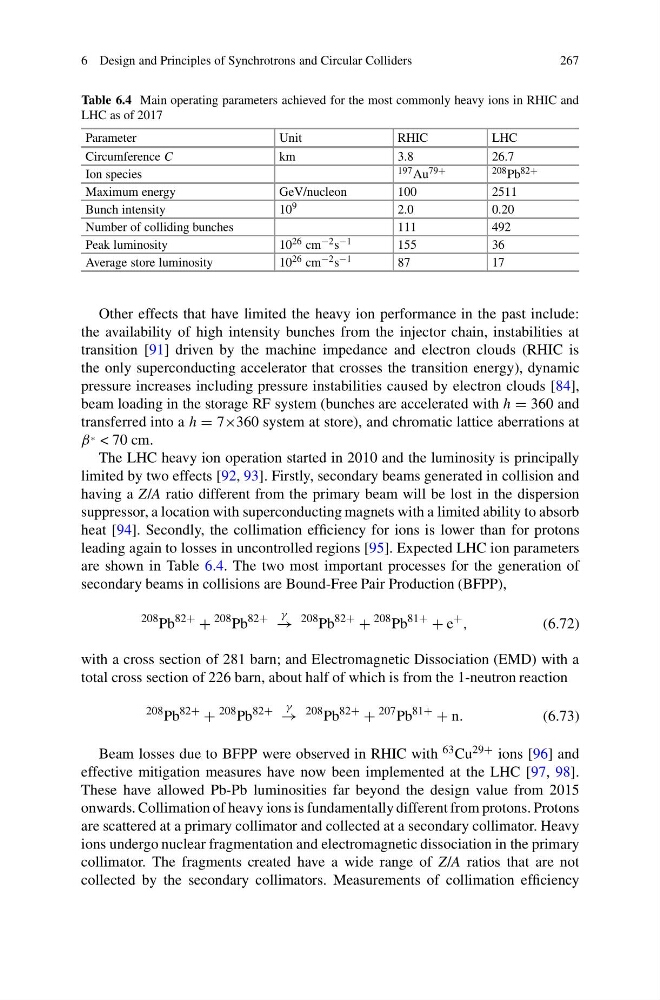
Table 6.4 Main operating parameters achieved for the most commonly heavy ions in RHIC and
LHC as of 2017
Parameter
Unit
RHIC
LHC
Circumference C
km
3.8
26.7
Ion species
197 Au 79+
208 Pb 82+
Maximum energy
GeV/nucleon
100
2511
Bunch intensity
10 9
2.0
0.20
Number of colliding bunches
111
492
Peak luminosity
10 26 cm −2 s −1
155
36
Average store luminosity
10 26 cm −2 s −1
87
17
Other effects that have limited the heavy ion performance in the past include:
the availability of high intensity bunches from the injector chain, instabilities at
transition [91] driven by the machine impedance and electron clouds (RHIC is
the only superconducting accelerator that crosses the transition energy), dynamic
pressure increases including pressure instabilities caused by electron clouds [84],
beam loading in the storage RF system (bunches are accelerated with h = 360 and
transferred into a h = 7×360 system at store), and chromatic lattice aberrations at
β ∗ < 70 cm.
The LHC heavy ion operation started in 2010 and the luminosity is principally
limited by two effects [92, 93]. Firstly, secondary beams generated in collision and
having a Z/A ratio different from the primary beam will be lost in the dispersion
suppressor, a location with superconducting magnets with a limited ability to absorb
heat [94]. Secondly, the collimation efficiency for ions is lower than for protons
leading again to losses in uncontrolled regions [95]. Expected LHC ion parameters
are shown in Table 6.4. The two most important processes for the generation of
secondary beams in collisions are Bound-Free Pair Production (BFPP),
208 Pb
82+
+
208 Pb
82+ γ
→
208 Pb
82+
+
208 Pb
81+
+ e
+ ,
(6.72)
with a cross section of 281 barn; and Electromagnetic Dissociation (EMD) with a
total cross section of 226 barn, about half of which is from the 1-neutron reaction
208 Pb
82+
+
208 Pb
82+ γ
→
208 Pb
82+
+
207 Pb
81+
+ n.
(6.73)
Beam losses due to BFPP were observed in RHIC with 63 Cu 29+ ions [96] and
effective mitigation measures have now been implemented at the LHC [97, 98].
These have allowed Pb-Pb luminosities far beyond the design value from 2015
onwards. Collimation of heavy ions is fundamentally different from protons. Protons
are scattered at a primary collimator and collected at a secondary collimator. Heavy
ions undergo nuclear fragmentation and electromagnetic dissociation in the primary
collimator. The fragments created have a wide range of Z/A ratios that are not
collected by the secondary collimators. Measurements of collimation efficiency
267
Table 6.4 Main operating parameters achieved for the most commonly heavy ions in RHIC and
LHC as of 2017
Parameter
Unit
RHIC
LHC
Circumference C
km
3.8
26.7
Ion species
197 Au 79+
208 Pb 82+
Maximum energy
GeV/nucleon
100
2511
Bunch intensity
10 9
2.0
0.20
Number of colliding bunches
111
492
Peak luminosity
10 26 cm −2 s −1
155
36
Average store luminosity
10 26 cm −2 s −1
87
17
Other effects that have limited the heavy ion performance in the past include:
the availability of high intensity bunches from the injector chain, instabilities at
transition [91] driven by the machine impedance and electron clouds (RHIC is
the only superconducting accelerator that crosses the transition energy), dynamic
pressure increases including pressure instabilities caused by electron clouds [84],
beam loading in the storage RF system (bunches are accelerated with h = 360 and
transferred into a h = 7×360 system at store), and chromatic lattice aberrations at
β ∗ < 70 cm.
The LHC heavy ion operation started in 2010 and the luminosity is principally
limited by two effects [92, 93]. Firstly, secondary beams generated in collision and
having a Z/A ratio different from the primary beam will be lost in the dispersion
suppressor, a location with superconducting magnets with a limited ability to absorb
heat [94]. Secondly, the collimation efficiency for ions is lower than for protons
leading again to losses in uncontrolled regions [95]. Expected LHC ion parameters
are shown in Table 6.4. The two most important processes for the generation of
secondary beams in collisions are Bound-Free Pair Production (BFPP),
208 Pb
82+
+
208 Pb
82+ γ
→
208 Pb
82+
+
208 Pb
81+
+ e
+ ,
(6.72)
with a cross section of 281 barn; and Electromagnetic Dissociation (EMD) with a
total cross section of 226 barn, about half of which is from the 1-neutron reaction
208 Pb
82+
+
208 Pb
82+ γ
→
208 Pb
82+
+
207 Pb
81+
+ n.
(6.73)
Beam losses due to BFPP were observed in RHIC with 63 Cu 29+ ions [96] and
effective mitigation measures have now been implemented at the LHC [97, 98].
These have allowed Pb-Pb luminosities far beyond the design value from 2015
onwards. Collimation of heavy ions is fundamentally different from protons. Protons
are scattered at a primary collimator and collected at a secondary collimator. Heavy
ions undergo nuclear fragmentation and electromagnetic dissociation in the primary
collimator. The fragments created have a wide range of Z/A ratios that are not
collected by the secondary collimators. Measurements of collimation efficiency