

6 Design and Principles of Synchrotrons and Circular Colliders
239
The key to this method is that the total cross section is related to the elastic cross
section for small values of the momentum transfer t by the so-called optical theorem
[43]:
lim
t →0
dσ el
dt
=
1 + ρ
2
σ 2
tot
16π
=
1
L
dN el
dt
t =0
(6.39)
Therefore the luminosity can in principle be calculated directly from experimental rates through:
L =
1 + ρ 2
16π
(N inel + N el )
2
(dN el /dt) t =0
(6.40)
All counting rates, the total number of events N inel + N el and the differential
elastic counting rate dN el /dt at small t have to be measured with high precision. This
requires a very good detector coverage of the whole space (4π) for the inelastic rate
and the possibility to measure to very small values of t.
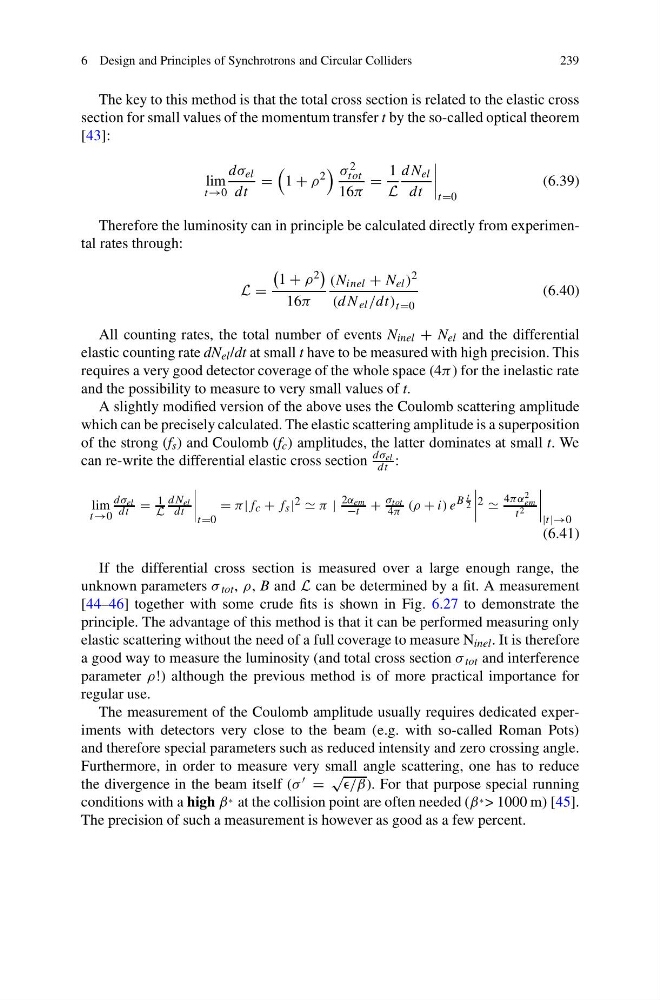
A slightly modified version of the above uses the Coulomb scattering amplitude
which can be precisely calculated. The elastic scattering amplitude is a superposition
of the strong (f s ) and Coulomb (f c ) amplitudes, the latter dominates at small t. We
can re-write the differential elastic cross section
dσ el
dt :
lim
t →0
dσ el
dt = 1
L
dN el
dt
t =0
= π|f c + f s | 2 π |
2α em
−t +
σ tot
4π (ρ + i) e B
t
2
2
4πα 2
em
t 2
|t |→0
(6.41)
If the differential cross section is measured over a large enough range, the
unknown parameters σ tot , ρ, B and L can be determined by a fit. A measurement
[44–46] together with some crude fits is shown in Fig. 6.27 to demonstrate the
principle. The advantage of this method is that it can be performed measuring only
elastic scattering without the need of a full coverage to measure N inel . It is therefore
a good way to measure the luminosity (and total cross section σ tot and interference
parameter ρ!) although the previous method is of more practical importance for
regular use.
The measurement of the Coulomb amplitude usually requires dedicated experiments with detectors very close to the beam (e.g. with so-called Roman Pots)
and therefore special parameters such as reduced intensity and zero crossing angle.
Furthermore, in order to measure very small angle scattering, one has to reduce
the divergence in the beam itself (σ =
√
/β). For that purpose special running
conditions with a high β ∗ at the collision point are often needed (β ∗ > 1000 m) [45].
The precision of such a measurement is however as good as a few percent.
239
The key to this method is that the total cross section is related to the elastic cross
section for small values of the momentum transfer t by the so-called optical theorem
[43]:
lim
t →0
dσ el
dt
=
1 + ρ
2
σ 2
tot
16π
=
1
L
dN el
dt
t =0
(6.39)
Therefore the luminosity can in principle be calculated directly from experimental rates through:
L =
1 + ρ 2
16π
(N inel + N el )
2
(dN el /dt) t =0
(6.40)
All counting rates, the total number of events N inel + N el and the differential
elastic counting rate dN el /dt at small t have to be measured with high precision. This
requires a very good detector coverage of the whole space (4π) for the inelastic rate
and the possibility to measure to very small values of t.
A slightly modified version of the above uses the Coulomb scattering amplitude
which can be precisely calculated. The elastic scattering amplitude is a superposition
of the strong (f s ) and Coulomb (f c ) amplitudes, the latter dominates at small t. We
can re-write the differential elastic cross section
dσ el
dt :
lim
t →0
dσ el
dt = 1
L
dN el
dt
t =0
= π|f c + f s | 2 π |
2α em
−t +
σ tot
4π (ρ + i) e B
t
2
2
4πα 2
em
t 2
|t |→0
(6.41)
If the differential cross section is measured over a large enough range, the
unknown parameters σ tot , ρ, B and L can be determined by a fit. A measurement
[44–46] together with some crude fits is shown in Fig. 6.27 to demonstrate the
principle. The advantage of this method is that it can be performed measuring only
elastic scattering without the need of a full coverage to measure N inel . It is therefore
a good way to measure the luminosity (and total cross section σ tot and interference
parameter ρ!) although the previous method is of more practical importance for
regular use.
The measurement of the Coulomb amplitude usually requires dedicated experiments with detectors very close to the beam (e.g. with so-called Roman Pots)
and therefore special parameters such as reduced intensity and zero crossing angle.
Furthermore, in order to measure very small angle scattering, one has to reduce
the divergence in the beam itself (σ =
√
/β). For that purpose special running
conditions with a high β ∗ at the collision point are often needed (β ∗ > 1000 m) [45].
The precision of such a measurement is however as good as a few percent.