

238
B. J. Holzer et al.
0
0.2
0.4
0.6
0.8
1
1.2
1.4
-4
-2
0
2
4
Counting rate
Transverse displacement in units of sigma
Counting rate
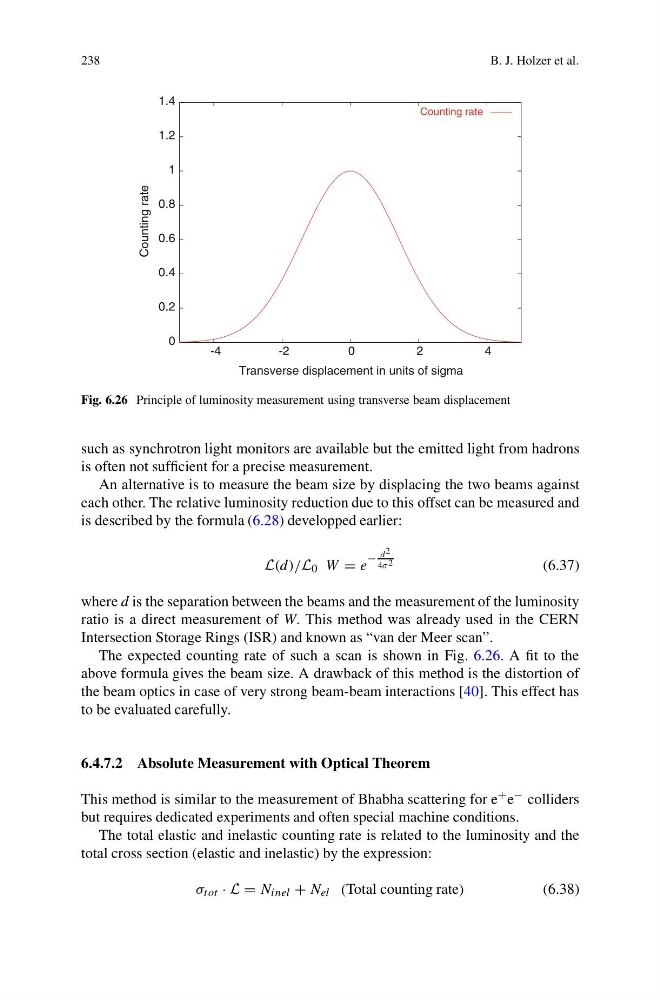
Fig. 6.26 Principle of luminosity measurement using transverse beam displacement
such as synchrotron light monitors are available but the emitted light from hadrons
is often not sufficient for a precise measurement.
An alternative is to measure the beam size by displacing the two beams against
each other. The relative luminosity reduction due to this offset can be measured and
is described by the formula (6.28) developped earlier:
L(d)/L 0 W = e
−
d 2
4σ 2
(6.37)
where d is the separation between the beams and the measurement of the luminosity
ratio is a direct measurement of W. This method was already used in the CERN
Intersection Storage Rings (ISR) and known as “van der Meer scan”.
The expected counting rate of such a scan is shown in Fig. 6.26. A fit to the
above formula gives the beam size. A drawback of this method is the distortion of
the beam optics in case of very strong beam-beam interactions [40]. This effect has
to be evaluated carefully.
6.4.7.2 Absolute Measurement with Optical Theorem
This method is similar to the measurement of Bhabha scattering for e + e − colliders
but requires dedicated experiments and often special machine conditions.
The total elastic and inelastic counting rate is related to the luminosity and the
total cross section (elastic and inelastic) by the expression:
σ tot · L = N inel + N el (Total counting rate)
(6.38)
B. J. Holzer et al.
0
0.2
0.4
0.6
0.8
1
1.2
1.4
-4
-2
0
2
4
Counting rate
Transverse displacement in units of sigma
Counting rate
Fig. 6.26 Principle of luminosity measurement using transverse beam displacement
such as synchrotron light monitors are available but the emitted light from hadrons
is often not sufficient for a precise measurement.
An alternative is to measure the beam size by displacing the two beams against
each other. The relative luminosity reduction due to this offset can be measured and
is described by the formula (6.28) developped earlier:
L(d)/L 0 W = e
−
d 2
4σ 2
(6.37)
where d is the separation between the beams and the measurement of the luminosity
ratio is a direct measurement of W. This method was already used in the CERN
Intersection Storage Rings (ISR) and known as “van der Meer scan”.
The expected counting rate of such a scan is shown in Fig. 6.26. A fit to the
above formula gives the beam size. A drawback of this method is the distortion of
the beam optics in case of very strong beam-beam interactions [40]. This effect has
to be evaluated carefully.
6.4.7.2 Absolute Measurement with Optical Theorem
This method is similar to the measurement of Bhabha scattering for e + e − colliders
but requires dedicated experiments and often special machine conditions.
The total elastic and inelastic counting rate is related to the luminosity and the
total cross section (elastic and inelastic) by the expression:
σ tot · L = N inel + N el (Total counting rate)
(6.38)