

6 Design and Principles of Synchrotrons and Circular Colliders
237
x
e+
e−
e+
e−
monitors
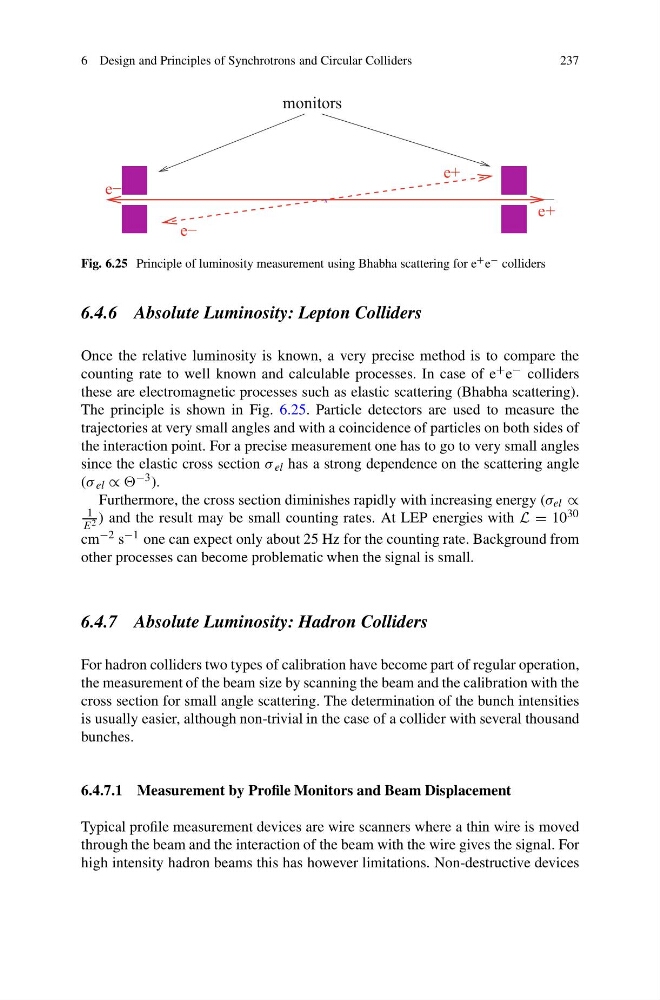
Fig. 6.25 Principle of luminosity measurement using Bhabha scattering for e + e − colliders
6.4.6 Absolute Luminosity: Lepton Colliders
Once the relative luminosity is known, a very precise method is to compare the
counting rate to well known and calculable processes. In case of e + e − colliders
these are electromagnetic processes such as elastic scattering (Bhabha scattering).
The principle is shown in Fig. 6.25. Particle detectors are used to measure the
trajectories at very small angles and with a coincidence of particles on both sides of
the interaction point. For a precise measurement one has to go to very small angles
since the elastic cross section σ el has a strong dependence on the scattering angle
(σ el ∝ −3 ).
Furthermore, the cross section diminishes rapidly with increasing energy (σ el ∝
1
E 2 ) and the result may be small counting rates. At LEP energies with L = 10 30
cm −2 s −1 one can expect only about 25 Hz for the counting rate. Background from
other processes can become problematic when the signal is small.
6.4.7 Absolute Luminosity: Hadron Colliders
For hadron colliders two types of calibration have become part of regular operation,
the measurement of the beam size by scanning the beam and the calibration with the
cross section for small angle scattering. The determination of the bunch intensities
is usually easier, although non-trivial in the case of a collider with several thousand
bunches.
6.4.7.1 Measurement by Profile Monitors and Beam Displacement
Typical profile measurement devices are wire scanners where a thin wire is moved
through the beam and the interaction of the beam with the wire gives the signal. For
high intensity hadron beams this has however limitations. Non-destructive devices
237
x
e+
e−
e+
e−
monitors
Fig. 6.25 Principle of luminosity measurement using Bhabha scattering for e + e − colliders
6.4.6 Absolute Luminosity: Lepton Colliders
Once the relative luminosity is known, a very precise method is to compare the
counting rate to well known and calculable processes. In case of e + e − colliders
these are electromagnetic processes such as elastic scattering (Bhabha scattering).
The principle is shown in Fig. 6.25. Particle detectors are used to measure the
trajectories at very small angles and with a coincidence of particles on both sides of
the interaction point. For a precise measurement one has to go to very small angles
since the elastic cross section σ el has a strong dependence on the scattering angle
(σ el ∝ −3 ).
Furthermore, the cross section diminishes rapidly with increasing energy (σ el ∝
1
E 2 ) and the result may be small counting rates. At LEP energies with L = 10 30
cm −2 s −1 one can expect only about 25 Hz for the counting rate. Background from
other processes can become problematic when the signal is small.
6.4.7 Absolute Luminosity: Hadron Colliders
For hadron colliders two types of calibration have become part of regular operation,
the measurement of the beam size by scanning the beam and the calibration with the
cross section for small angle scattering. The determination of the bunch intensities
is usually easier, although non-trivial in the case of a collider with several thousand
bunches.
6.4.7.1 Measurement by Profile Monitors and Beam Displacement
Typical profile measurement devices are wire scanners where a thin wire is moved
through the beam and the interaction of the beam with the wire gives the signal. For
high intensity hadron beams this has however limitations. Non-destructive devices