

240
B. J. Holzer et al.
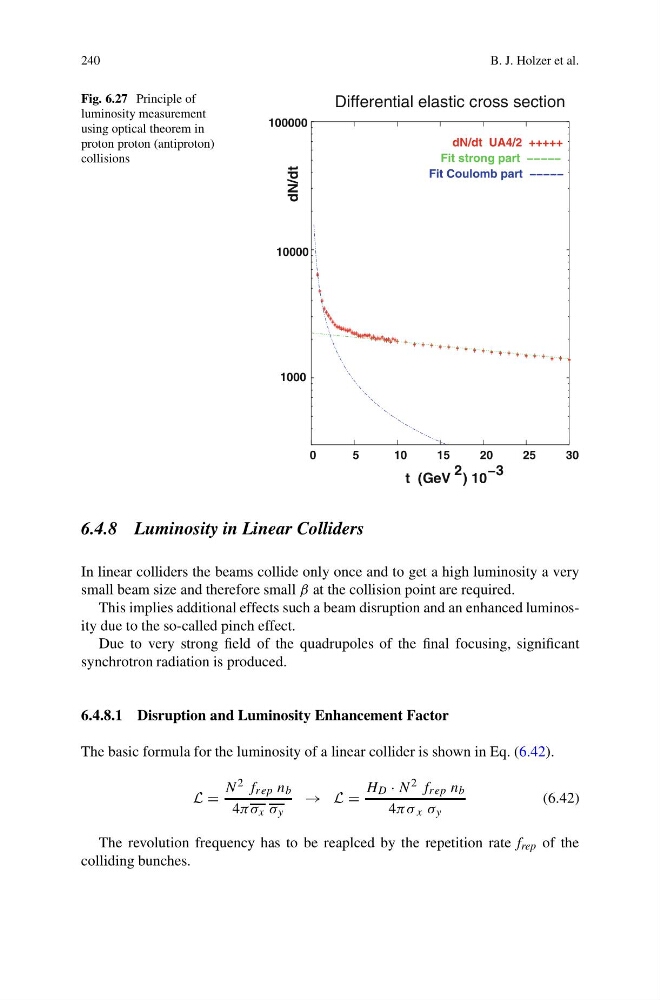
Fig. 6.27 Principle of
luminosity measurement
using optical theorem in
proton proton (antiproton)
collisions
Differential elastic cross section
dN/dt UA4/2 +++++
Fit Coulomb part −−−−−
Fit strong part −−−−−
dN/dt
0
5
10
15
20
25
30
1000
10000
100000
t (GeV ) 10
2
−3
6.4.8 Luminosity in Linear Colliders
In linear colliders the beams collide only once and to get a high luminosity a very
small beam size and therefore small β at the collision point are required.
This implies additional effects such a beam disruption and an enhanced luminosity due to the so-called pinch effect.
Due to very strong field of the quadrupoles of the final focusing, significant
synchrotron radiation is produced.
6.4.8.1 Disruption and Luminosity Enhancement Factor
The basic formula for the luminosity of a linear collider is shown in Eq. (6.42).
L =
N 2 f rep n b
4πσ x σ y
→ L =
H D · N 2 f rep n b
4πσ x σ y
(6.42)
The revolution frequency has to be reaplced by the repetition rate f rep of the
colliding bunches.
B. J. Holzer et al.
Fig. 6.27 Principle of
luminosity measurement
using optical theorem in
proton proton (antiproton)
collisions
Differential elastic cross section
dN/dt UA4/2 +++++
Fit Coulomb part −−−−−
Fit strong part −−−−−
dN/dt
0
5
10
15
20
25
30
1000
10000
100000
t (GeV ) 10
2
−3
6.4.8 Luminosity in Linear Colliders
In linear colliders the beams collide only once and to get a high luminosity a very
small beam size and therefore small β at the collision point are required.
This implies additional effects such a beam disruption and an enhanced luminosity due to the so-called pinch effect.
Due to very strong field of the quadrupoles of the final focusing, significant
synchrotron radiation is produced.
6.4.8.1 Disruption and Luminosity Enhancement Factor
The basic formula for the luminosity of a linear collider is shown in Eq. (6.42).
L =
N 2 f rep n b
4πσ x σ y
→ L =
H D · N 2 f rep n b
4πσ x σ y
(6.42)
The revolution frequency has to be reaplced by the repetition rate f rep of the
colliding bunches.