

6 Design and Principles of Synchrotrons and Circular Colliders
233
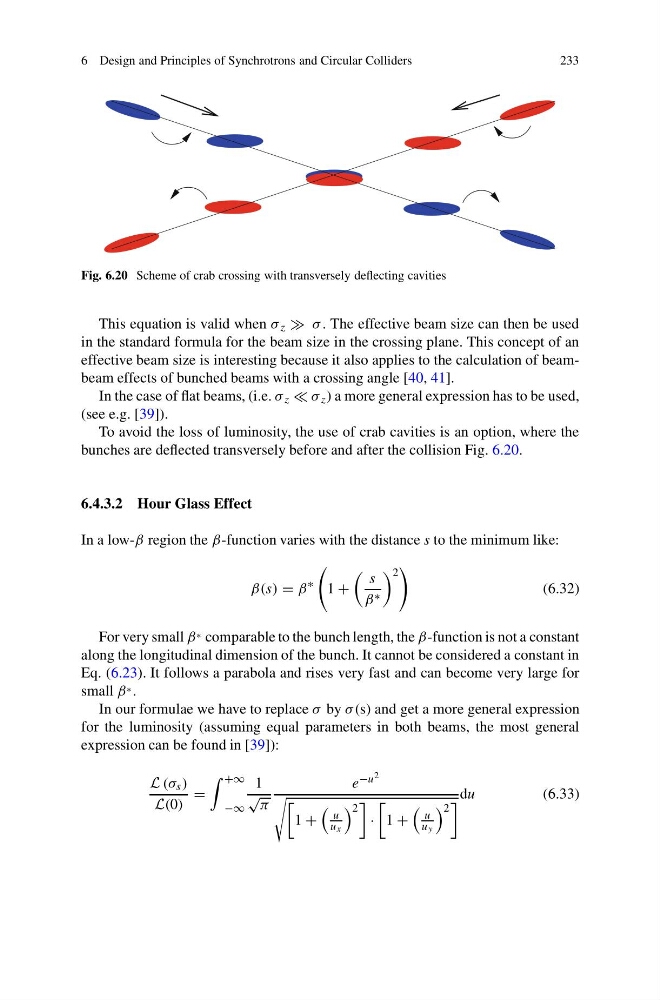
Fig. 6.20 Scheme of crab crossing with transversely deflecting cavities
This equation is valid when σ z σ . The effective beam size can then be used
in the standard formula for the beam size in the crossing plane. This concept of an
effective beam size is interesting because it also applies to the calculation of beambeam effects of bunched beams with a crossing angle [40, 41].
In the case of flat beams, (i.e. σ z σ z ) a more general expression has to be used,
(see e.g. [39]).
To avoid the loss of luminosity, the use of crab cavities is an option, where the
bunches are deflected transversely before and after the collision Fig. 6.20.
6.4.3.2 Hour Glass Effect
In a low-β region the β-function varies with the distance s to the minimum like:
β(s) = β
∗
1 +
s
β ∗
2
(6.32)
For very small β ∗ comparable to the bunch length, the β-function is not a constant
along the longitudinal dimension of the bunch. It cannot be considered a constant in
Eq. (6.23). It follows a parabola and rises very fast and can become very large for
small β ∗ .
In our formulae we have to replace σ by σ (s) and get a more general expression
for the luminosity (assuming equal parameters in both beams, the most general
expression can be found in [39]):
L (σ s )
L(0)
=
+∞
−∞
1
√
π
e −u 2
1 +
u
u x
2
·
1 +
u
u y
2
du
(6.33)
233
Fig. 6.20 Scheme of crab crossing with transversely deflecting cavities
This equation is valid when σ z σ . The effective beam size can then be used
in the standard formula for the beam size in the crossing plane. This concept of an
effective beam size is interesting because it also applies to the calculation of beambeam effects of bunched beams with a crossing angle [40, 41].
In the case of flat beams, (i.e. σ z σ z ) a more general expression has to be used,
(see e.g. [39]).
To avoid the loss of luminosity, the use of crab cavities is an option, where the
bunches are deflected transversely before and after the collision Fig. 6.20.
6.4.3.2 Hour Glass Effect
In a low-β region the β-function varies with the distance s to the minimum like:
β(s) = β
∗
1 +
s
β ∗
2
(6.32)
For very small β ∗ comparable to the bunch length, the β-function is not a constant
along the longitudinal dimension of the bunch. It cannot be considered a constant in
Eq. (6.23). It follows a parabola and rises very fast and can become very large for
small β ∗ .
In our formulae we have to replace σ by σ (s) and get a more general expression
for the luminosity (assuming equal parameters in both beams, the most general
expression can be found in [39]):
L (σ s )
L(0)
=
+∞
−∞
1
√
π
e −u 2
1 +
u
u x
2
·
1 +
u
u y
2
du
(6.33)