

234
B. J. Holzer et al.
Using the expressions: u x = β ∗
x /σ s and u y = β ∗
y /σ s
For the case of round beams it can be simplified and the integral becomes:
L (σ s )
L(0)
=
+∞
−∞
1
√
π
e −u 2
1 +
u
u x
2
du =
√
π · u x · e
u 2
x · erfc (u x )
(6.34)
Here erfc(u) is the complex error function. The hourglass effect depends strongly
on the relative value of β ∗ and the bunch length σ s . For small β ∗ the effect becomes
relevant since the beam size varies rapidly along the longitudinal bunch direction,
i.e. when s becomes comparable to the bunch length in Eq. (6.32). A loss of
luminosity according to Eq. (6.34) is the consequence.
6.4.3.3 Crabbed Waist Scheme
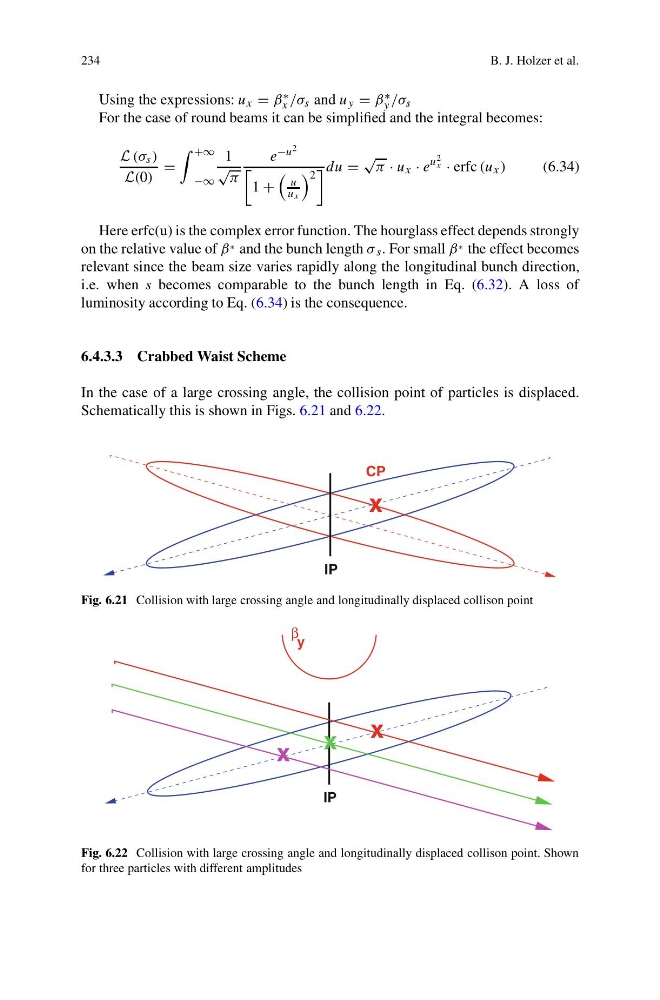
In the case of a large crossing angle, the collision point of particles is displaced.
Schematically this is shown in Figs. 6.21 and 6.22.
IP
CP
x
Fig. 6.21 Collision with large crossing angle and longitudinally displaced collison point
IP
x x
x
β
y
Fig. 6.22 Collision with large crossing angle and longitudinally displaced collison point. Shown
for three particles with different amplitudes
B. J. Holzer et al.
Using the expressions: u x = β ∗
x /σ s and u y = β ∗
y /σ s
For the case of round beams it can be simplified and the integral becomes:
L (σ s )
L(0)
=
+∞
−∞
1
√
π
e −u 2
1 +
u
u x
2
du =
√
π · u x · e
u 2
x · erfc (u x )
(6.34)
Here erfc(u) is the complex error function. The hourglass effect depends strongly
on the relative value of β ∗ and the bunch length σ s . For small β ∗ the effect becomes
relevant since the beam size varies rapidly along the longitudinal bunch direction,
i.e. when s becomes comparable to the bunch length in Eq. (6.32). A loss of
luminosity according to Eq. (6.34) is the consequence.
6.4.3.3 Crabbed Waist Scheme
In the case of a large crossing angle, the collision point of particles is displaced.
Schematically this is shown in Figs. 6.21 and 6.22.
IP
CP
x
Fig. 6.21 Collision with large crossing angle and longitudinally displaced collison point
IP
x x
x
β
y
Fig. 6.22 Collision with large crossing angle and longitudinally displaced collison point. Shown
for three particles with different amplitudes