

6 Design and Principles of Synchrotrons and Circular Colliders
225
field can be varied to achieve the desired phase space density distribution. This is
the process of phase space painting, where the small emittance LINAC beam is the
brush and the large acceptance of the receiving machine is the canvas.
In addition to beam loss from scattering at the foil, another significant source of
beam loss can be the field-stripping in the third chicane magnet of excited H 0 . In
ISIS [17] the injection is made on the ramp, and the dispersion at the foil provides
some of the transverse phase space painting. For SNS [18], where the average beam
power is over 1 MW, the uncontrolled beam losses must be kept extremely low and
the accumulation is made over 1160 turns.
The use of stripping foils is disadvantageous for several reasons, in particular
the associated uncontrolled beam losses, but also due to the simple mechanical
and radiological difficulties in handling such fragile objects. A foil-free method
of H − stripping using a high-powered laser to resonantly excite neutral H 0 before
field stripping in a dipole has been proposed and demonstrated in principle, and is
promising for very high energy H − injection systems [19].
6.3.4 Lepton Accumulation Injection
Injection of leptons can take advantage of the strong damping which is present
from synchrotron radiation to accumulate intensity. This is very commonly used
at Synchrotron Radiation rings, where top-up operation [20] consists of frequently
injecting small amounts of beam to replace beam losses and keep the beam and
synchrotron radiation intensities stable in a very small range.
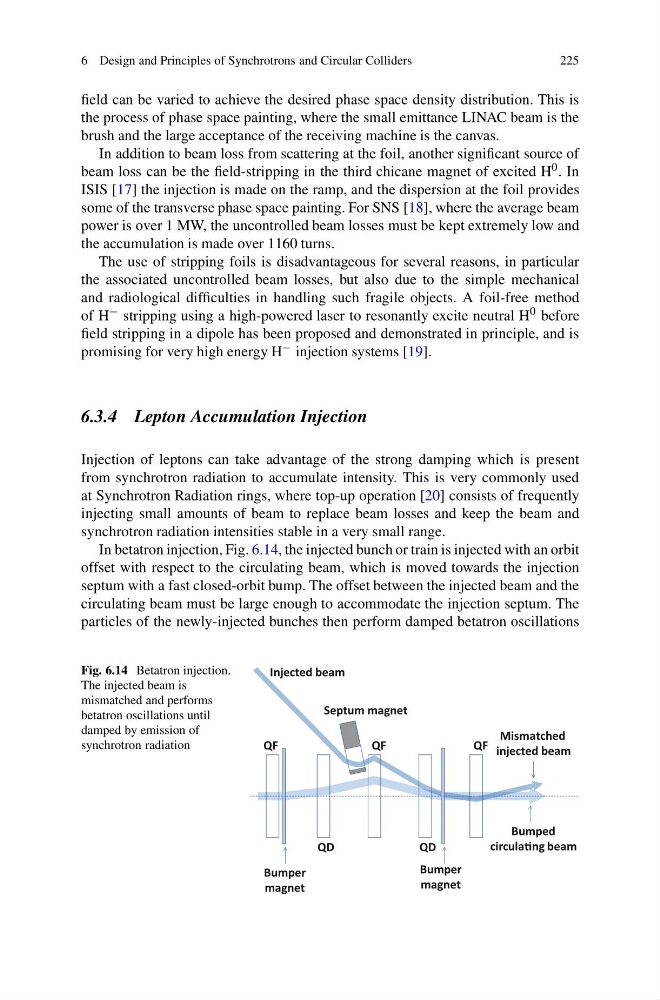
In betatron injection, Fig. 6.14, the injected bunch or train is injected with an orbit
offset with respect to the circulating beam, which is moved towards the injection
septum with a fast closed-orbit bump. The offset between the injected beam and the
circulating beam must be large enough to accommodate the injection septum. The
particles of the newly-injected bunches then perform damped betatron oscillations
Fig. 6.14 Betatron injection.
The injected beam is
mismatched and performs
betatron oscillations until
damped by emission of
synchrotron radiation
Injected beam
Bumper
magnet
Bumper
magnet
Septum magnet
QF
QD
QF
QD
QF
Bumped
circulaƟng beam
Mismatched
injected beam
225
field can be varied to achieve the desired phase space density distribution. This is
the process of phase space painting, where the small emittance LINAC beam is the
brush and the large acceptance of the receiving machine is the canvas.
In addition to beam loss from scattering at the foil, another significant source of
beam loss can be the field-stripping in the third chicane magnet of excited H 0 . In
ISIS [17] the injection is made on the ramp, and the dispersion at the foil provides
some of the transverse phase space painting. For SNS [18], where the average beam
power is over 1 MW, the uncontrolled beam losses must be kept extremely low and
the accumulation is made over 1160 turns.
The use of stripping foils is disadvantageous for several reasons, in particular
the associated uncontrolled beam losses, but also due to the simple mechanical
and radiological difficulties in handling such fragile objects. A foil-free method
of H − stripping using a high-powered laser to resonantly excite neutral H 0 before
field stripping in a dipole has been proposed and demonstrated in principle, and is
promising for very high energy H − injection systems [19].
6.3.4 Lepton Accumulation Injection
Injection of leptons can take advantage of the strong damping which is present
from synchrotron radiation to accumulate intensity. This is very commonly used
at Synchrotron Radiation rings, where top-up operation [20] consists of frequently
injecting small amounts of beam to replace beam losses and keep the beam and
synchrotron radiation intensities stable in a very small range.
In betatron injection, Fig. 6.14, the injected bunch or train is injected with an orbit
offset with respect to the circulating beam, which is moved towards the injection
septum with a fast closed-orbit bump. The offset between the injected beam and the
circulating beam must be large enough to accommodate the injection septum. The
particles of the newly-injected bunches then perform damped betatron oscillations
Fig. 6.14 Betatron injection.
The injected beam is
mismatched and performs
betatron oscillations until
damped by emission of
synchrotron radiation
Injected beam
Bumper
magnet
Bumper
magnet
Septum magnet
QF
QD
QF
QD
QF
Bumped
circulaƟng beam
Mismatched
injected beam