

226
B. J. Holzer et al.
Injected beam with
momentum offset
Bumper
magnet
Bumper
magnet
Septum magnet
QF
QD
QF
QD
QF
Bumped
circulaƟng beam
dx = Dx
δ δp
⋅ δp
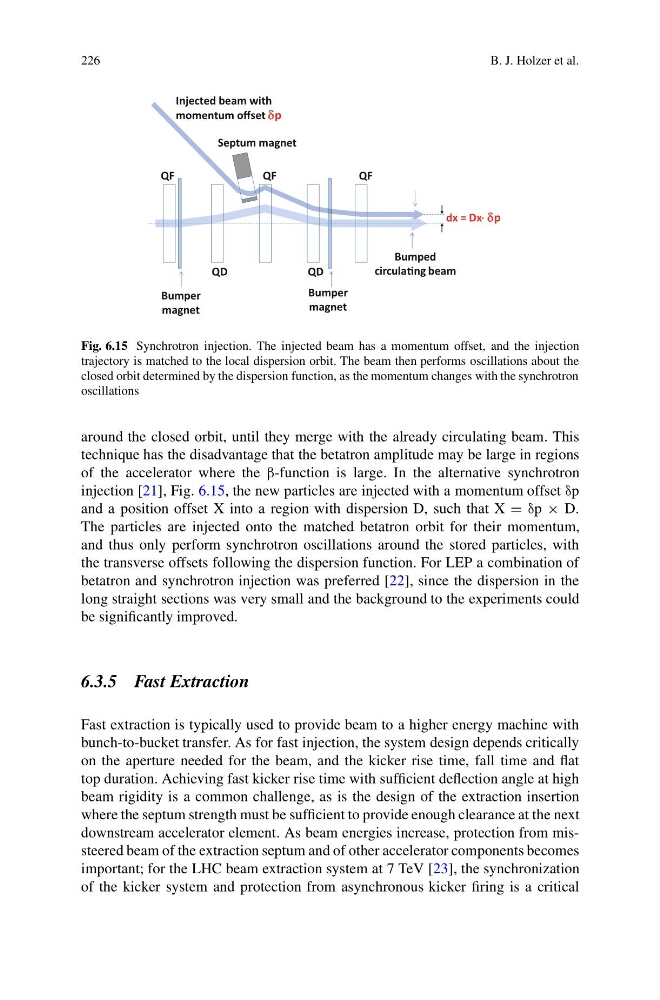
Fig. 6.15 Synchrotron injection. The injected beam has a momentum offset, and the injection
trajectory is matched to the local dispersion orbit. The beam then performs oscillations about the
closed orbit determined by the dispersion function, as the momentum changes with the synchrotron
oscillations
around the closed orbit, until they merge with the already circulating beam. This
technique has the disadvantage that the betatron amplitude may be large in regions
of the accelerator where the β-function is large. In the alternative synchrotron
injection [21], Fig. 6.15, the new particles are injected with a momentum offset δp
and a position offset X into a region with dispersion D, such that X = δp × D.
The particles are injected onto the matched betatron orbit for their momentum,
and thus only perform synchrotron oscillations around the stored particles, with
the transverse offsets following the dispersion function. For LEP a combination of
betatron and synchrotron injection was preferred [22], since the dispersion in the
long straight sections was very small and the background to the experiments could
be significantly improved.
6.3.5 Fast Extraction
Fast extraction is typically used to provide beam to a higher energy machine with
bunch-to-bucket transfer. As for fast injection, the system design depends critically
on the aperture needed for the beam, and the kicker rise time, fall time and flat
top duration. Achieving fast kicker rise time with sufficient deflection angle at high
beam rigidity is a common challenge, as is the design of the extraction insertion
where the septum strength must be sufficient to provide enough clearance at the next
downstream accelerator element. As beam energies increase, protection from missteered beam of the extraction septum and of other accelerator components becomes
important; for the LHC beam extraction system at 7 TeV [23], the synchronization
of the kicker system and protection from asynchronous kicker firing is a critical
B. J. Holzer et al.
Injected beam with
momentum offset
Bumper
magnet
Bumper
magnet
Septum magnet
QF
QD
QF
QD
QF
Bumped
circulaƟng beam
dx = Dx
δ δp
⋅ δp
Fig. 6.15 Synchrotron injection. The injected beam has a momentum offset, and the injection
trajectory is matched to the local dispersion orbit. The beam then performs oscillations about the
closed orbit determined by the dispersion function, as the momentum changes with the synchrotron
oscillations
around the closed orbit, until they merge with the already circulating beam. This
technique has the disadvantage that the betatron amplitude may be large in regions
of the accelerator where the β-function is large. In the alternative synchrotron
injection [21], Fig. 6.15, the new particles are injected with a momentum offset δp
and a position offset X into a region with dispersion D, such that X = δp × D.
The particles are injected onto the matched betatron orbit for their momentum,
and thus only perform synchrotron oscillations around the stored particles, with
the transverse offsets following the dispersion function. For LEP a combination of
betatron and synchrotron injection was preferred [22], since the dispersion in the
long straight sections was very small and the background to the experiments could
be significantly improved.
6.3.5 Fast Extraction
Fast extraction is typically used to provide beam to a higher energy machine with
bunch-to-bucket transfer. As for fast injection, the system design depends critically
on the aperture needed for the beam, and the kicker rise time, fall time and flat
top duration. Achieving fast kicker rise time with sufficient deflection angle at high
beam rigidity is a common challenge, as is the design of the extraction insertion
where the septum strength must be sufficient to provide enough clearance at the next
downstream accelerator element. As beam energies increase, protection from missteered beam of the extraction septum and of other accelerator components becomes
important; for the LHC beam extraction system at 7 TeV [23], the synchronization
of the kicker system and protection from asynchronous kicker firing is a critical