

218
B. J. Holzer et al.
of the optical parameters α(s), β(s) and D(s) we obtain a situation at the end of the
suppressor where we get D(s) = D’(s) = 0 and the values for α and β unchanged.
The boundary conditions after the suppressor section
D(s) = D
(s) = 0,
β x (s) = β x arc , α x (s) = α x arc ,
(6.15)
β y (s) = β y arc , α x (s) = α y arc ,
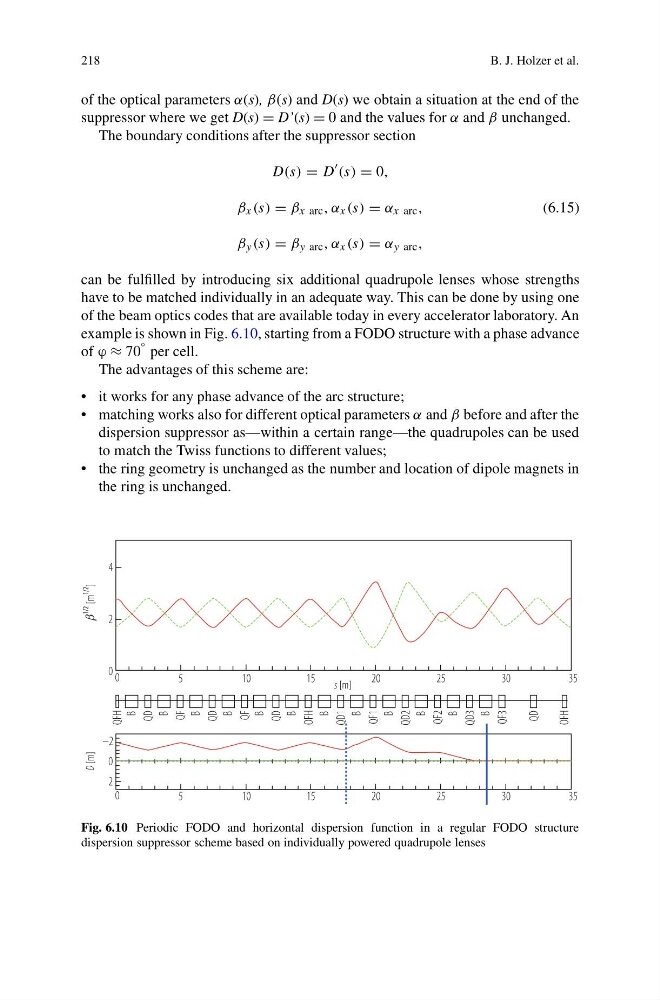
can be fulfilled by introducing six additional quadrupole lenses whose strengths
have to be matched individually in an adequate way. This can be done by using one
of the beam optics codes that are available today in every accelerator laboratory. An
example is shown in Fig. 6.10, starting from a FODO structure with a phase advance
of ϕ ≈ 70
◦ per cell.
The advantages of this scheme are:
• it works for any phase advance of the arc structure;
• matching works also for different optical parameters α and β before and after the
dispersion suppressor as—within a certain range—the quadrupoles can be used
to match the Twiss functions to different values;
• the ring geometry is unchanged as the number and location of dipole magnets in
the ring is unchanged.
Fig. 6.10 Periodic FODO and horizontal dispersion function in a regular FODO structure
dispersion suppressor scheme based on individually powered quadrupole lenses
B. J. Holzer et al.
of the optical parameters α(s), β(s) and D(s) we obtain a situation at the end of the
suppressor where we get D(s) = D’(s) = 0 and the values for α and β unchanged.
The boundary conditions after the suppressor section
D(s) = D
(s) = 0,
β x (s) = β x arc , α x (s) = α x arc ,
(6.15)
β y (s) = β y arc , α x (s) = α y arc ,
can be fulfilled by introducing six additional quadrupole lenses whose strengths
have to be matched individually in an adequate way. This can be done by using one
of the beam optics codes that are available today in every accelerator laboratory. An
example is shown in Fig. 6.10, starting from a FODO structure with a phase advance
of ϕ ≈ 70
◦ per cell.
The advantages of this scheme are:
• it works for any phase advance of the arc structure;
• matching works also for different optical parameters α and β before and after the
dispersion suppressor as—within a certain range—the quadrupoles can be used
to match the Twiss functions to different values;
• the ring geometry is unchanged as the number and location of dipole magnets in
the ring is unchanged.
Fig. 6.10 Periodic FODO and horizontal dispersion function in a regular FODO structure
dispersion suppressor scheme based on individually powered quadrupole lenses