

6 Design and Principles of Synchrotrons and Circular Colliders
219
On the other hand there are a number of disadvantages that have to be mentioned:
• as the strength of the additional quadrupole magnets have to be matched
individually the scheme needs additional power supplies and quadrupole magnet
types which can be an expensive requirement;
• the required quadrupole fields are in general stronger than in the arc;
• the β function reaches higher values (sometimes really high values) which leads
to higher beam sensitivity and larger aperture needs.
There are alternative ways to suppress the dispersion, which do not need
individually powered quadrupole lenses but instead change the strength of the dipole
magnets at the end of the arc structure.
6.2.3.2 The “Clever” Way: Half Bend Schemes
This dispersion suppressing scheme is made up of n additional FODO cells that are
added to the periodic arc structure but where the bending strength of the dipole
magnets is reduced. As before we split the lattice into three parts: the periodic
structure of the FODO cells in the arc, the lattice insertion where the dispersion
is suppressed, followed by a dispersion free section which can be another FODO
structure without bending magnets or a mini beta insertion.
Starting from the dispersion free straight section the basic idea of this scheme
is to create with a special arrangement of dipole magnets inside the dispersion
suppressor—exactly the dispersion that corresponds to the periodic solution of the
arc FODO cells. The solution will depend on the phase advance of the cells as well
as on the strength of the bending magnets inside the suppressor magnets.
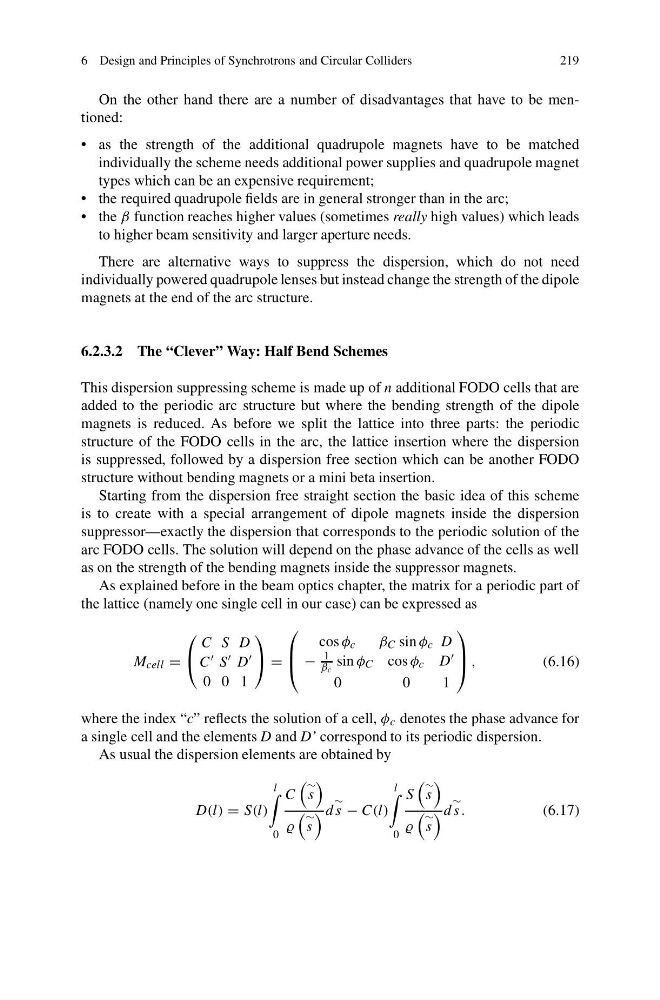
As explained before in the beam optics chapter, the matrix for a periodic part of
the lattice (namely one single cell in our case) can be expressed as
M cell =
⎛
⎝
C S D
C S D
0 0 1
⎞
⎠ =
⎛
⎜
⎝
cos φ c
β C sin φ c D
−
1
β c
sin φ C cos φ c D
0
0
1
⎞
⎟
⎠ ,
(6.16)
where the index “c” reflects the solution of a cell, φ c denotes the phase advance for
a single cell and the elements D and D’ correspond to its periodic dispersion.
As usual the dispersion elements are obtained by
D(l) = S(l)
l
0
C
∼
s
∼
s
d
∼
s − C(l)
l
0
S
∼
s
∼
s
d
∼
s .
(6.17)
219
On the other hand there are a number of disadvantages that have to be mentioned:
• as the strength of the additional quadrupole magnets have to be matched
individually the scheme needs additional power supplies and quadrupole magnet
types which can be an expensive requirement;
• the required quadrupole fields are in general stronger than in the arc;
• the β function reaches higher values (sometimes really high values) which leads
to higher beam sensitivity and larger aperture needs.
There are alternative ways to suppress the dispersion, which do not need
individually powered quadrupole lenses but instead change the strength of the dipole
magnets at the end of the arc structure.
6.2.3.2 The “Clever” Way: Half Bend Schemes
This dispersion suppressing scheme is made up of n additional FODO cells that are
added to the periodic arc structure but where the bending strength of the dipole
magnets is reduced. As before we split the lattice into three parts: the periodic
structure of the FODO cells in the arc, the lattice insertion where the dispersion
is suppressed, followed by a dispersion free section which can be another FODO
structure without bending magnets or a mini beta insertion.
Starting from the dispersion free straight section the basic idea of this scheme
is to create with a special arrangement of dipole magnets inside the dispersion
suppressor—exactly the dispersion that corresponds to the periodic solution of the
arc FODO cells. The solution will depend on the phase advance of the cells as well
as on the strength of the bending magnets inside the suppressor magnets.
As explained before in the beam optics chapter, the matrix for a periodic part of
the lattice (namely one single cell in our case) can be expressed as
M cell =
⎛
⎝
C S D
C S D
0 0 1
⎞
⎠ =
⎛
⎜
⎝
cos φ c
β C sin φ c D
−
1
β c
sin φ C cos φ c D
0
0
1
⎞
⎟
⎠ ,
(6.16)
where the index “c” reflects the solution of a cell, φ c denotes the phase advance for
a single cell and the elements D and D’ correspond to its periodic dispersion.
As usual the dispersion elements are obtained by
D(l) = S(l)
l
0
C
∼
s
∼
s
d
∼
s − C(l)
l
0
S
∼
s
∼
s
d
∼
s .
(6.17)