

6 Design and Principles of Synchrotrons and Circular Colliders
217
It has to be mentioned in this context that especially in the case of synchrotron
light sources a variety of lattice types has been developed with the goal to achieve
small or even zero dispersion in the ring or in parts of it. However, these lattices
are optimised for the purpose of high brilliant synchrotron radiation and are not
ideal for high-energy particle accelerators, where FODO cells are usually the most
appropriate choice.
Referring to high energy colliders we will concentrate therefore on the interaction
region, i.e. a straight section of a ring where two counter rotating beams collide
in a dispersion free part of the storage ring. A non-vanishing dispersion dilutes
the luminosity of the machine and leads to additional stop bands in the working
diagram of the accelerator (“synchro-betatron resonances”), that are driven by the
beam-beam interaction. Therefore sections are inserted in our magnet lattice that are
designed to reduce the function D(s) to zero. Three main techniques are widely used:
the quadrupole based dispersion suppressor, the missing bend scheme and the half
bend scheme. We will not present all of them in detail but instead restrict ourselves
to the basic idea behind it.
6.2.3.1 The “Straightforward” Way: Dispersion Suppression Using
Quadrupole Magnets
Let us assume here that a periodic lattice is given in the arc (see Fig. 6.2) and that
this FODO structure simply is continued through the straight section—but with
vanishing dispersion. Given an optical solution in the arc cells, as for example
shown in Fig. 6.9, we have to guarantee that starting from the periodic solution
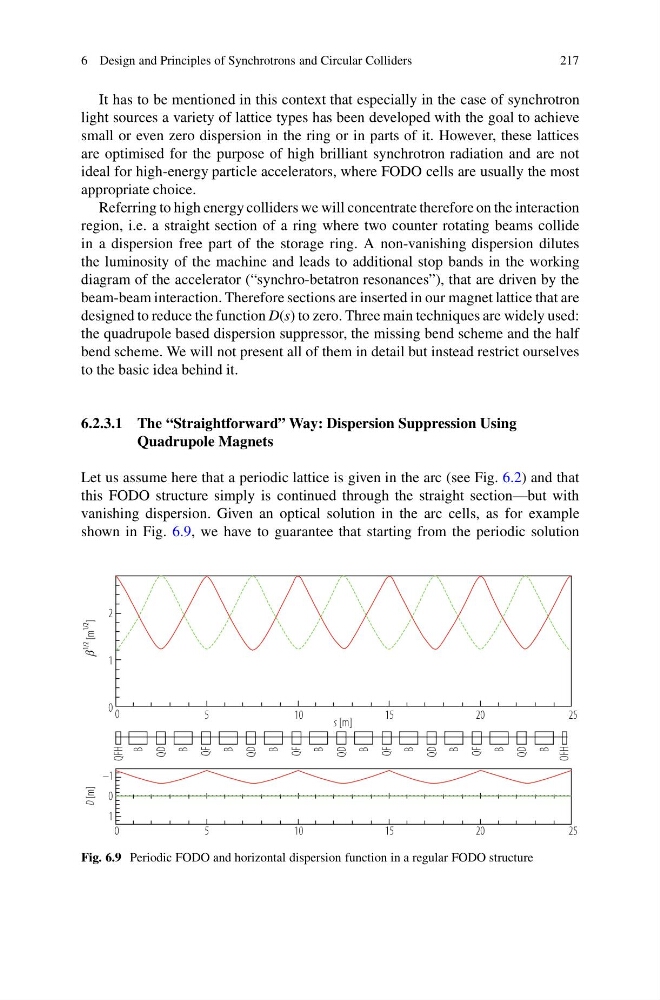
Fig. 6.9 Periodic FODO and horizontal dispersion function in a regular FODO structure
217
It has to be mentioned in this context that especially in the case of synchrotron
light sources a variety of lattice types has been developed with the goal to achieve
small or even zero dispersion in the ring or in parts of it. However, these lattices
are optimised for the purpose of high brilliant synchrotron radiation and are not
ideal for high-energy particle accelerators, where FODO cells are usually the most
appropriate choice.
Referring to high energy colliders we will concentrate therefore on the interaction
region, i.e. a straight section of a ring where two counter rotating beams collide
in a dispersion free part of the storage ring. A non-vanishing dispersion dilutes
the luminosity of the machine and leads to additional stop bands in the working
diagram of the accelerator (“synchro-betatron resonances”), that are driven by the
beam-beam interaction. Therefore sections are inserted in our magnet lattice that are
designed to reduce the function D(s) to zero. Three main techniques are widely used:
the quadrupole based dispersion suppressor, the missing bend scheme and the half
bend scheme. We will not present all of them in detail but instead restrict ourselves
to the basic idea behind it.
6.2.3.1 The “Straightforward” Way: Dispersion Suppression Using
Quadrupole Magnets
Let us assume here that a periodic lattice is given in the arc (see Fig. 6.2) and that
this FODO structure simply is continued through the straight section—but with
vanishing dispersion. Given an optical solution in the arc cells, as for example
shown in Fig. 6.9, we have to guarantee that starting from the periodic solution
Fig. 6.9 Periodic FODO and horizontal dispersion function in a regular FODO structure