

6 Design and Principles of Synchrotrons and Circular Colliders
215
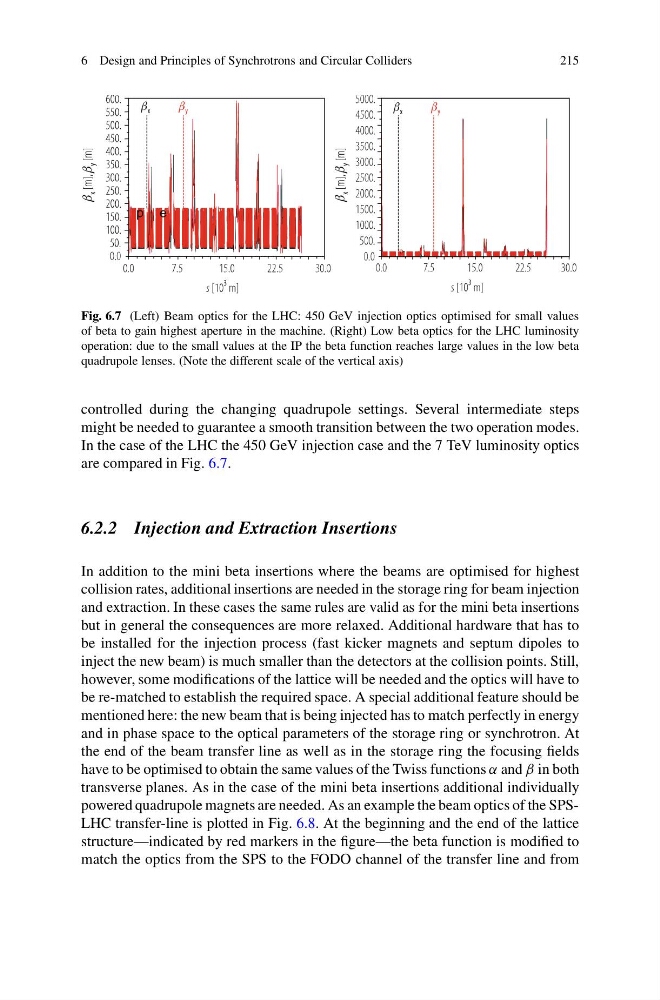
Fig. 6.7 (Left) Beam optics for the LHC: 450 GeV injection optics optimised for small values
of beta to gain highest aperture in the machine. (Right) Low beta optics for the LHC luminosity
operation: due to the small values at the IP the beta function reaches large values in the low beta
quadrupole lenses. (Note the different scale of the vertical axis)
controlled during the changing quadrupole settings. Several intermediate steps
might be needed to guarantee a smooth transition between the two operation modes.
In the case of the LHC the 450 GeV injection case and the 7 TeV luminosity optics
are compared in Fig. 6.7.
6.2.2 Injection and Extraction Insertions
In addition to the mini beta insertions where the beams are optimised for highest
collision rates, additional insertions are needed in the storage ring for beam injection
and extraction. In these cases the same rules are valid as for the mini beta insertions
but in general the consequences are more relaxed. Additional hardware that has to
be installed for the injection process (fast kicker magnets and septum dipoles to
inject the new beam) is much smaller than the detectors at the collision points. Still,
however, some modifications of the lattice will be needed and the optics will have to
be re-matched to establish the required space. A special additional feature should be
mentioned here: the new beam that is being injected has to match perfectly in energy
and in phase space to the optical parameters of the storage ring or synchrotron. At
the end of the beam transfer line as well as in the storage ring the focusing fields
have to be optimised to obtain the same values of the Twiss functions α and β in both
transverse planes. As in the case of the mini beta insertions additional individually
powered quadrupole magnets are needed. As an example the beam optics of the SPSLHC transfer-line is plotted in Fig. 6.8. At the beginning and the end of the lattice
structure—indicated by red markers in the figure—the beta function is modified to
match the optics from the SPS to the FODO channel of the transfer line and from
215
Fig. 6.7 (Left) Beam optics for the LHC: 450 GeV injection optics optimised for small values
of beta to gain highest aperture in the machine. (Right) Low beta optics for the LHC luminosity
operation: due to the small values at the IP the beta function reaches large values in the low beta
quadrupole lenses. (Note the different scale of the vertical axis)
controlled during the changing quadrupole settings. Several intermediate steps
might be needed to guarantee a smooth transition between the two operation modes.
In the case of the LHC the 450 GeV injection case and the 7 TeV luminosity optics
are compared in Fig. 6.7.
6.2.2 Injection and Extraction Insertions
In addition to the mini beta insertions where the beams are optimised for highest
collision rates, additional insertions are needed in the storage ring for beam injection
and extraction. In these cases the same rules are valid as for the mini beta insertions
but in general the consequences are more relaxed. Additional hardware that has to
be installed for the injection process (fast kicker magnets and septum dipoles to
inject the new beam) is much smaller than the detectors at the collision points. Still,
however, some modifications of the lattice will be needed and the optics will have to
be re-matched to establish the required space. A special additional feature should be
mentioned here: the new beam that is being injected has to match perfectly in energy
and in phase space to the optical parameters of the storage ring or synchrotron. At
the end of the beam transfer line as well as in the storage ring the focusing fields
have to be optimised to obtain the same values of the Twiss functions α and β in both
transverse planes. As in the case of the mini beta insertions additional individually
powered quadrupole magnets are needed. As an example the beam optics of the SPSLHC transfer-line is plotted in Fig. 6.8. At the beginning and the end of the lattice
structure—indicated by red markers in the figure—the beta function is modified to
match the optics from the SPS to the FODO channel of the transfer line and from