

214
B. J. Holzer et al.
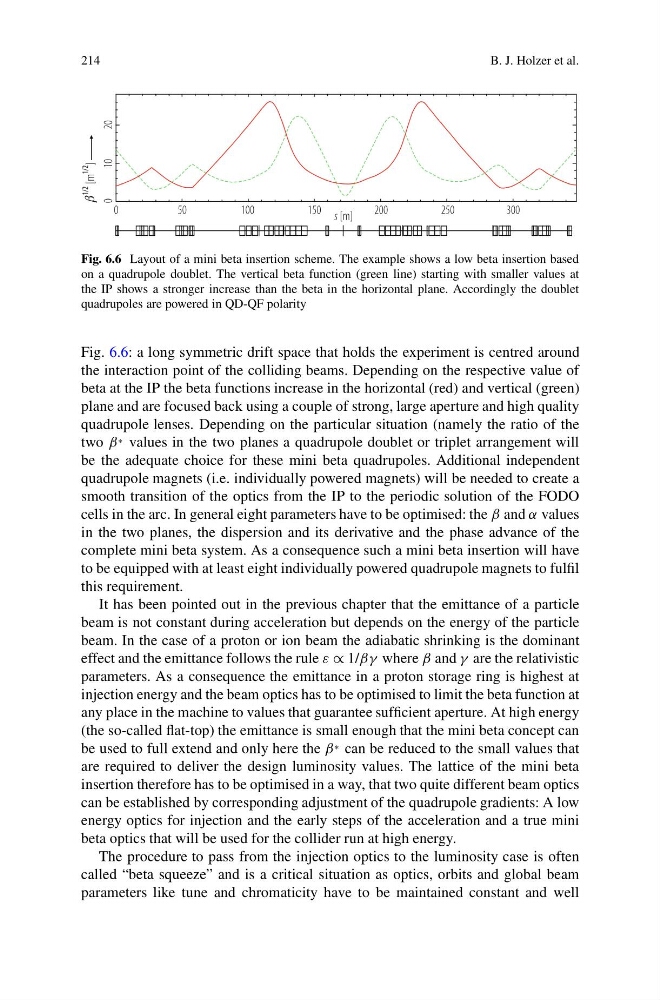
Fig. 6.6 Layout of a mini beta insertion scheme. The example shows a low beta insertion based
on a quadrupole doublet. The vertical beta function (green line) starting with smaller values at
the IP shows a stronger increase than the beta in the horizontal plane. Accordingly the doublet
quadrupoles are powered in QD-QF polarity
Fig. 6.6: a long symmetric drift space that holds the experiment is centred around
the interaction point of the colliding beams. Depending on the respective value of
beta at the IP the beta functions increase in the horizontal (red) and vertical (green)
plane and are focused back using a couple of strong, large aperture and high quality
quadrupole lenses. Depending on the particular situation (namely the ratio of the
two β ∗ values in the two planes a quadrupole doublet or triplet arrangement will
be the adequate choice for these mini beta quadrupoles. Additional independent
quadrupole magnets (i.e. individually powered magnets) will be needed to create a
smooth transition of the optics from the IP to the periodic solution of the FODO
cells in the arc. In general eight parameters have to be optimised: the β and α values
in the two planes, the dispersion and its derivative and the phase advance of the
complete mini beta system. As a consequence such a mini beta insertion will have
to be equipped with at least eight individually powered quadrupole magnets to fulfil
this requirement.
It has been pointed out in the previous chapter that the emittance of a particle
beam is not constant during acceleration but depends on the energy of the particle
beam. In the case of a proton or ion beam the adiabatic shrinking is the dominant
effect and the emittance follows the rule ε ∝ 1/βγ where β and γ are the relativistic
parameters. As a consequence the emittance in a proton storage ring is highest at
injection energy and the beam optics has to be optimised to limit the beta function at
any place in the machine to values that guarantee sufficient aperture. At high energy
(the so-called flat-top) the emittance is small enough that the mini beta concept can
be used to full extend and only here the β ∗ can be reduced to the small values that
are required to deliver the design luminosity values. The lattice of the mini beta
insertion therefore has to be optimised in a way, that two quite different beam optics
can be established by corresponding adjustment of the quadrupole gradients: A low
energy optics for injection and the early steps of the acceleration and a true mini
beta optics that will be used for the collider run at high energy.
The procedure to pass from the injection optics to the luminosity case is often
called “beta squeeze” and is a critical situation as optics, orbits and global beam
parameters like tune and chromaticity have to be maintained constant and well
B. J. Holzer et al.
Fig. 6.6 Layout of a mini beta insertion scheme. The example shows a low beta insertion based
on a quadrupole doublet. The vertical beta function (green line) starting with smaller values at
the IP shows a stronger increase than the beta in the horizontal plane. Accordingly the doublet
quadrupoles are powered in QD-QF polarity
Fig. 6.6: a long symmetric drift space that holds the experiment is centred around
the interaction point of the colliding beams. Depending on the respective value of
beta at the IP the beta functions increase in the horizontal (red) and vertical (green)
plane and are focused back using a couple of strong, large aperture and high quality
quadrupole lenses. Depending on the particular situation (namely the ratio of the
two β ∗ values in the two planes a quadrupole doublet or triplet arrangement will
be the adequate choice for these mini beta quadrupoles. Additional independent
quadrupole magnets (i.e. individually powered magnets) will be needed to create a
smooth transition of the optics from the IP to the periodic solution of the FODO
cells in the arc. In general eight parameters have to be optimised: the β and α values
in the two planes, the dispersion and its derivative and the phase advance of the
complete mini beta system. As a consequence such a mini beta insertion will have
to be equipped with at least eight individually powered quadrupole magnets to fulfil
this requirement.
It has been pointed out in the previous chapter that the emittance of a particle
beam is not constant during acceleration but depends on the energy of the particle
beam. In the case of a proton or ion beam the adiabatic shrinking is the dominant
effect and the emittance follows the rule ε ∝ 1/βγ where β and γ are the relativistic
parameters. As a consequence the emittance in a proton storage ring is highest at
injection energy and the beam optics has to be optimised to limit the beta function at
any place in the machine to values that guarantee sufficient aperture. At high energy
(the so-called flat-top) the emittance is small enough that the mini beta concept can
be used to full extend and only here the β ∗ can be reduced to the small values that
are required to deliver the design luminosity values. The lattice of the mini beta
insertion therefore has to be optimised in a way, that two quite different beam optics
can be established by corresponding adjustment of the quadrupole gradients: A low
energy optics for injection and the early steps of the acceleration and a true mini
beta optics that will be used for the collider run at high energy.
The procedure to pass from the injection optics to the luminosity case is often
called “beta squeeze” and is a critical situation as optics, orbits and global beam
parameters like tune and chromaticity have to be maintained constant and well