

6 Design and Principles of Synchrotrons and Circular Colliders
213
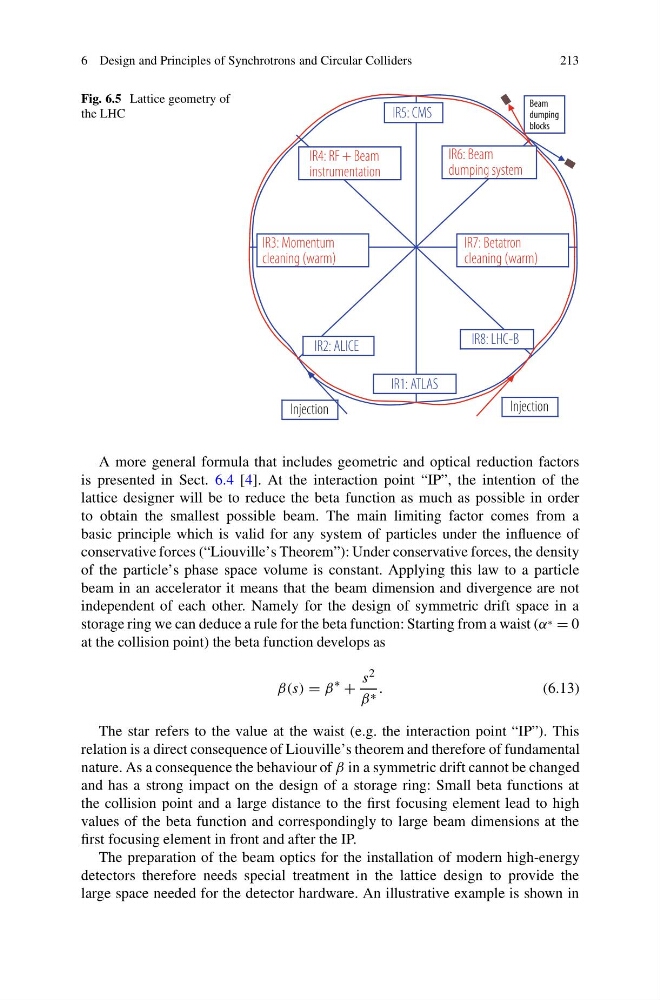
Fig. 6.5 Lattice geometry of
the LHC
A more general formula that includes geometric and optical reduction factors
is presented in Sect. 6.4 [4]. At the interaction point “IP”, the intention of the
lattice designer will be to reduce the beta function as much as possible in order
to obtain the smallest possible beam. The main limiting factor comes from a
basic principle which is valid for any system of particles under the influence of
conservative forces (“Liouville’s Theorem”): Under conservative forces, the density
of the particle’s phase space volume is constant. Applying this law to a particle
beam in an accelerator it means that the beam dimension and divergence are not
independent of each other. Namely for the design of symmetric drift space in a
storage ring we can deduce a rule for the beta function: Starting from a waist (α ∗ = 0
at the collision point) the beta function develops as
β(s) = β
∗
+
s 2
β ∗ .
(6.13)
The star refers to the value at the waist (e.g. the interaction point “IP”). This
relation is a direct consequence of Liouville’s theorem and therefore of fundamental
nature. As a consequence the behaviour of β in a symmetric drift cannot be changed
and has a strong impact on the design of a storage ring: Small beta functions at
the collision point and a large distance to the first focusing element lead to high
values of the beta function and correspondingly to large beam dimensions at the
first focusing element in front and after the IP.
The preparation of the beam optics for the installation of modern high-energy
detectors therefore needs special treatment in the lattice design to provide the
large space needed for the detector hardware. An illustrative example is shown in
213
Fig. 6.5 Lattice geometry of
the LHC
A more general formula that includes geometric and optical reduction factors
is presented in Sect. 6.4 [4]. At the interaction point “IP”, the intention of the
lattice designer will be to reduce the beta function as much as possible in order
to obtain the smallest possible beam. The main limiting factor comes from a
basic principle which is valid for any system of particles under the influence of
conservative forces (“Liouville’s Theorem”): Under conservative forces, the density
of the particle’s phase space volume is constant. Applying this law to a particle
beam in an accelerator it means that the beam dimension and divergence are not
independent of each other. Namely for the design of symmetric drift space in a
storage ring we can deduce a rule for the beta function: Starting from a waist (α ∗ = 0
at the collision point) the beta function develops as
β(s) = β
∗
+
s 2
β ∗ .
(6.13)
The star refers to the value at the waist (e.g. the interaction point “IP”). This
relation is a direct consequence of Liouville’s theorem and therefore of fundamental
nature. As a consequence the behaviour of β in a symmetric drift cannot be changed
and has a strong impact on the design of a storage ring: Small beta functions at
the collision point and a large distance to the first focusing element lead to high
values of the beta function and correspondingly to large beam dimensions at the
first focusing element in front and after the IP.
The preparation of the beam optics for the installation of modern high-energy
detectors therefore needs special treatment in the lattice design to provide the
large space needed for the detector hardware. An illustrative example is shown in