

212
B. J. Holzer et al.
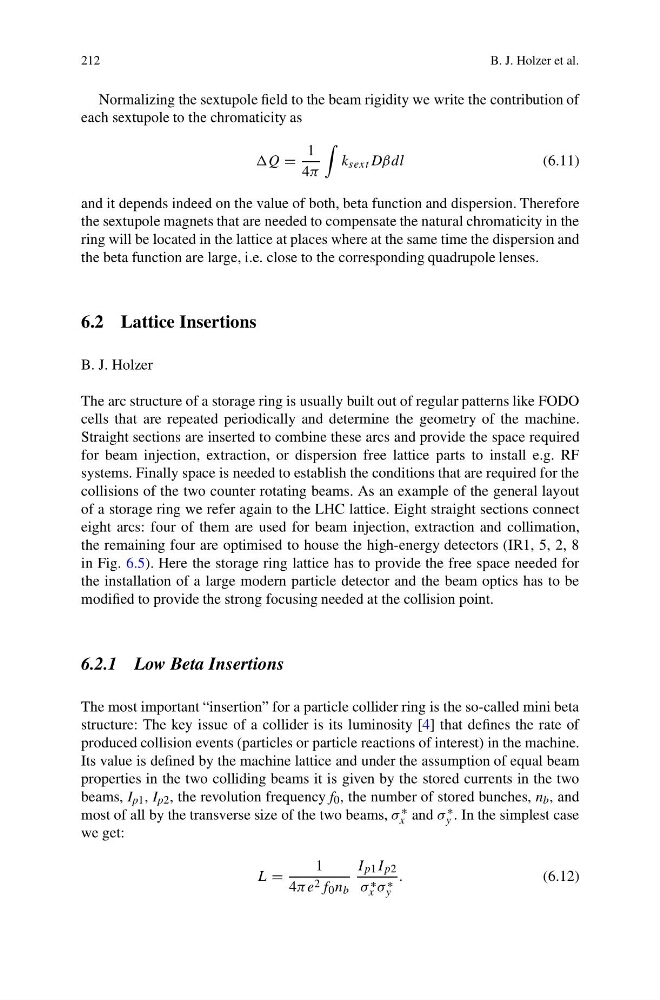
Normalizing the sextupole field to the beam rigidity we write the contribution of
each sextupole to the chromaticity as
=
1
4π
k sext Dβdl
(6.11)
and it depends indeed on the value of both, beta function and dispersion. Therefore
the sextupole magnets that are needed to compensate the natural chromaticity in the
ring will be located in the lattice at places where at the same time the dispersion and
the beta function are large, i.e. close to the corresponding quadrupole lenses.
6.2 Lattice Insertions
B. J. Holzer
The arc structure of a storage ring is usually built out of regular patterns like FODO
cells that are repeated periodically and determine the geometry of the machine.
Straight sections are inserted to combine these arcs and provide the space required
for beam injection, extraction, or dispersion free lattice parts to install e.g. RF
systems. Finally space is needed to establish the conditions that are required for the
collisions of the two counter rotating beams. As an example of the general layout
of a storage ring we refer again to the LHC lattice. Eight straight sections connect
eight arcs: four of them are used for beam injection, extraction and collimation,
the remaining four are optimised to house the high-energy detectors (IR1, 5, 2, 8
in Fig. 6.5). Here the storage ring lattice has to provide the free space needed for
the installation of a large modern particle detector and the beam optics has to be
modified to provide the strong focusing needed at the collision point.
6.2.1 Low Beta Insertions
The most important “insertion” for a particle collider ring is the so-called mini beta
structure: The key issue of a collider is its luminosity [4] that defines the rate of
produced collision events (particles or particle reactions of interest) in the machine.
Its value is defined by the machine lattice and under the assumption of equal beam
properties in the two colliding beams it is given by the stored currents in the two
beams, I p1 , I p2 , the revolution frequency f 0 , the number of stored bunches, n b , and
most of all by the transverse size of the two beams, σ ∗
x and σ ∗
y . In the simplest case
we get:
L =
1
4πe 2 f 0 n b
I p1 I p2
σ ∗
x σ ∗
y
.
(6.12)
B. J. Holzer et al.
Normalizing the sextupole field to the beam rigidity we write the contribution of
each sextupole to the chromaticity as
=
1
4π
k sext Dβdl
(6.11)
and it depends indeed on the value of both, beta function and dispersion. Therefore
the sextupole magnets that are needed to compensate the natural chromaticity in the
ring will be located in the lattice at places where at the same time the dispersion and
the beta function are large, i.e. close to the corresponding quadrupole lenses.
6.2 Lattice Insertions
B. J. Holzer
The arc structure of a storage ring is usually built out of regular patterns like FODO
cells that are repeated periodically and determine the geometry of the machine.
Straight sections are inserted to combine these arcs and provide the space required
for beam injection, extraction, or dispersion free lattice parts to install e.g. RF
systems. Finally space is needed to establish the conditions that are required for the
collisions of the two counter rotating beams. As an example of the general layout
of a storage ring we refer again to the LHC lattice. Eight straight sections connect
eight arcs: four of them are used for beam injection, extraction and collimation,
the remaining four are optimised to house the high-energy detectors (IR1, 5, 2, 8
in Fig. 6.5). Here the storage ring lattice has to provide the free space needed for
the installation of a large modern particle detector and the beam optics has to be
modified to provide the strong focusing needed at the collision point.
6.2.1 Low Beta Insertions
The most important “insertion” for a particle collider ring is the so-called mini beta
structure: The key issue of a collider is its luminosity [4] that defines the rate of
produced collision events (particles or particle reactions of interest) in the machine.
Its value is defined by the machine lattice and under the assumption of equal beam
properties in the two colliding beams it is given by the stored currents in the two
beams, I p1 , I p2 , the revolution frequency f 0 , the number of stored bunches, n b , and
most of all by the transverse size of the two beams, σ ∗
x and σ ∗
y . In the simplest case
we get:
L =
1
4πe 2 f 0 n b
I p1 I p2
σ ∗
x σ ∗
y
.
(6.12)