

6 Design and Principles of Synchrotrons and Circular Colliders
211
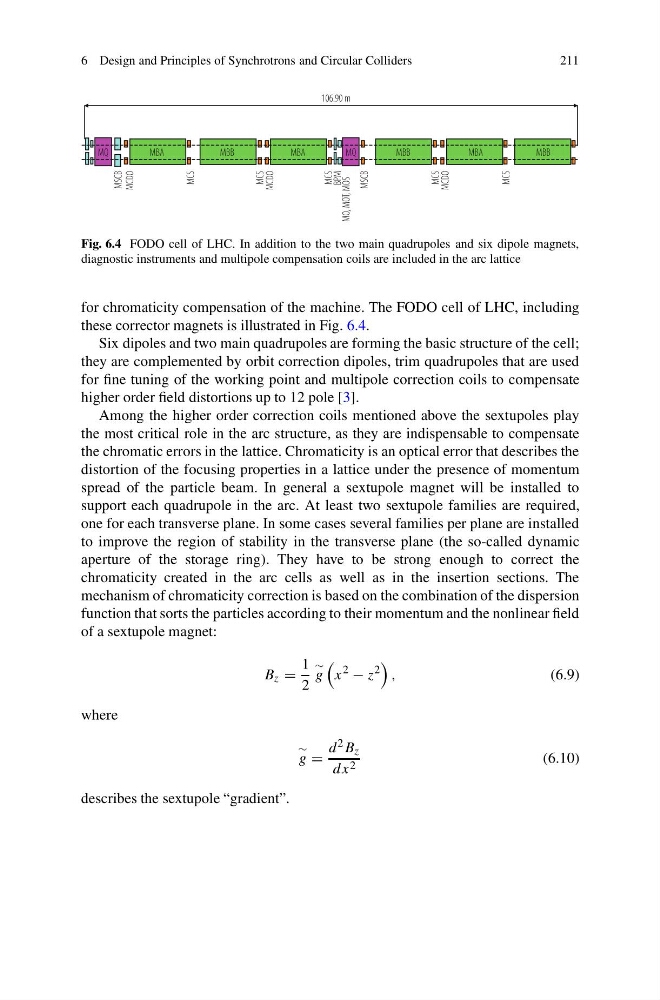
Fig. 6.4 FODO cell of LHC. In addition to the two main quadrupoles and six dipole magnets,
diagnostic instruments and multipole compensation coils are included in the arc lattice
for chromaticity compensation of the machine. The FODO cell of LHC, including
these corrector magnets is illustrated in Fig. 6.4.
Six dipoles and two main quadrupoles are forming the basic structure of the cell;
they are complemented by orbit correction dipoles, trim quadrupoles that are used
for fine tuning of the working point and multipole correction coils to compensate
higher order field distortions up to 12 pole [3].
Among the higher order correction coils mentioned above the sextupoles play
the most critical role in the arc structure, as they are indispensable to compensate
the chromatic errors in the lattice. Chromaticity is an optical error that describes the
distortion of the focusing properties in a lattice under the presence of momentum
spread of the particle beam. In general a sextupole magnet will be installed to
support each quadrupole in the arc. At least two sextupole families are required,
one for each transverse plane. In some cases several families per plane are installed
to improve the region of stability in the transverse plane (the so-called dynamic
aperture of the storage ring). They have to be strong enough to correct the
chromaticity created in the arc cells as well as in the insertion sections. The
mechanism of chromaticity correction is based on the combination of the dispersion
function that sorts the particles according to their momentum and the nonlinear field
of a sextupole magnet:
B z =
1
2
∼
g
x
2
− z
2
,
(6.9)
where
∼
g =
d 2 B z
dx 2
(6.10)
describes the sextupole “gradient”.
211
Fig. 6.4 FODO cell of LHC. In addition to the two main quadrupoles and six dipole magnets,
diagnostic instruments and multipole compensation coils are included in the arc lattice
for chromaticity compensation of the machine. The FODO cell of LHC, including
these corrector magnets is illustrated in Fig. 6.4.
Six dipoles and two main quadrupoles are forming the basic structure of the cell;
they are complemented by orbit correction dipoles, trim quadrupoles that are used
for fine tuning of the working point and multipole correction coils to compensate
higher order field distortions up to 12 pole [3].
Among the higher order correction coils mentioned above the sextupoles play
the most critical role in the arc structure, as they are indispensable to compensate
the chromatic errors in the lattice. Chromaticity is an optical error that describes the
distortion of the focusing properties in a lattice under the presence of momentum
spread of the particle beam. In general a sextupole magnet will be installed to
support each quadrupole in the arc. At least two sextupole families are required,
one for each transverse plane. In some cases several families per plane are installed
to improve the region of stability in the transverse plane (the so-called dynamic
aperture of the storage ring). They have to be strong enough to correct the
chromaticity created in the arc cells as well as in the insertion sections. The
mechanism of chromaticity correction is based on the combination of the dispersion
function that sorts the particles according to their momentum and the nonlinear field
of a sextupole magnet:
B z =
1
2
∼
g
x
2
− z
2
,
(6.9)
where
∼
g =
d 2 B z
dx 2
(6.10)
describes the sextupole “gradient”.