

210
B. J. Holzer et al.
In the following we briefly summarise these rules.
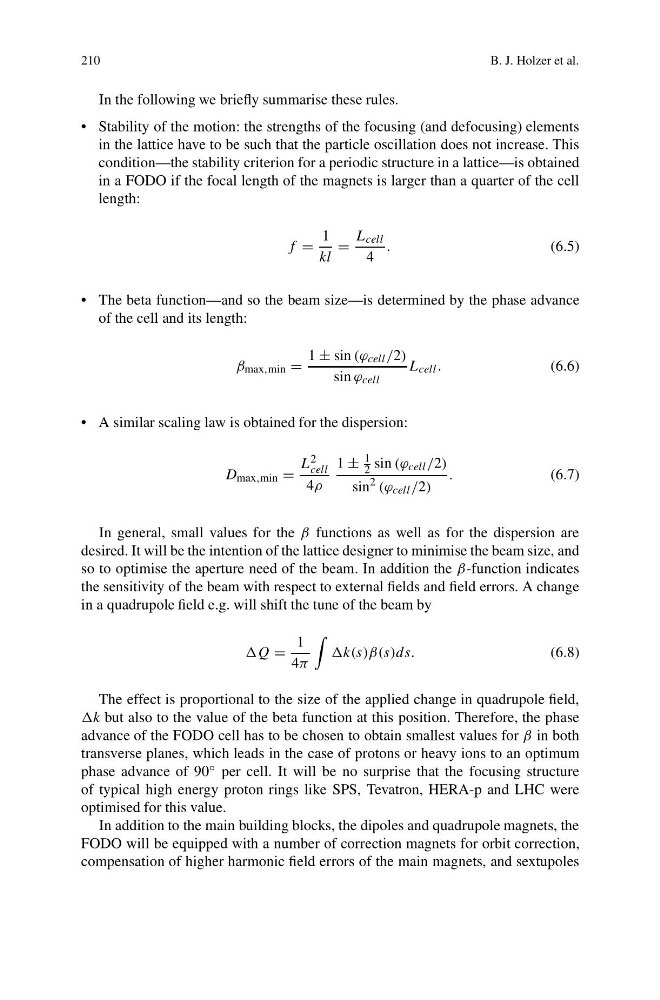
• Stability of the motion: the strengths of the focusing (and defocusing) elements
in the lattice have to be such that the particle oscillation does not increase. This
condition—the stability criterion for a periodic structure in a lattice—is obtained
in a FODO if the focal length of the magnets is larger than a quarter of the cell
length:
f =
1
kl
=
L cell
4
.
(6.5)
• The beta function—and so the beam size—is determined by the phase advance
of the cell and its length:
β max,min =
1 ± sin (ϕ cell /2)
sin ϕ cell
L cell .
(6.6)
• A similar scaling law is obtained for the dispersion:
D max,min =
L 2
cell
4ρ
1 ±
1
2 sin (ϕ cell /2)
sin
2 (ϕ cell /2)
.
(6.7)
In general, small values for the β functions as well as for the dispersion are
desired. It will be the intention of the lattice designer to minimise the beam size, and
so to optimise the aperture need of the beam. In addition the β-function indicates
the sensitivity of the beam with respect to external fields and field errors. A change
in a quadrupole field e.g. will shift the tune of the beam by
=
1
4π
k(s)β(s)ds.
(6.8)
The effect is proportional to the size of the applied change in quadrupole field,
but also to the value of the beta function at this position. Therefore, the phase
advance of the FODO cell has to be chosen to obtain smallest values for β in both
transverse planes, which leads in the case of protons or heavy ions to an optimum
phase advance of 90 ◦ per cell. It will be no surprise that the focusing structure
of typical high energy proton rings like SPS, Tevatron, HERA-p and LHC were
optimised for this value.
In addition to the main building blocks, the dipoles and quadrupole magnets, the
FODO will be equipped with a number of correction magnets for orbit correction,
compensation of higher harmonic field errors of the main magnets, and sextupoles
B. J. Holzer et al.
In the following we briefly summarise these rules.
• Stability of the motion: the strengths of the focusing (and defocusing) elements
in the lattice have to be such that the particle oscillation does not increase. This
condition—the stability criterion for a periodic structure in a lattice—is obtained
in a FODO if the focal length of the magnets is larger than a quarter of the cell
length:
f =
1
kl
=
L cell
4
.
(6.5)
• The beta function—and so the beam size—is determined by the phase advance
of the cell and its length:
β max,min =
1 ± sin (ϕ cell /2)
sin ϕ cell
L cell .
(6.6)
• A similar scaling law is obtained for the dispersion:
D max,min =
L 2
cell
4ρ
1 ±
1
2 sin (ϕ cell /2)
sin
2 (ϕ cell /2)
.
(6.7)
In general, small values for the β functions as well as for the dispersion are
desired. It will be the intention of the lattice designer to minimise the beam size, and
so to optimise the aperture need of the beam. In addition the β-function indicates
the sensitivity of the beam with respect to external fields and field errors. A change
in a quadrupole field e.g. will shift the tune of the beam by
=
1
4π
k(s)β(s)ds.
(6.8)
The effect is proportional to the size of the applied change in quadrupole field,
but also to the value of the beta function at this position. Therefore, the phase
advance of the FODO cell has to be chosen to obtain smallest values for β in both
transverse planes, which leads in the case of protons or heavy ions to an optimum
phase advance of 90 ◦ per cell. It will be no surprise that the focusing structure
of typical high energy proton rings like SPS, Tevatron, HERA-p and LHC were
optimised for this value.
In addition to the main building blocks, the dipoles and quadrupole magnets, the
FODO will be equipped with a number of correction magnets for orbit correction,
compensation of higher harmonic field errors of the main magnets, and sextupoles