

5 Interactions of Beams with Surroundings
201
ES.QS7
quadrupoles
horizontal
50
100
50
100
vertical
[mm]
[mm]
COLH.QS10
COLH.QS6
COLH.QS1
COLV.QS5
IP
full bend
radiation
radiation
weak bend
[m]
0
100
200
10
8
3
5
QS
11
9
6
4
1 2
0
7
COLZ.QS4
ES.QS4
COLV.QS1
COLZ.QS2
ES.QS2
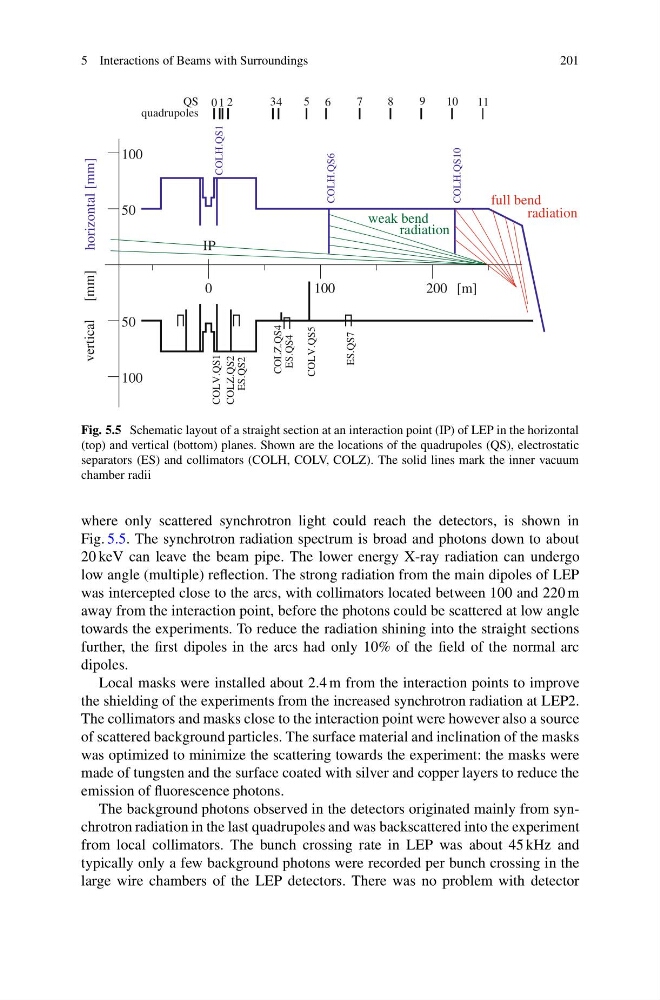
Fig. 5.5 Schematic layout of a straight section at an interaction point (IP) of LEP in the horizontal
(top) and vertical (bottom) planes. Shown are the locations of the quadrupoles (QS), electrostatic
separators (ES) and collimators (COLH, COLV, COLZ). The solid lines mark the inner vacuum
chamber radii
where only scattered synchrotron light could reach the detectors, is shown in
Fig. 5.5. The synchrotron radiation spectrum is broad and photons down to about
20 keV can leave the beam pipe. The lower energy X-ray radiation can undergo
low angle (multiple) reflection. The strong radiation from the main dipoles of LEP
was intercepted close to the arcs, with collimators located between 100 and 220 m
away from the interaction point, before the photons could be scattered at low angle
towards the experiments. To reduce the radiation shining into the straight sections
further, the first dipoles in the arcs had only 10% of the field of the normal arc
dipoles.
Local masks were installed about 2.4 m from the interaction points to improve
the shielding of the experiments from the increased synchrotron radiation at LEP2.
The collimators and masks close to the interaction point were however also a source
of scattered background particles. The surface material and inclination of the masks
was optimized to minimize the scattering towards the experiment: the masks were
made of tungsten and the surface coated with silver and copper layers to reduce the
emission of fluorescence photons.
The background photons observed in the detectors originated mainly from synchrotron radiation in the last quadrupoles and was backscattered into the experiment
from local collimators. The bunch crossing rate in LEP was about 45 kHz and
typically only a few background photons were recorded per bunch crossing in the
large wire chambers of the LEP detectors. There was no problem with detector
201
ES.QS7
quadrupoles
horizontal
50
100
50
100
vertical
[mm]
[mm]
COLH.QS10
COLH.QS6
COLH.QS1
COLV.QS5
IP
full bend
radiation
radiation
weak bend
[m]
0
100
200
10
8
3
5
QS
11
9
6
4
1 2
0
7
COLZ.QS4
ES.QS4
COLV.QS1
COLZ.QS2
ES.QS2
Fig. 5.5 Schematic layout of a straight section at an interaction point (IP) of LEP in the horizontal
(top) and vertical (bottom) planes. Shown are the locations of the quadrupoles (QS), electrostatic
separators (ES) and collimators (COLH, COLV, COLZ). The solid lines mark the inner vacuum
chamber radii
where only scattered synchrotron light could reach the detectors, is shown in
Fig. 5.5. The synchrotron radiation spectrum is broad and photons down to about
20 keV can leave the beam pipe. The lower energy X-ray radiation can undergo
low angle (multiple) reflection. The strong radiation from the main dipoles of LEP
was intercepted close to the arcs, with collimators located between 100 and 220 m
away from the interaction point, before the photons could be scattered at low angle
towards the experiments. To reduce the radiation shining into the straight sections
further, the first dipoles in the arcs had only 10% of the field of the normal arc
dipoles.
Local masks were installed about 2.4 m from the interaction points to improve
the shielding of the experiments from the increased synchrotron radiation at LEP2.
The collimators and masks close to the interaction point were however also a source
of scattered background particles. The surface material and inclination of the masks
was optimized to minimize the scattering towards the experiment: the masks were
made of tungsten and the surface coated with silver and copper layers to reduce the
emission of fluorescence photons.
The background photons observed in the detectors originated mainly from synchrotron radiation in the last quadrupoles and was backscattered into the experiment
from local collimators. The bunch crossing rate in LEP was about 45 kHz and
typically only a few background photons were recorded per bunch crossing in the
large wire chambers of the LEP detectors. There was no problem with detector