

200
M. Brugger et al.
Half of the power is radiated below the critical photon energy.
Quadrupoles can be considered as bending magnets which increase in strength
with the distance from the magnet axis. The equations given above also hold for
quadrupoles for Gaussian beams if we take as ρ the bending radius of the quadrupole
at 1σ offset from the beam axis [19]. The normalised quadrupole power spectrum is
s q (k) =
9
√
3
8π
k
∞
0
1 − erf(k/
√
2s)
K 5/3 (s) ds , k =
E
E cr,1σ
,
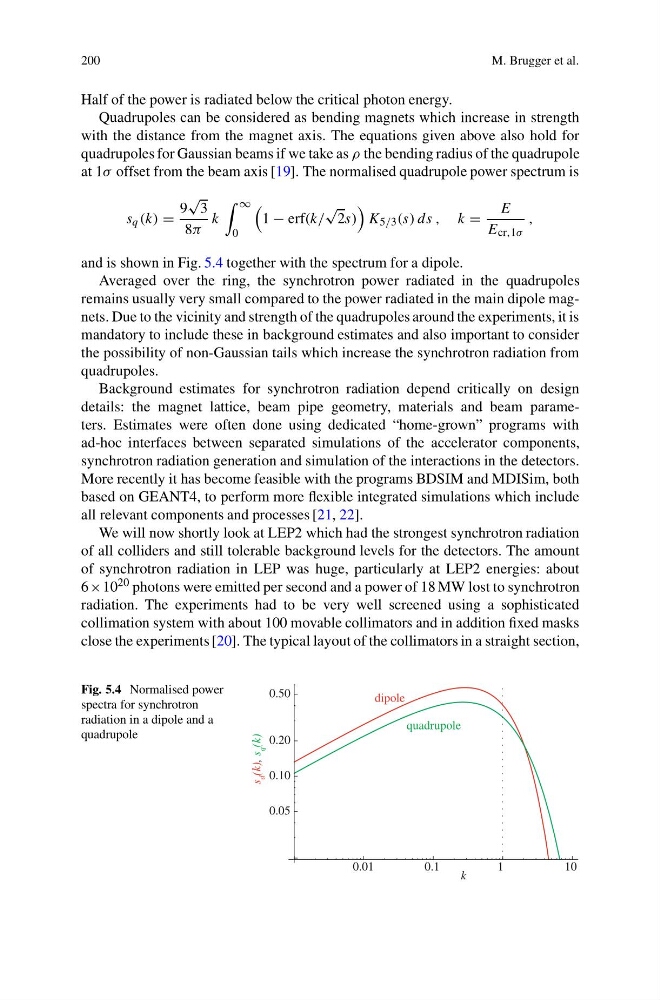
and is shown in Fig. 5.4 together with the spectrum for a dipole.
Averaged over the ring, the synchrotron power radiated in the quadrupoles
remains usually very small compared to the power radiated in the main dipole magnets. Due to the vicinity and strength of the quadrupoles around the experiments, it is
mandatory to include these in background estimates and also important to consider
the possibility of non-Gaussian tails which increase the synchrotron radiation from
quadrupoles.
Background estimates for synchrotron radiation depend critically on design
details: the magnet lattice, beam pipe geometry, materials and beam parameters. Estimates were often done using dedicated “home-grown” programs with
ad-hoc interfaces between separated simulations of the accelerator components,
synchrotron radiation generation and simulation of the interactions in the detectors.
More recently it has become feasible with the programs BDSIM and MDISim, both
based on GEANT4, to perform more flexible integrated simulations which include
all relevant components and processes [21, 22].
We will now shortly look at LEP2 which had the strongest synchrotron radiation
of all colliders and still tolerable background levels for the detectors. The amount
of synchrotron radiation in LEP was huge, particularly at LEP2 energies: about
6×10 20 photons were emitted per second and a power of 18 MW lost to synchrotron
radiation. The experiments had to be very well screened using a sophisticated
collimation system with about 100 movable collimators and in addition fixed masks
close the experiments [20]. The typical layout of the collimators in a straight section,
Fig. 5.4 Normalised power
spectra for synchrotron
radiation in a dipole and a
quadrupole
0.01
0.1
1
10
0.05
0.10
0.20
0.50
dipole
quadrupole
s
d
(k),
s
q
(k)
k
M. Brugger et al.
Half of the power is radiated below the critical photon energy.
Quadrupoles can be considered as bending magnets which increase in strength
with the distance from the magnet axis. The equations given above also hold for
quadrupoles for Gaussian beams if we take as ρ the bending radius of the quadrupole
at 1σ offset from the beam axis [19]. The normalised quadrupole power spectrum is
s q (k) =
9
√
3
8π
k
∞
0
1 − erf(k/
√
2s)
K 5/3 (s) ds , k =
E
E cr,1σ
,
and is shown in Fig. 5.4 together with the spectrum for a dipole.
Averaged over the ring, the synchrotron power radiated in the quadrupoles
remains usually very small compared to the power radiated in the main dipole magnets. Due to the vicinity and strength of the quadrupoles around the experiments, it is
mandatory to include these in background estimates and also important to consider
the possibility of non-Gaussian tails which increase the synchrotron radiation from
quadrupoles.
Background estimates for synchrotron radiation depend critically on design
details: the magnet lattice, beam pipe geometry, materials and beam parameters. Estimates were often done using dedicated “home-grown” programs with
ad-hoc interfaces between separated simulations of the accelerator components,
synchrotron radiation generation and simulation of the interactions in the detectors.
More recently it has become feasible with the programs BDSIM and MDISim, both
based on GEANT4, to perform more flexible integrated simulations which include
all relevant components and processes [21, 22].
We will now shortly look at LEP2 which had the strongest synchrotron radiation
of all colliders and still tolerable background levels for the detectors. The amount
of synchrotron radiation in LEP was huge, particularly at LEP2 energies: about
6×10 20 photons were emitted per second and a power of 18 MW lost to synchrotron
radiation. The experiments had to be very well screened using a sophisticated
collimation system with about 100 movable collimators and in addition fixed masks
close the experiments [20]. The typical layout of the collimators in a straight section,
Fig. 5.4 Normalised power
spectra for synchrotron
radiation in a dipole and a
quadrupole
0.01
0.1
1
10
0.05
0.10
0.20
0.50
dipole
quadrupole
s
d
(k),
s
q
(k)
k