

194
M. Brugger et al.
p
N
e
N
γ
γ
γ
e
N
p-N, (in)-elastic
e-N elastic, Coulomb
e-N inelastic, Bremsstrahlung
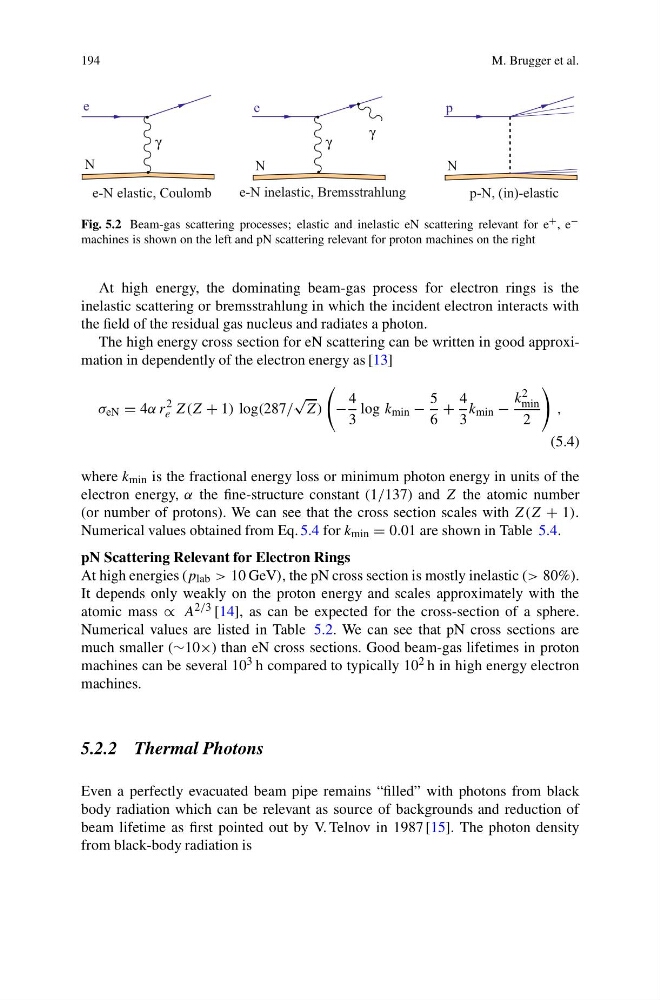
Fig. 5.2 Beam-gas scattering processes; elastic and inelastic eN scattering relevant for e + , e −
machines is shown on the left and pN scattering relevant for proton machines on the right
At high energy, the dominating beam-gas process for electron rings is the
inelastic scattering or bremsstrahlung in which the incident electron interacts with
the field of the residual gas nucleus and radiates a photon.
The high energy cross section for eN scattering can be written in good approximation in dependently of the electron energy as [13]
σ eN = 4α r
2
e Z(Z + 1) log(287/
√
Z)
−
4
3
log k min −
5
6
+
4
3
k min −
k 2
min
2
,
(5.4)
where k min is the fractional energy loss or minimum photon energy in units of the
electron energy, α the fine-structure constant (1/137) and Z the atomic number
(or number of protons). We can see that the cross section scales with Z(Z + 1).
Numerical values obtained from Eq. 5.4 for k min = 0.01 are shown in Table 5.4.
pN Scattering Relevant for Electron Rings
At high energies (p lab > 10 GeV), the pN cross section is mostly inelastic (> 80%).
It depends only weakly on the proton energy and scales approximately with the
atomic mass ∝ A 2/3 [14], as can be expected for the cross-section of a sphere.
Numerical values are listed in Table 5.2. We can see that pN cross sections are
much smaller (∼10×) than eN cross sections. Good beam-gas lifetimes in proton
machines can be several 10 3 h compared to typically 10 2 h in high energy electron
machines.
5.2.2 Thermal Photons
Even a perfectly evacuated beam pipe remains “filled” with photons from black
body radiation which can be relevant as source of backgrounds and reduction of
beam lifetime as first pointed out by V. Telnov in 1987 [15]. The photon density
from black-body radiation is
M. Brugger et al.
p
N
e
N
γ
γ
γ
e
N
p-N, (in)-elastic
e-N elastic, Coulomb
e-N inelastic, Bremsstrahlung
Fig. 5.2 Beam-gas scattering processes; elastic and inelastic eN scattering relevant for e + , e −
machines is shown on the left and pN scattering relevant for proton machines on the right
At high energy, the dominating beam-gas process for electron rings is the
inelastic scattering or bremsstrahlung in which the incident electron interacts with
the field of the residual gas nucleus and radiates a photon.
The high energy cross section for eN scattering can be written in good approximation in dependently of the electron energy as [13]
σ eN = 4α r
2
e Z(Z + 1) log(287/
√
Z)
−
4
3
log k min −
5
6
+
4
3
k min −
k 2
min
2
,
(5.4)
where k min is the fractional energy loss or minimum photon energy in units of the
electron energy, α the fine-structure constant (1/137) and Z the atomic number
(or number of protons). We can see that the cross section scales with Z(Z + 1).
Numerical values obtained from Eq. 5.4 for k min = 0.01 are shown in Table 5.4.
pN Scattering Relevant for Electron Rings
At high energies (p lab > 10 GeV), the pN cross section is mostly inelastic (> 80%).
It depends only weakly on the proton energy and scales approximately with the
atomic mass ∝ A 2/3 [14], as can be expected for the cross-section of a sphere.
Numerical values are listed in Table 5.2. We can see that pN cross sections are
much smaller (∼10×) than eN cross sections. Good beam-gas lifetimes in proton
machines can be several 10 3 h compared to typically 10 2 h in high energy electron
machines.
5.2.2 Thermal Photons
Even a perfectly evacuated beam pipe remains “filled” with photons from black
body radiation which can be relevant as source of backgrounds and reduction of
beam lifetime as first pointed out by V. Telnov in 1987 [15]. The photon density
from black-body radiation is