

5 Interactions of Beams with Surroundings
193
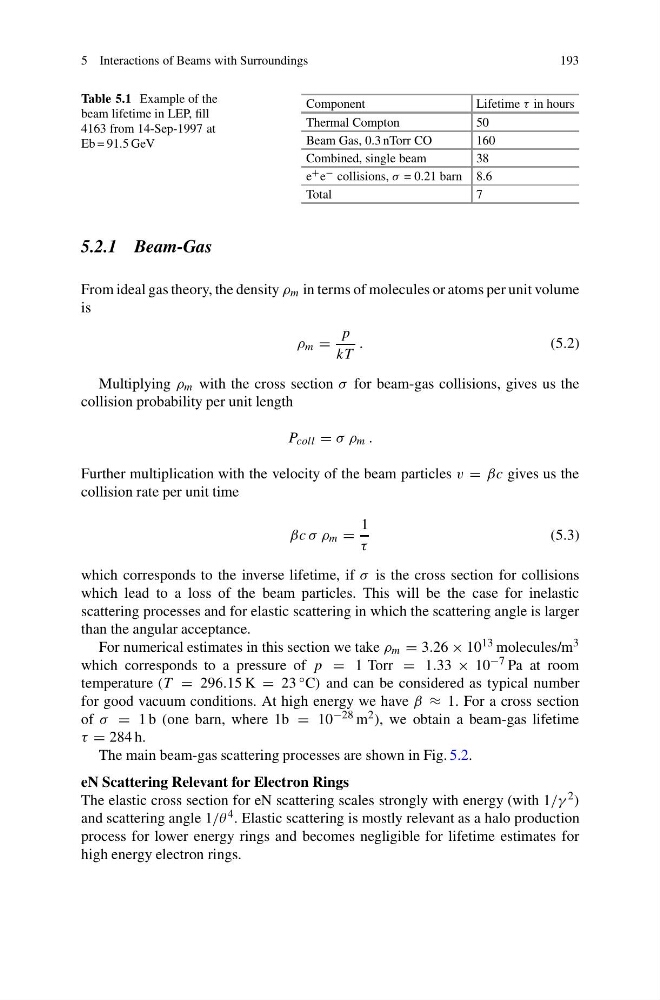
Table 5.1 Example of the
beam lifetime in LEP, fill
4163 from 14-Sep-1997 at
Eb = 91.5 GeV
Component
Lifetime τ in hours
Thermal Compton
50
Beam Gas, 0.3 nTorr CO
160
Combined, single beam
38
e + e − collisions, σ = 0.21 barn 8.6
Total
7
5.2.1 Beam-Gas
From ideal gas theory, the density ρ m in terms of molecules or atoms per unit volume
is
ρ m =
p
kT
.
(5.2)
Multiplying ρ m with the cross section σ for beam-gas collisions, gives us the
collision probability per unit length
P coll = σ ρ m .
Further multiplication with the velocity of the beam particles v = βc gives us the
collision rate per unit time
βc σ ρ m =
1
τ
(5.3)
which corresponds to the inverse lifetime, if σ is the cross section for collisions
which lead to a loss of the beam particles. This will be the case for inelastic
scattering processes and for elastic scattering in which the scattering angle is larger
than the angular acceptance.
For numerical estimates in this section we take ρ m = 3.26 × 10 13 molecules/m 3
which corresponds to a pressure of p = 1 Torr = 1.33 × 10 −7 Pa at room
temperature (T = 296.15 K = 23 ◦ C) and can be considered as typical number
for good vacuum conditions. At high energy we have β ≈ 1. For a cross section
of σ = 1 b (one barn, where 1b = 10 −28 m 2 ), we obtain a beam-gas lifetime
τ = 284 h.
The main beam-gas scattering processes are shown in Fig. 5.2.
eN Scattering Relevant for Electron Rings
The elastic cross section for eN scattering scales strongly with energy (with 1/γ 2 )
and scattering angle 1/θ 4 . Elastic scattering is mostly relevant as a halo production
process for lower energy rings and becomes negligible for lifetime estimates for
high energy electron rings.
193
Table 5.1 Example of the
beam lifetime in LEP, fill
4163 from 14-Sep-1997 at
Eb = 91.5 GeV
Component
Lifetime τ in hours
Thermal Compton
50
Beam Gas, 0.3 nTorr CO
160
Combined, single beam
38
e + e − collisions, σ = 0.21 barn 8.6
Total
7
5.2.1 Beam-Gas
From ideal gas theory, the density ρ m in terms of molecules or atoms per unit volume
is
ρ m =
p
kT
.
(5.2)
Multiplying ρ m with the cross section σ for beam-gas collisions, gives us the
collision probability per unit length
P coll = σ ρ m .
Further multiplication with the velocity of the beam particles v = βc gives us the
collision rate per unit time
βc σ ρ m =
1
τ
(5.3)
which corresponds to the inverse lifetime, if σ is the cross section for collisions
which lead to a loss of the beam particles. This will be the case for inelastic
scattering processes and for elastic scattering in which the scattering angle is larger
than the angular acceptance.
For numerical estimates in this section we take ρ m = 3.26 × 10 13 molecules/m 3
which corresponds to a pressure of p = 1 Torr = 1.33 × 10 −7 Pa at room
temperature (T = 296.15 K = 23 ◦ C) and can be considered as typical number
for good vacuum conditions. At high energy we have β ≈ 1. For a cross section
of σ = 1 b (one barn, where 1b = 10 −28 m 2 ), we obtain a beam-gas lifetime
τ = 284 h.
The main beam-gas scattering processes are shown in Fig. 5.2.
eN Scattering Relevant for Electron Rings
The elastic cross section for eN scattering scales strongly with energy (with 1/γ 2 )
and scattering angle 1/θ 4 . Elastic scattering is mostly relevant as a halo production
process for lower energy rings and becomes negligible for lifetime estimates for
high energy electron rings.