

166
E. Metral et al.
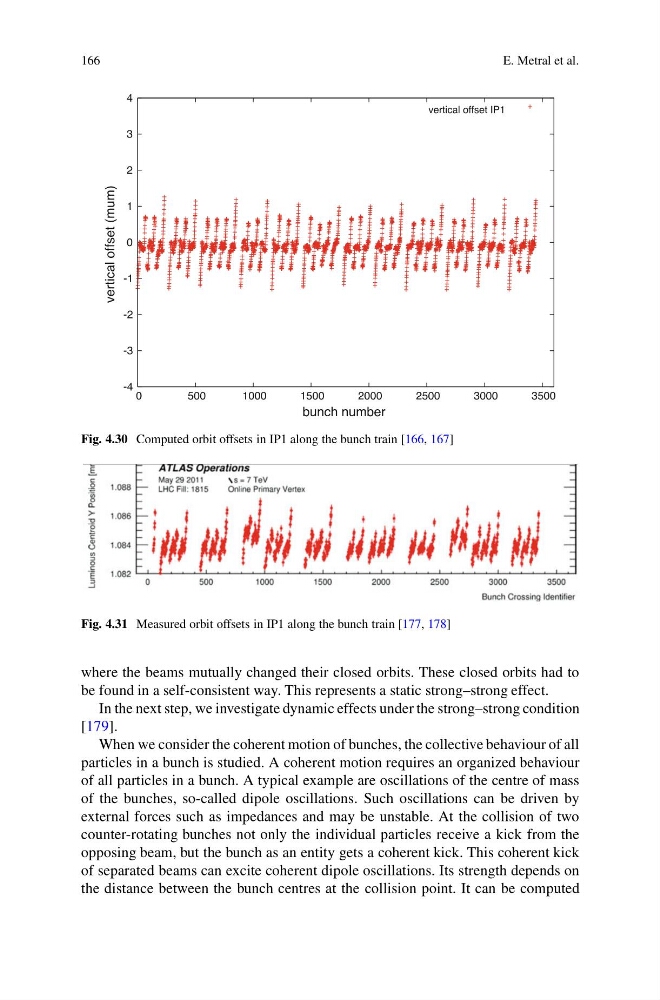
Fig. 4.30 Computed orbit offsets in IP1 along the bunch train [166, 167]
Fig. 4.31 Measured orbit offsets in IP1 along the bunch train [177, 178]
where the beams mutually changed their closed orbits. These closed orbits had to
be found in a self-consistent way. This represents a static strong–strong effect.
In the next step, we investigate dynamic effects under the strong–strong condition
[179].
When we consider the coherent motion of bunches, the collective behaviour of all
particles in a bunch is studied. A coherent motion requires an organized behaviour
of all particles in a bunch. A typical example are oscillations of the centre of mass
of the bunches, so-called dipole oscillations. Such oscillations can be driven by
external forces such as impedances and may be unstable. At the collision of two
counter-rotating bunches not only the individual particles receive a kick from the
opposing beam, but the bunch as an entity gets a coherent kick. This coherent kick
of separated beams can excite coherent dipole oscillations. Its strength depends on
the distance between the bunch centres at the collision point. It can be computed
E. Metral et al.
Fig. 4.30 Computed orbit offsets in IP1 along the bunch train [166, 167]
Fig. 4.31 Measured orbit offsets in IP1 along the bunch train [177, 178]
where the beams mutually changed their closed orbits. These closed orbits had to
be found in a self-consistent way. This represents a static strong–strong effect.
In the next step, we investigate dynamic effects under the strong–strong condition
[179].
When we consider the coherent motion of bunches, the collective behaviour of all
particles in a bunch is studied. A coherent motion requires an organized behaviour
of all particles in a bunch. A typical example are oscillations of the centre of mass
of the bunches, so-called dipole oscillations. Such oscillations can be driven by
external forces such as impedances and may be unstable. At the collision of two
counter-rotating bunches not only the individual particles receive a kick from the
opposing beam, but the bunch as an entity gets a coherent kick. This coherent kick
of separated beams can excite coherent dipole oscillations. Its strength depends on
the distance between the bunch centres at the collision point. It can be computed