

4 Impedance and Collective Effects
165
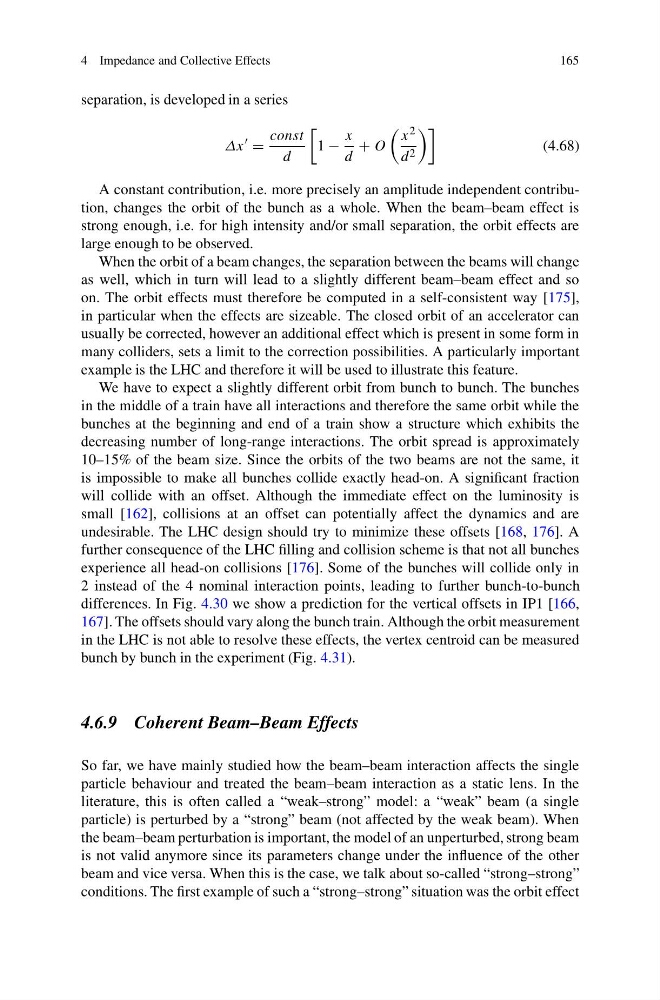
separation, is developed in a series
Δx
=
const
d
1 −
x
d
+ O
x 2
d 2
(4.68)
A constant contribution, i.e. more precisely an amplitude independent contribution, changes the orbit of the bunch as a whole. When the beam–beam effect is
strong enough, i.e. for high intensity and/or small separation, the orbit effects are
large enough to be observed.
When the orbit of a beam changes, the separation between the beams will change
as well, which in turn will lead to a slightly different beam–beam effect and so
on. The orbit effects must therefore be computed in a self-consistent way [175],
in particular when the effects are sizeable. The closed orbit of an accelerator can
usually be corrected, however an additional effect which is present in some form in
many colliders, sets a limit to the correction possibilities. A particularly important
example is the LHC and therefore it will be used to illustrate this feature.
We have to expect a slightly different orbit from bunch to bunch. The bunches
in the middle of a train have all interactions and therefore the same orbit while the
bunches at the beginning and end of a train show a structure which exhibits the
decreasing number of long-range interactions. The orbit spread is approximately
10–15% of the beam size. Since the orbits of the two beams are not the same, it
is impossible to make all bunches collide exactly head-on. A significant fraction
will collide with an offset. Although the immediate effect on the luminosity is
small [162], collisions at an offset can potentially affect the dynamics and are
undesirable. The LHC design should try to minimize these offsets [168, 176]. A
further consequence of the LHC filling and collision scheme is that not all bunches
experience all head-on collisions [176]. Some of the bunches will collide only in
2 instead of the 4 nominal interaction points, leading to further bunch-to-bunch
differences. In Fig. 4.30 we show a prediction for the vertical offsets in IP1 [166,
167]. The offsets should vary along the bunch train. Although the orbit measurement
in the LHC is not able to resolve these effects, the vertex centroid can be measured
bunch by bunch in the experiment (Fig. 4.31).
4.6.9 Coherent Beam–Beam Effects
So far, we have mainly studied how the beam–beam interaction affects the single
particle behaviour and treated the beam–beam interaction as a static lens. In the
literature, this is often called a “weak–strong” model: a “weak” beam (a single
particle) is perturbed by a “strong” beam (not affected by the weak beam). When
the beam–beam perturbation is important, the model of an unperturbed, strong beam
is not valid anymore since its parameters change under the influence of the other
beam and vice versa. When this is the case, we talk about so-called “strong–strong”
conditions. The first example of such a “strong–strong” situation was the orbit effect
165
separation, is developed in a series
Δx
=
const
d
1 −
x
d
+ O
x 2
d 2
(4.68)
A constant contribution, i.e. more precisely an amplitude independent contribution, changes the orbit of the bunch as a whole. When the beam–beam effect is
strong enough, i.e. for high intensity and/or small separation, the orbit effects are
large enough to be observed.
When the orbit of a beam changes, the separation between the beams will change
as well, which in turn will lead to a slightly different beam–beam effect and so
on. The orbit effects must therefore be computed in a self-consistent way [175],
in particular when the effects are sizeable. The closed orbit of an accelerator can
usually be corrected, however an additional effect which is present in some form in
many colliders, sets a limit to the correction possibilities. A particularly important
example is the LHC and therefore it will be used to illustrate this feature.
We have to expect a slightly different orbit from bunch to bunch. The bunches
in the middle of a train have all interactions and therefore the same orbit while the
bunches at the beginning and end of a train show a structure which exhibits the
decreasing number of long-range interactions. The orbit spread is approximately
10–15% of the beam size. Since the orbits of the two beams are not the same, it
is impossible to make all bunches collide exactly head-on. A significant fraction
will collide with an offset. Although the immediate effect on the luminosity is
small [162], collisions at an offset can potentially affect the dynamics and are
undesirable. The LHC design should try to minimize these offsets [168, 176]. A
further consequence of the LHC filling and collision scheme is that not all bunches
experience all head-on collisions [176]. Some of the bunches will collide only in
2 instead of the 4 nominal interaction points, leading to further bunch-to-bunch
differences. In Fig. 4.30 we show a prediction for the vertical offsets in IP1 [166,
167]. The offsets should vary along the bunch train. Although the orbit measurement
in the LHC is not able to resolve these effects, the vertex centroid can be measured
bunch by bunch in the experiment (Fig. 4.31).
4.6.9 Coherent Beam–Beam Effects
So far, we have mainly studied how the beam–beam interaction affects the single
particle behaviour and treated the beam–beam interaction as a static lens. In the
literature, this is often called a “weak–strong” model: a “weak” beam (a single
particle) is perturbed by a “strong” beam (not affected by the weak beam). When
the beam–beam perturbation is important, the model of an unperturbed, strong beam
is not valid anymore since its parameters change under the influence of the other
beam and vice versa. When this is the case, we talk about so-called “strong–strong”
conditions. The first example of such a “strong–strong” situation was the orbit effect