

164
E. Metral et al.
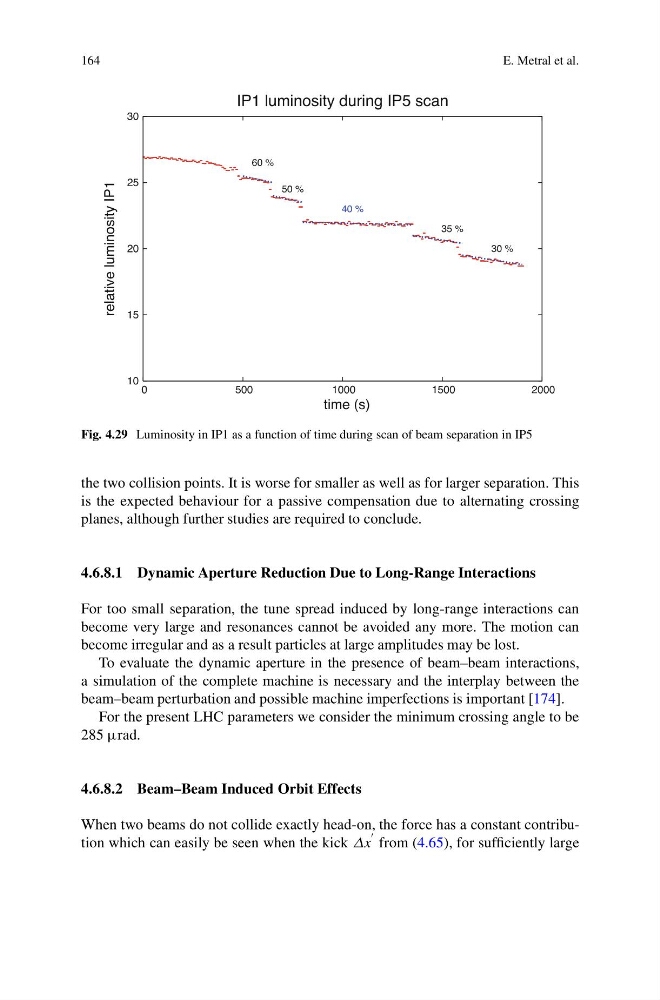
Fig. 4.29 Luminosity in IP1 as a function of time during scan of beam separation in IP5
the two collision points. It is worse for smaller as well as for larger separation. This
is the expected behaviour for a passive compensation due to alternating crossing
planes, although further studies are required to conclude.
4.6.8.1 Dynamic Aperture Reduction Due to Long-Range Interactions
For too small separation, the tune spread induced by long-range interactions can
become very large and resonances cannot be avoided any more. The motion can
become irregular and as a result particles at large amplitudes may be lost.
To evaluate the dynamic aperture in the presence of beam–beam interactions,
a simulation of the complete machine is necessary and the interplay between the
beam–beam perturbation and possible machine imperfections is important [174].
For the present LHC parameters we consider the minimum crossing angle to be
285 μrad.
4.6.8.2 Beam–Beam Induced Orbit Effects
When two beams do not collide exactly head-on, the force has a constant contribution which can easily be seen when the kick Δx
from (4.65), for sufficiently large
E. Metral et al.
Fig. 4.29 Luminosity in IP1 as a function of time during scan of beam separation in IP5
the two collision points. It is worse for smaller as well as for larger separation. This
is the expected behaviour for a passive compensation due to alternating crossing
planes, although further studies are required to conclude.
4.6.8.1 Dynamic Aperture Reduction Due to Long-Range Interactions
For too small separation, the tune spread induced by long-range interactions can
become very large and resonances cannot be avoided any more. The motion can
become irregular and as a result particles at large amplitudes may be lost.
To evaluate the dynamic aperture in the presence of beam–beam interactions,
a simulation of the complete machine is necessary and the interplay between the
beam–beam perturbation and possible machine imperfections is important [174].
For the present LHC parameters we consider the minimum crossing angle to be
285 μrad.
4.6.8.2 Beam–Beam Induced Orbit Effects
When two beams do not collide exactly head-on, the force has a constant contribution which can easily be seen when the kick Δx
from (4.65), for sufficiently large