

4 Impedance and Collective Effects
167
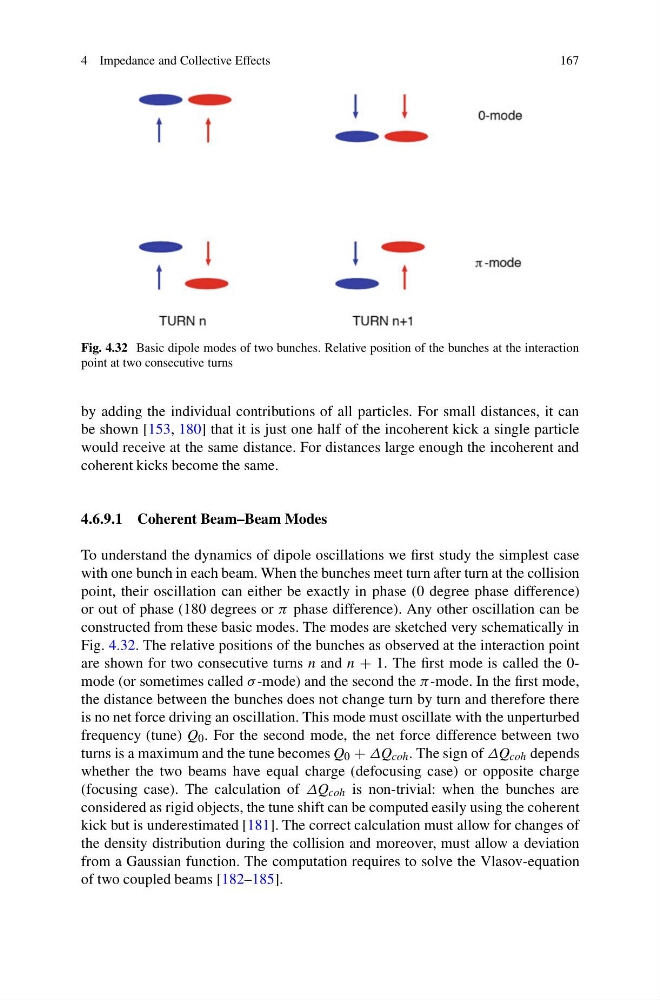
Fig. 4.32 Basic dipole modes of two bunches. Relative position of the bunches at the interaction
point at two consecutive turns
by adding the individual contributions of all particles. For small distances, it can
be shown [153, 180] that it is just one half of the incoherent kick a single particle
would receive at the same distance. For distances large enough the incoherent and
coherent kicks become the same.
4.6.9.1 Coherent Beam–Beam Modes
To understand the dynamics of dipole oscillations we first study the simplest case
with one bunch in each beam. When the bunches meet turn after turn at the collision
point, their oscillation can either be exactly in phase (0 degree phase difference)
or out of phase (180 degrees or π phase difference). Any other oscillation can be
constructed from these basic modes. The modes are sketched very schematically in
Fig. 4.32. The relative positions of the bunches as observed at the interaction point
are shown for two consecutive turns n and n + 1. The first mode is called the 0mode (or sometimes called σ -mode) and the second the π-mode. In the first mode,
the distance between the bunches does not change turn by turn and therefore there
is no net force driving an oscillation. This mode must oscillate with the unperturbed
frequency (tune) Q 0 . For the second mode, the net force difference between two
turns is a maximum and the tune becomes Q 0 + ΔQ coh . The sign of ΔQ coh depends
whether the two beams have equal charge (defocusing case) or opposite charge
(focusing case). The calculation of ΔQ coh is non-trivial: when the bunches are
considered as rigid objects, the tune shift can be computed easily using the coherent
kick but is underestimated [181]. The correct calculation must allow for changes of
the density distribution during the collision and moreover, must allow a deviation
from a Gaussian function. The computation requires to solve the Vlasov-equation
of two coupled beams [182–185].
167
Fig. 4.32 Basic dipole modes of two bunches. Relative position of the bunches at the interaction
point at two consecutive turns
by adding the individual contributions of all particles. For small distances, it can
be shown [153, 180] that it is just one half of the incoherent kick a single particle
would receive at the same distance. For distances large enough the incoherent and
coherent kicks become the same.
4.6.9.1 Coherent Beam–Beam Modes
To understand the dynamics of dipole oscillations we first study the simplest case
with one bunch in each beam. When the bunches meet turn after turn at the collision
point, their oscillation can either be exactly in phase (0 degree phase difference)
or out of phase (180 degrees or π phase difference). Any other oscillation can be
constructed from these basic modes. The modes are sketched very schematically in
Fig. 4.32. The relative positions of the bunches as observed at the interaction point
are shown for two consecutive turns n and n + 1. The first mode is called the 0mode (or sometimes called σ -mode) and the second the π-mode. In the first mode,
the distance between the bunches does not change turn by turn and therefore there
is no net force driving an oscillation. This mode must oscillate with the unperturbed
frequency (tune) Q 0 . For the second mode, the net force difference between two
turns is a maximum and the tune becomes Q 0 + ΔQ coh . The sign of ΔQ coh depends
whether the two beams have equal charge (defocusing case) or opposite charge
(focusing case). The calculation of ΔQ coh is non-trivial: when the bunches are
considered as rigid objects, the tune shift can be computed easily using the coherent
kick but is underestimated [181]. The correct calculation must allow for changes of
the density distribution during the collision and moreover, must allow a deviation
from a Gaussian function. The computation requires to solve the Vlasov-equation
of two coupled beams [182–185].