

158
E. Metral et al.
interactions than bunches from the middle of a train [168]. Bunches with fewer longrange interactions have a very different integrated beam–beam effect and a different
dynamics must be expected. In particular they will have a different tune and occupy
a different area in the working diagram, therefore may be susceptible to resonances
which can be avoided for nominal bunches. The overall space needed in the working
diagram is therefore largely increased [166, 168].
4.6.5 Head-on Beam–Beam Tune Shift
The nominal LHC parameters have been chosen to reach the design luminosity
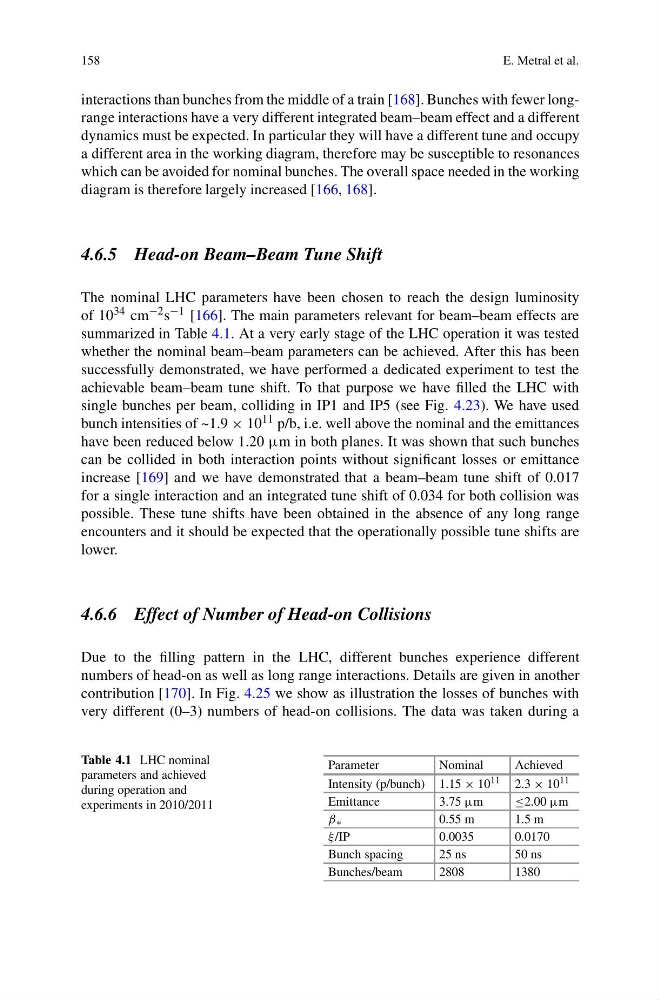
of 10 34 cm −2 s −1 [166]. The main parameters relevant for beam–beam effects are
summarized in Table 4.1. At a very early stage of the LHC operation it was tested
whether the nominal beam–beam parameters can be achieved. After this has been
successfully demonstrated, we have performed a dedicated experiment to test the
achievable beam–beam tune shift. To that purpose we have filled the LHC with
single bunches per beam, colliding in IP1 and IP5 (see Fig. 4.23). We have used
bunch intensities of ~1.9 × 10 11 p/b, i.e. well above the nominal and the emittances
have been reduced below 1.20 μm in both planes. It was shown that such bunches
can be collided in both interaction points without significant losses or emittance
increase [169] and we have demonstrated that a beam–beam tune shift of 0.017
for a single interaction and an integrated tune shift of 0.034 for both collision was
possible. These tune shifts have been obtained in the absence of any long range
encounters and it should be expected that the operationally possible tune shifts are
lower.
4.6.6 Effect of Number of Head-on Collisions
Due to the filling pattern in the LHC, different bunches experience different
numbers of head-on as well as long range interactions. Details are given in another
contribution [170]. In Fig. 4.25 we show as illustration the losses of bunches with
very different (0–3) numbers of head-on collisions. The data was taken during a
Table 4.1 LHC nominal
parameters and achieved
during operation and
experiments in 2010/2011
Parameter
Nominal
Achieved
Intensity (p/bunch) 1.15 × 10 11 2.3 × 10 11
Emittance
3.75 μm
≤2.00 μm
β ∗
0.55 m
1.5 m
ξ /IP
0.0035
0.0170
Bunch spacing
25 ns
50 ns
Bunches/beam
2808
1380
E. Metral et al.
interactions than bunches from the middle of a train [168]. Bunches with fewer longrange interactions have a very different integrated beam–beam effect and a different
dynamics must be expected. In particular they will have a different tune and occupy
a different area in the working diagram, therefore may be susceptible to resonances
which can be avoided for nominal bunches. The overall space needed in the working
diagram is therefore largely increased [166, 168].
4.6.5 Head-on Beam–Beam Tune Shift
The nominal LHC parameters have been chosen to reach the design luminosity
of 10 34 cm −2 s −1 [166]. The main parameters relevant for beam–beam effects are
summarized in Table 4.1. At a very early stage of the LHC operation it was tested
whether the nominal beam–beam parameters can be achieved. After this has been
successfully demonstrated, we have performed a dedicated experiment to test the
achievable beam–beam tune shift. To that purpose we have filled the LHC with
single bunches per beam, colliding in IP1 and IP5 (see Fig. 4.23). We have used
bunch intensities of ~1.9 × 10 11 p/b, i.e. well above the nominal and the emittances
have been reduced below 1.20 μm in both planes. It was shown that such bunches
can be collided in both interaction points without significant losses or emittance
increase [169] and we have demonstrated that a beam–beam tune shift of 0.017
for a single interaction and an integrated tune shift of 0.034 for both collision was
possible. These tune shifts have been obtained in the absence of any long range
encounters and it should be expected that the operationally possible tune shifts are
lower.
4.6.6 Effect of Number of Head-on Collisions
Due to the filling pattern in the LHC, different bunches experience different
numbers of head-on as well as long range interactions. Details are given in another
contribution [170]. In Fig. 4.25 we show as illustration the losses of bunches with
very different (0–3) numbers of head-on collisions. The data was taken during a
Table 4.1 LHC nominal
parameters and achieved
during operation and
experiments in 2010/2011
Parameter
Nominal
Achieved
Intensity (p/bunch) 1.15 × 10 11 2.3 × 10 11
Emittance
3.75 μm
≤2.00 μm
β ∗
0.55 m
1.5 m
ξ /IP
0.0035
0.0170
Bunch spacing
25 ns
50 ns
Bunches/beam
2808
1380