

4 Impedance and Collective Effects
159
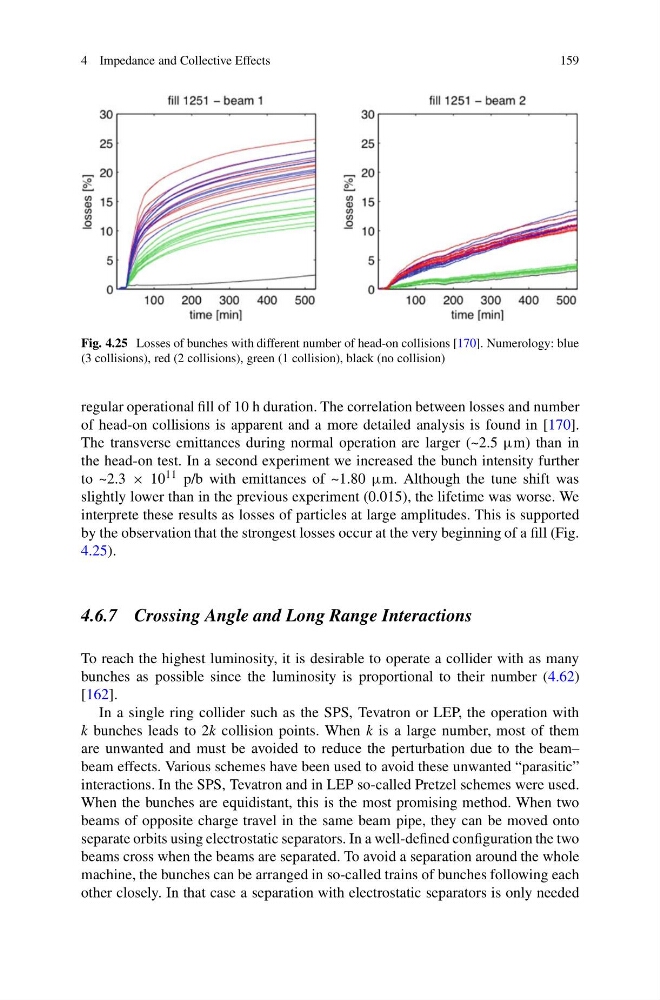
Fig. 4.25 Losses of bunches with different number of head-on collisions [170]. Numerology: blue
(3 collisions), red (2 collisions), green (1 collision), black (no collision)
regular operational fill of 10 h duration. The correlation between losses and number
of head-on collisions is apparent and a more detailed analysis is found in [170].
The transverse emittances during normal operation are larger (~2.5 μm) than in
the head-on test. In a second experiment we increased the bunch intensity further
to ~2.3 × 10 11 p/b with emittances of ~1.80 μm. Although the tune shift was
slightly lower than in the previous experiment (0.015), the lifetime was worse. We
interprete these results as losses of particles at large amplitudes. This is supported
by the observation that the strongest losses occur at the very beginning of a fill (Fig.
4.25).
4.6.7 Crossing Angle and Long Range Interactions
To reach the highest luminosity, it is desirable to operate a collider with as many
bunches as possible since the luminosity is proportional to their number (4.62)
[162].
In a single ring collider such as the SPS, Tevatron or LEP, the operation with
k bunches leads to 2k collision points. When k is a large number, most of them
are unwanted and must be avoided to reduce the perturbation due to the beam–
beam effects. Various schemes have been used to avoid these unwanted “parasitic”
interactions. In the SPS, Tevatron and in LEP so-called Pretzel schemes were used.
When the bunches are equidistant, this is the most promising method. When two
beams of opposite charge travel in the same beam pipe, they can be moved onto
separate orbits using electrostatic separators. In a well-defined configuration the two
beams cross when the beams are separated. To avoid a separation around the whole
machine, the bunches can be arranged in so-called trains of bunches following each
other closely. In that case a separation with electrostatic separators is only needed
159
Fig. 4.25 Losses of bunches with different number of head-on collisions [170]. Numerology: blue
(3 collisions), red (2 collisions), green (1 collision), black (no collision)
regular operational fill of 10 h duration. The correlation between losses and number
of head-on collisions is apparent and a more detailed analysis is found in [170].
The transverse emittances during normal operation are larger (~2.5 μm) than in
the head-on test. In a second experiment we increased the bunch intensity further
to ~2.3 × 10 11 p/b with emittances of ~1.80 μm. Although the tune shift was
slightly lower than in the previous experiment (0.015), the lifetime was worse. We
interprete these results as losses of particles at large amplitudes. This is supported
by the observation that the strongest losses occur at the very beginning of a fill (Fig.
4.25).
4.6.7 Crossing Angle and Long Range Interactions
To reach the highest luminosity, it is desirable to operate a collider with as many
bunches as possible since the luminosity is proportional to their number (4.62)
[162].
In a single ring collider such as the SPS, Tevatron or LEP, the operation with
k bunches leads to 2k collision points. When k is a large number, most of them
are unwanted and must be avoided to reduce the perturbation due to the beam–
beam effects. Various schemes have been used to avoid these unwanted “parasitic”
interactions. In the SPS, Tevatron and in LEP so-called Pretzel schemes were used.
When the bunches are equidistant, this is the most promising method. When two
beams of opposite charge travel in the same beam pipe, they can be moved onto
separate orbits using electrostatic separators. In a well-defined configuration the two
beams cross when the beams are separated. To avoid a separation around the whole
machine, the bunches can be arranged in so-called trains of bunches following each
other closely. In that case a separation with electrostatic separators is only needed