

152
E. Metral et al.
4.6.3 Incoherent Effects: Single Particle Effects
The force we have derived is the force of a beam on a single test particle. It can
be used to study single particle or incoherent effects. For that we treat a particle
crossing a beam like it was moving through a static electromagnetic lens. We have
to expect all effects that are known from resonance and non-linear theory such as
• Unstable and/or irregular motion
• Beam blow up or bad lifetime
4.6.3.1 Beam–Beam Parameter
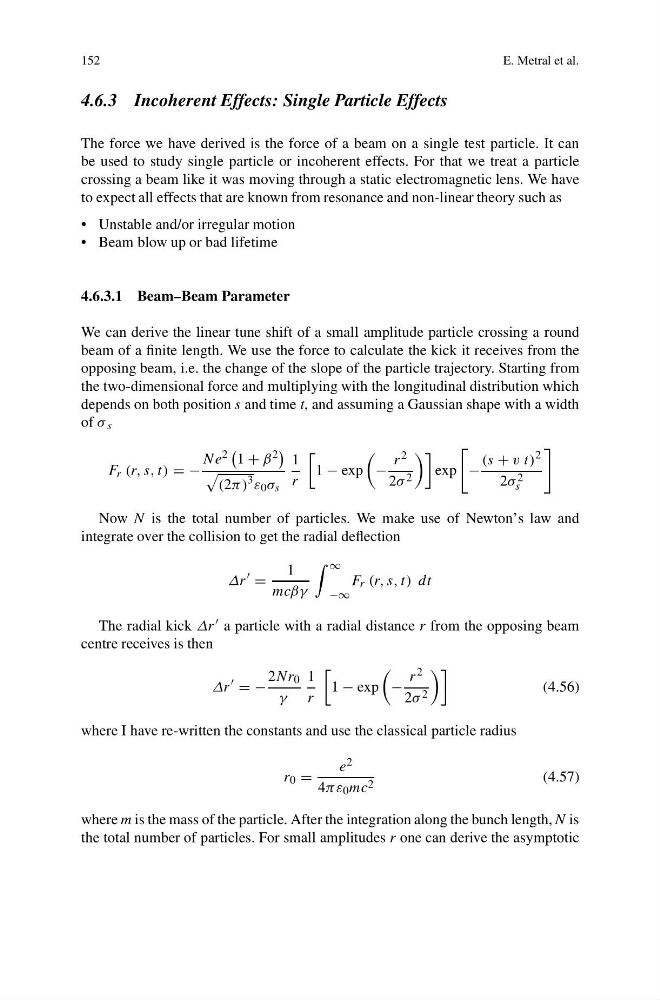
We can derive the linear tune shift of a small amplitude particle crossing a round
beam of a finite length. We use the force to calculate the kick it receives from the
opposing beam, i.e. the change of the slope of the particle trajectory. Starting from
the two-dimensional force and multiplying with the longitudinal distribution which
depends on both position s and time t, and assuming a Gaussian shape with a width
of σ s
F r (r, s, t) = −
Ne 2
1 + β 2
(2π)
3 ε 0 σ s
1
r
1 − exp
−
r 2
2σ 2
exp
−
(s + v t)
2
2σ 2
s
Now N is the total number of particles. We make use of Newton’s law and
integrate over the collision to get the radial deflection
Δr
=
1
mcβγ
∞
−∞
F r (r, s, t) dt
The radial kick Δr a particle with a radial distance r from the opposing beam
centre receives is then
Δr
= −
2Nr 0
γ
1
r
1 − exp
−
r 2
2σ 2
(4.56)
where I have re-written the constants and use the classical particle radius
r 0 =
e 2
4πε 0 mc 2
(4.57)
where m is the mass of the particle. After the integration along the bunch length, N is
the total number of particles. For small amplitudes r one can derive the asymptotic
E. Metral et al.
4.6.3 Incoherent Effects: Single Particle Effects
The force we have derived is the force of a beam on a single test particle. It can
be used to study single particle or incoherent effects. For that we treat a particle
crossing a beam like it was moving through a static electromagnetic lens. We have
to expect all effects that are known from resonance and non-linear theory such as
• Unstable and/or irregular motion
• Beam blow up or bad lifetime
4.6.3.1 Beam–Beam Parameter
We can derive the linear tune shift of a small amplitude particle crossing a round
beam of a finite length. We use the force to calculate the kick it receives from the
opposing beam, i.e. the change of the slope of the particle trajectory. Starting from
the two-dimensional force and multiplying with the longitudinal distribution which
depends on both position s and time t, and assuming a Gaussian shape with a width
of σ s
F r (r, s, t) = −
Ne 2
1 + β 2
(2π)
3 ε 0 σ s
1
r
1 − exp
−
r 2
2σ 2
exp
−
(s + v t)
2
2σ 2
s
Now N is the total number of particles. We make use of Newton’s law and
integrate over the collision to get the radial deflection
Δr
=
1
mcβγ
∞
−∞
F r (r, s, t) dt
The radial kick Δr a particle with a radial distance r from the opposing beam
centre receives is then
Δr
= −
2Nr 0
γ
1
r
1 − exp
−
r 2
2σ 2
(4.56)
where I have re-written the constants and use the classical particle radius
r 0 =
e 2
4πε 0 mc 2
(4.57)
where m is the mass of the particle. After the integration along the bunch length, N is
the total number of particles. For small amplitudes r one can derive the asymptotic