

138
E. Metral et al.
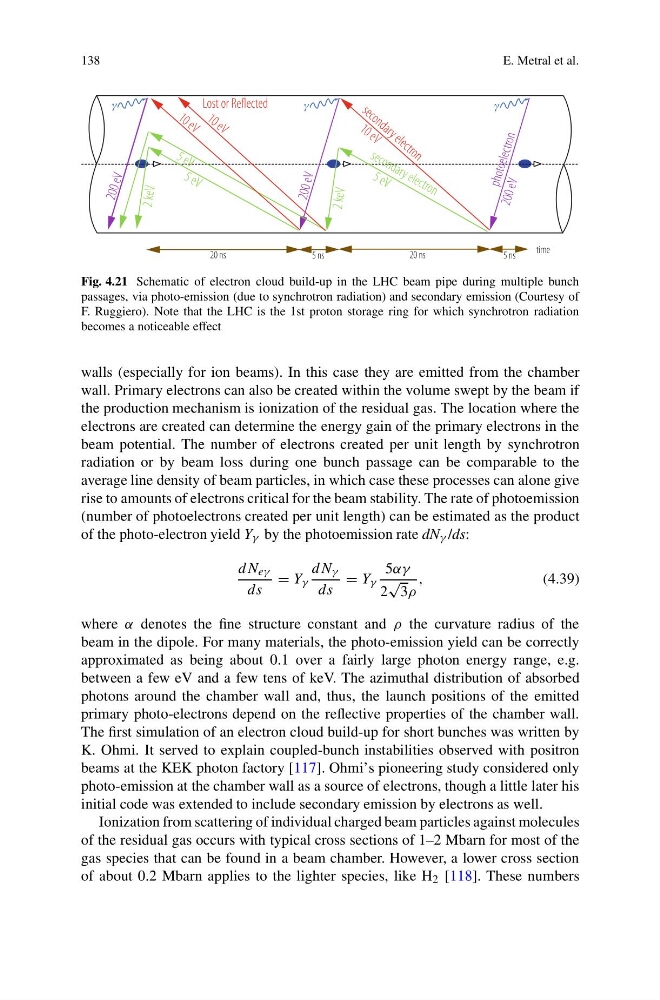
Fig. 4.21 Schematic of electron cloud build-up in the LHC beam pipe during multiple bunch
passages, via photo-emission (due to synchrotron radiation) and secondary emission (Courtesy of
F. Ruggiero). Note that the LHC is the 1st proton storage ring for which synchrotron radiation
becomes a noticeable effect
walls (especially for ion beams). In this case they are emitted from the chamber
wall. Primary electrons can also be created within the volume swept by the beam if
the production mechanism is ionization of the residual gas. The location where the
electrons are created can determine the energy gain of the primary electrons in the
beam potential. The number of electrons created per unit length by synchrotron
radiation or by beam loss during one bunch passage can be comparable to the
average line density of beam particles, in which case these processes can alone give
rise to amounts of electrons critical for the beam stability. The rate of photoemission
(number of photoelectrons created per unit length) can be estimated as the product
of the photo-electron yield Y γ by the photoemission rate dN γ /ds:
dN eγ
ds
= Y γ
dN γ
ds
= Y γ
5αγ
2
√
3ρ
,
(4.39)
where α denotes the fine structure constant and ρ the curvature radius of the
beam in the dipole. For many materials, the photo-emission yield can be correctly
approximated as being about 0.1 over a fairly large photon energy range, e.g.
between a few eV and a few tens of keV. The azimuthal distribution of absorbed
photons around the chamber wall and, thus, the launch positions of the emitted
primary photo-electrons depend on the reflective properties of the chamber wall.
The first simulation of an electron cloud build-up for short bunches was written by
K. Ohmi. It served to explain coupled-bunch instabilities observed with positron
beams at the KEK photon factory [117]. Ohmi’s pioneering study considered only
photo-emission at the chamber wall as a source of electrons, though a little later his
initial code was extended to include secondary emission by electrons as well.
Ionization from scattering of individual charged beam particles against molecules
of the residual gas occurs with typical cross sections of 1–2 Mbarn for most of the
gas species that can be found in a beam chamber. However, a lower cross section
of about 0.2 Mbarn applies to the lighter species, like H 2 [118]. These numbers
E. Metral et al.
Fig. 4.21 Schematic of electron cloud build-up in the LHC beam pipe during multiple bunch
passages, via photo-emission (due to synchrotron radiation) and secondary emission (Courtesy of
F. Ruggiero). Note that the LHC is the 1st proton storage ring for which synchrotron radiation
becomes a noticeable effect
walls (especially for ion beams). In this case they are emitted from the chamber
wall. Primary electrons can also be created within the volume swept by the beam if
the production mechanism is ionization of the residual gas. The location where the
electrons are created can determine the energy gain of the primary electrons in the
beam potential. The number of electrons created per unit length by synchrotron
radiation or by beam loss during one bunch passage can be comparable to the
average line density of beam particles, in which case these processes can alone give
rise to amounts of electrons critical for the beam stability. The rate of photoemission
(number of photoelectrons created per unit length) can be estimated as the product
of the photo-electron yield Y γ by the photoemission rate dN γ /ds:
dN eγ
ds
= Y γ
dN γ
ds
= Y γ
5αγ
2
√
3ρ
,
(4.39)
where α denotes the fine structure constant and ρ the curvature radius of the
beam in the dipole. For many materials, the photo-emission yield can be correctly
approximated as being about 0.1 over a fairly large photon energy range, e.g.
between a few eV and a few tens of keV. The azimuthal distribution of absorbed
photons around the chamber wall and, thus, the launch positions of the emitted
primary photo-electrons depend on the reflective properties of the chamber wall.
The first simulation of an electron cloud build-up for short bunches was written by
K. Ohmi. It served to explain coupled-bunch instabilities observed with positron
beams at the KEK photon factory [117]. Ohmi’s pioneering study considered only
photo-emission at the chamber wall as a source of electrons, though a little later his
initial code was extended to include secondary emission by electrons as well.
Ionization from scattering of individual charged beam particles against molecules
of the residual gas occurs with typical cross sections of 1–2 Mbarn for most of the
gas species that can be found in a beam chamber. However, a lower cross section
of about 0.2 Mbarn applies to the lighter species, like H 2 [118]. These numbers