

4 Impedance and Collective Effects
137
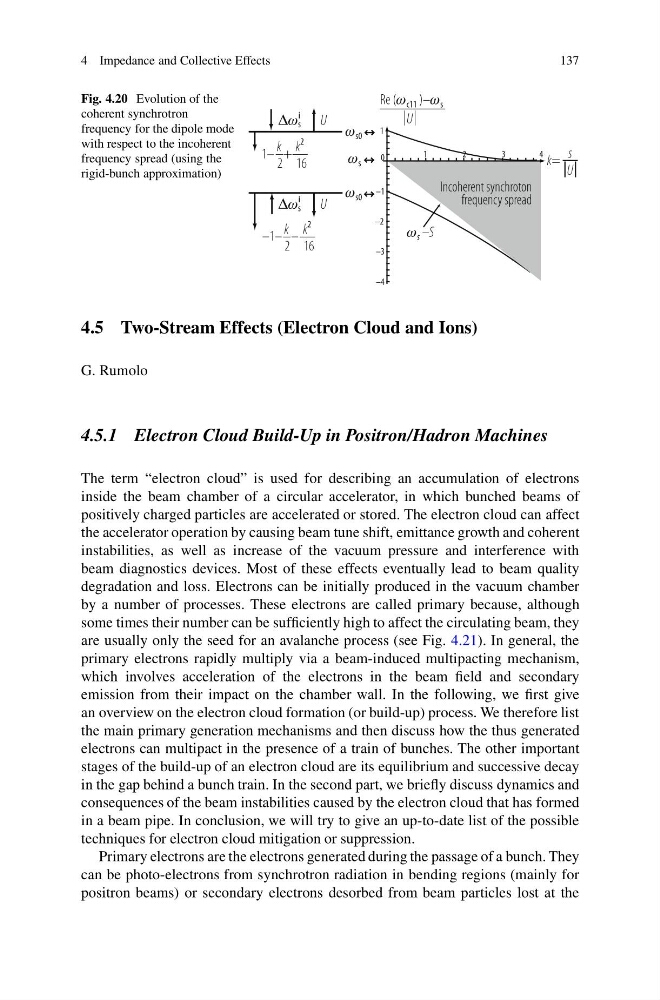
Fig. 4.20 Evolution of the
coherent synchrotron
frequency for the dipole mode
with respect to the incoherent
frequency spread (using the
rigid-bunch approximation)
4.5 Two-Stream Effects (Electron Cloud and Ions)
G. Rumolo
4.5.1 Electron Cloud Build-Up in Positron/Hadron Machines
The term “electron cloud” is used for describing an accumulation of electrons
inside the beam chamber of a circular accelerator, in which bunched beams of
positively charged particles are accelerated or stored. The electron cloud can affect
the accelerator operation by causing beam tune shift, emittance growth and coherent
instabilities, as well as increase of the vacuum pressure and interference with
beam diagnostics devices. Most of these effects eventually lead to beam quality
degradation and loss. Electrons can be initially produced in the vacuum chamber
by a number of processes. These electrons are called primary because, although
some times their number can be sufficiently high to affect the circulating beam, they
are usually only the seed for an avalanche process (see Fig. 4.21). In general, the
primary electrons rapidly multiply via a beam-induced multipacting mechanism,
which involves acceleration of the electrons in the beam field and secondary
emission from their impact on the chamber wall. In the following, we first give
an overview on the electron cloud formation (or build-up) process. We therefore list
the main primary generation mechanisms and then discuss how the thus generated
electrons can multipact in the presence of a train of bunches. The other important
stages of the build-up of an electron cloud are its equilibrium and successive decay
in the gap behind a bunch train. In the second part, we briefly discuss dynamics and
consequences of the beam instabilities caused by the electron cloud that has formed
in a beam pipe. In conclusion, we will try to give an up-to-date list of the possible
techniques for electron cloud mitigation or suppression.
Primary electrons are the electrons generated during the passage of a bunch. They
can be photo-electrons from synchrotron radiation in bending regions (mainly for
positron beams) or secondary electrons desorbed from beam particles lost at the
137
Fig. 4.20 Evolution of the
coherent synchrotron
frequency for the dipole mode
with respect to the incoherent
frequency spread (using the
rigid-bunch approximation)
4.5 Two-Stream Effects (Electron Cloud and Ions)
G. Rumolo
4.5.1 Electron Cloud Build-Up in Positron/Hadron Machines
The term “electron cloud” is used for describing an accumulation of electrons
inside the beam chamber of a circular accelerator, in which bunched beams of
positively charged particles are accelerated or stored. The electron cloud can affect
the accelerator operation by causing beam tune shift, emittance growth and coherent
instabilities, as well as increase of the vacuum pressure and interference with
beam diagnostics devices. Most of these effects eventually lead to beam quality
degradation and loss. Electrons can be initially produced in the vacuum chamber
by a number of processes. These electrons are called primary because, although
some times their number can be sufficiently high to affect the circulating beam, they
are usually only the seed for an avalanche process (see Fig. 4.21). In general, the
primary electrons rapidly multiply via a beam-induced multipacting mechanism,
which involves acceleration of the electrons in the beam field and secondary
emission from their impact on the chamber wall. In the following, we first give
an overview on the electron cloud formation (or build-up) process. We therefore list
the main primary generation mechanisms and then discuss how the thus generated
electrons can multipact in the presence of a train of bunches. The other important
stages of the build-up of an electron cloud are its equilibrium and successive decay
in the gap behind a bunch train. In the second part, we briefly discuss dynamics and
consequences of the beam instabilities caused by the electron cloud that has formed
in a beam pipe. In conclusion, we will try to give an up-to-date list of the possible
techniques for electron cloud mitigation or suppression.
Primary electrons are the electrons generated during the passage of a bunch. They
can be photo-electrons from synchrotron radiation in bending regions (mainly for
positron beams) or secondary electrons desorbed from beam particles lost at the