

4 Impedance and Collective Effects
139
refer to singly charged particles at ultrarelativistic energies. For fully ionized atoms,
the cross section scales roughly with the square of the atomic number, i.e. like
Z 2 . Additionally, it increases by several orders of magnitude towards lower beam
energies. If the beam density is sufficiently high, as it will be in certain sections of
the next generation of linear colliders, ionization by the collective electric field of
the bunch replaces single-particle scattering ionization as the dominant ionization
process [119]. When this happens, the beam completely and instantly ionizes the
residual gas in its neighbourhood.
Protons or ions impacting on the wall can be responsible for the generation of a
large number of electrons. The secondary-electron yield from ion impact is approximately proportional to the projectile stopping power and inversely proportional
to the cosine of the angle of incidence [120]. Since the stopping power is in turn
proportional to the square of the charge number divided by the mass number, this
value, usually very high because of the shallow angles at which losses typically
occur, can be further amplified by one or two orders of magnitude for heavy ion
beams. Production of this type of electrons also occurs with a high rate at the
collimators, where significant beam loss routinely occurs by design.
The mechanism responsible for an exponential growth of the number of electrons
is beam induced multipacting. The primary electrons are accelerated by the electric
field of a passing bunch to such high energies that they produce, on average, more
than one secondary electron when they again hit the wall of the vacuum chamber.
The Secondary Emission Yield (SEY) of the chamber material is by definition the
number of secondary electrons produced on average by an electron impact. It is
obviously a function of the impinging electron energy, its angle of incidence, and the
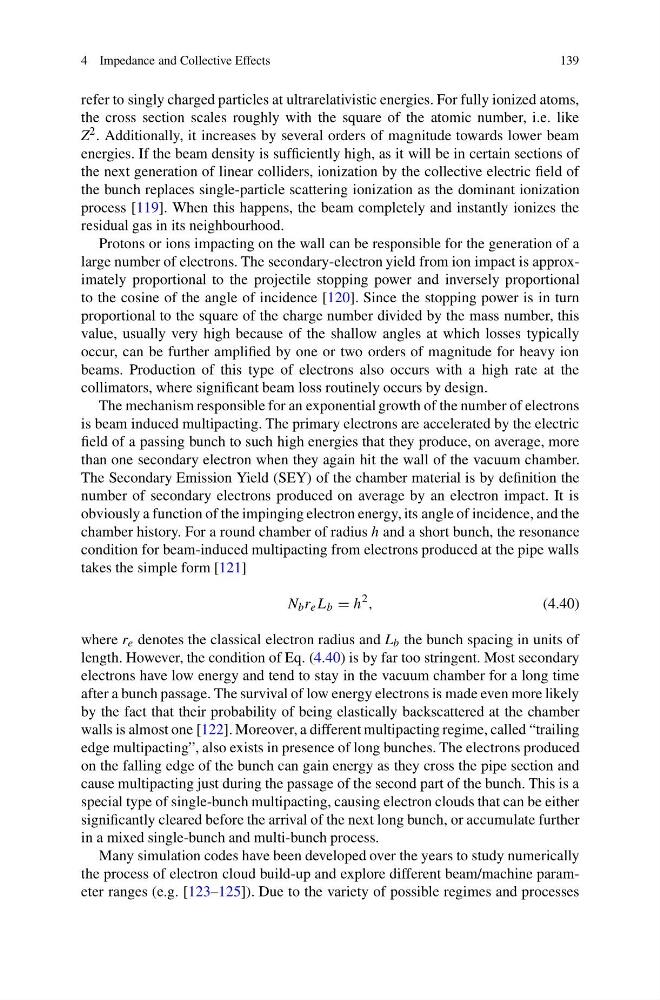
chamber history. For a round chamber of radius h and a short bunch, the resonance
condition for beam-induced multipacting from electrons produced at the pipe walls
takes the simple form [121]
N b r e L b = h
2 ,
(4.40)
where r e denotes the classical electron radius and L b the bunch spacing in units of
length. However, the condition of Eq. (4.40) is by far too stringent. Most secondary
electrons have low energy and tend to stay in the vacuum chamber for a long time
after a bunch passage. The survival of low energy electrons is made even more likely
by the fact that their probability of being elastically backscattered at the chamber
walls is almost one [122]. Moreover, a different multipacting regime, called “trailing
edge multipacting”, also exists in presence of long bunches. The electrons produced
on the falling edge of the bunch can gain energy as they cross the pipe section and
cause multipacting just during the passage of the second part of the bunch. This is a
special type of single-bunch multipacting, causing electron clouds that can be either
significantly cleared before the arrival of the next long bunch, or accumulate further
in a mixed single-bunch and multi-bunch process.
Many simulation codes have been developed over the years to study numerically
the process of electron cloud build-up and explore different beam/machine parameter ranges (e.g. [123–125]). Due to the variety of possible regimes and processes
139
refer to singly charged particles at ultrarelativistic energies. For fully ionized atoms,
the cross section scales roughly with the square of the atomic number, i.e. like
Z 2 . Additionally, it increases by several orders of magnitude towards lower beam
energies. If the beam density is sufficiently high, as it will be in certain sections of
the next generation of linear colliders, ionization by the collective electric field of
the bunch replaces single-particle scattering ionization as the dominant ionization
process [119]. When this happens, the beam completely and instantly ionizes the
residual gas in its neighbourhood.
Protons or ions impacting on the wall can be responsible for the generation of a
large number of electrons. The secondary-electron yield from ion impact is approximately proportional to the projectile stopping power and inversely proportional
to the cosine of the angle of incidence [120]. Since the stopping power is in turn
proportional to the square of the charge number divided by the mass number, this
value, usually very high because of the shallow angles at which losses typically
occur, can be further amplified by one or two orders of magnitude for heavy ion
beams. Production of this type of electrons also occurs with a high rate at the
collimators, where significant beam loss routinely occurs by design.
The mechanism responsible for an exponential growth of the number of electrons
is beam induced multipacting. The primary electrons are accelerated by the electric
field of a passing bunch to such high energies that they produce, on average, more
than one secondary electron when they again hit the wall of the vacuum chamber.
The Secondary Emission Yield (SEY) of the chamber material is by definition the
number of secondary electrons produced on average by an electron impact. It is
obviously a function of the impinging electron energy, its angle of incidence, and the
chamber history. For a round chamber of radius h and a short bunch, the resonance
condition for beam-induced multipacting from electrons produced at the pipe walls
takes the simple form [121]
N b r e L b = h
2 ,
(4.40)
where r e denotes the classical electron radius and L b the bunch spacing in units of
length. However, the condition of Eq. (4.40) is by far too stringent. Most secondary
electrons have low energy and tend to stay in the vacuum chamber for a long time
after a bunch passage. The survival of low energy electrons is made even more likely
by the fact that their probability of being elastically backscattered at the chamber
walls is almost one [122]. Moreover, a different multipacting regime, called “trailing
edge multipacting”, also exists in presence of long bunches. The electrons produced
on the falling edge of the bunch can gain energy as they cross the pipe section and
cause multipacting just during the passage of the second part of the bunch. This is a
special type of single-bunch multipacting, causing electron clouds that can be either
significantly cleared before the arrival of the next long bunch, or accumulate further
in a mixed single-bunch and multi-bunch process.
Many simulation codes have been developed over the years to study numerically
the process of electron cloud build-up and explore different beam/machine parameter ranges (e.g. [123–125]). Due to the variety of possible regimes and processes