

130
E. Metral et al.
0.0
0.5
1.0
1.5
2.0
- 1.5
- 1.0
- 0.5
0.0
0.5
x
Re
Ȉ
Ȉ
(
Q ) /
Q
s
0.0
0.5
1.0
1.5
2.0
- 1.0
- 0.5
0.0
0.5
1.0
x
Im (
Q )
/
Q
s
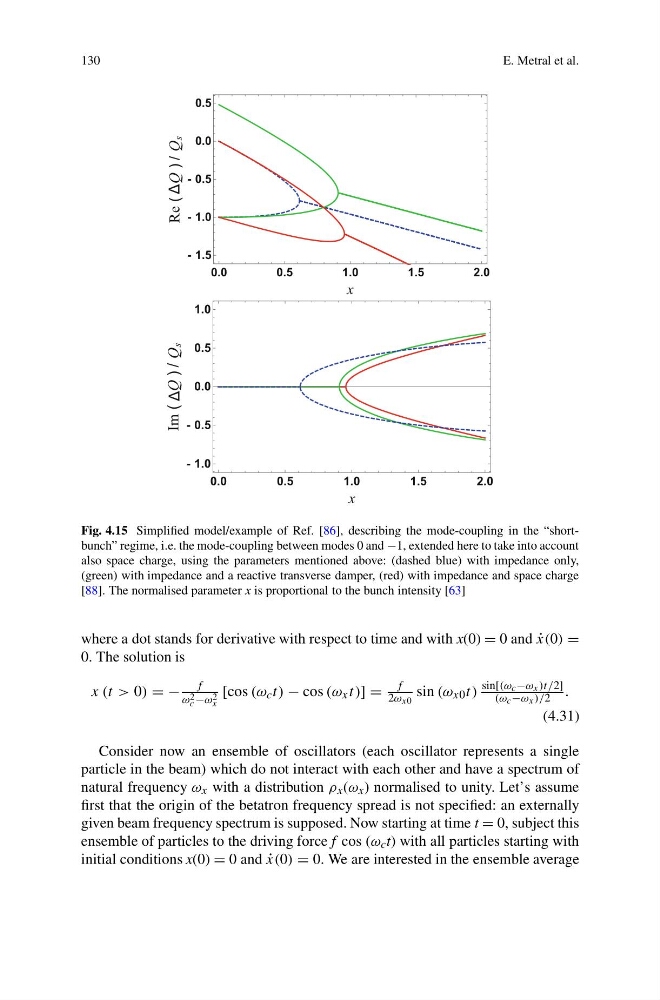
Fig. 4.15 Simplified model/example of Ref. [86], describing the mode-coupling in the “shortbunch” regime, i.e. the mode-coupling between modes 0 and −1, extended here to take into account
also space charge, using the parameters mentioned above: (dashed blue) with impedance only,
(green) with impedance and a reactive transverse damper, (red) with impedance and space charge
[88]. The normalised parameter x is proportional to the bunch intensity [63]
where a dot stands for derivative with respect to time and with x(0) = 0 and ˙
x(0) =
0. The solution is
x (t > 0) = −
f
ω 2
c −ω 2
x
[cos (ω c t) − cos (ω x t)] =
f
2ω x0
sin (ω x0 t)
sin[(ω c −ω x )t/2]
(ω c −ω x )/2 .
(4.31)
Consider now an ensemble of oscillators (each oscillator represents a single
particle in the beam) which do not interact with each other and have a spectrum of
natural frequency ω x with a distribution ρ x (ω x ) normalised to unity. Let’s assume
first that the origin of the betatron frequency spread is not specified: an externally
given beam frequency spectrum is supposed. Now starting at time t = 0, subject this
ensemble of particles to the driving force f cos (ω c t) with all particles starting with
initial conditions x(0) = 0 and ˙
x(0) = 0. We are interested in the ensemble average
E. Metral et al.
0.0
0.5
1.0
1.5
2.0
- 1.5
- 1.0
- 0.5
0.0
0.5
x
Re
Ȉ
Ȉ
(
Q ) /
Q
s
0.0
0.5
1.0
1.5
2.0
- 1.0
- 0.5
0.0
0.5
1.0
x
Im (
Q )
/
Q
s
Fig. 4.15 Simplified model/example of Ref. [86], describing the mode-coupling in the “shortbunch” regime, i.e. the mode-coupling between modes 0 and −1, extended here to take into account
also space charge, using the parameters mentioned above: (dashed blue) with impedance only,
(green) with impedance and a reactive transverse damper, (red) with impedance and space charge
[88]. The normalised parameter x is proportional to the bunch intensity [63]
where a dot stands for derivative with respect to time and with x(0) = 0 and ˙
x(0) =
0. The solution is
x (t > 0) = −
f
ω 2
c −ω 2
x
[cos (ω c t) − cos (ω x t)] =
f
2ω x0
sin (ω x0 t)
sin[(ω c −ω x )t/2]
(ω c −ω x )/2 .
(4.31)
Consider now an ensemble of oscillators (each oscillator represents a single
particle in the beam) which do not interact with each other and have a spectrum of
natural frequency ω x with a distribution ρ x (ω x ) normalised to unity. Let’s assume
first that the origin of the betatron frequency spread is not specified: an externally
given beam frequency spectrum is supposed. Now starting at time t = 0, subject this
ensemble of particles to the driving force f cos (ω c t) with all particles starting with
initial conditions x(0) = 0 and ˙
x(0) = 0. We are interested in the ensemble average